
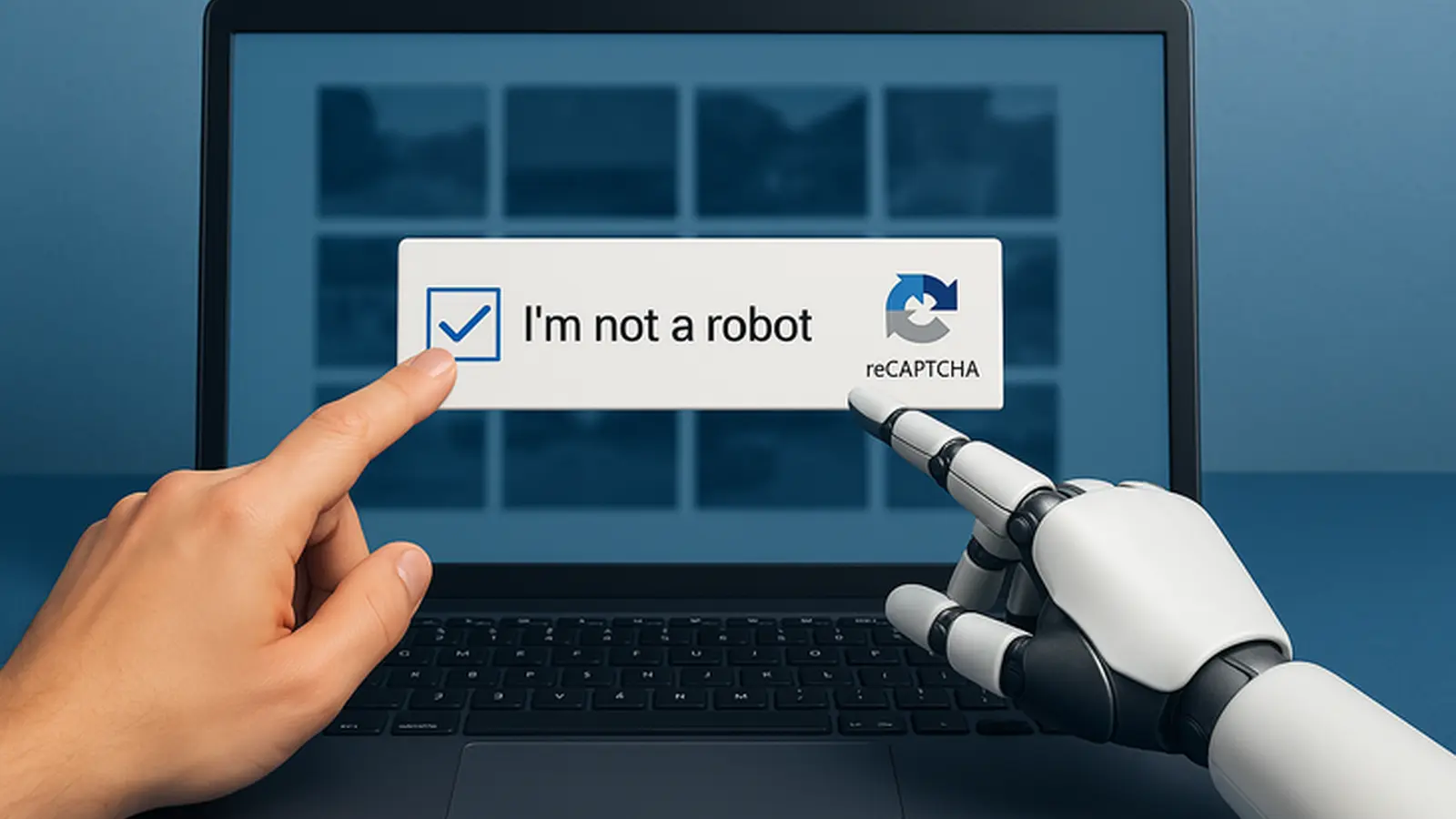
Imagine proving you’re human with a simple wave. Sounds like science fiction? Google is quietly piloting exactly that — a reCAPTCHA update that asks users to perform short hand movements in front of their device camera instead of solving image puzzles.
Why the change? Because bots have gotten clever. Machine learning models can now crack many of the classic image and audio challenges that once separated humans from automated scripts. A physical gesture is harder to fake at scale. A small, real-world motion adds a layer of embodied verification that’s tough for remote AI to emulate convincingly.
Here’s how the experiment works: the website requests camera permission through the browser. If you grant it, the system records a very short clip of your hand moving to complete the challenge. That clip is analyzed to confirm human movement patterns and then discarded.
No audio is recorded, and Google says the video is deleted immediately after the verification completes.
It’s not meant to replace every CAPTCHA right away. Google frames the camera-based option as optional, running alongside existing visual and audio challenges. Think of it as another tool in the bot-detection toolbox rather than a wholesale swap.

Privacy questions will follow. Asking for camera access triggers understandable caution. Google’s pitch is that short, ephemeral clips give stronger proof of personhood while minimizing retained data. Whether users and regulators accept that balance remains to be seen.
From a security standpoint, the move makes sense. Physical gestures introduce temporal and spatial cues — tiny variations in speed, depth, and flow — that are difficult for remote AI farms to synthesize quickly. In other words: a still image or a solvable puzzle can be outsourced, but a live human motion is a different adversary.
There are edge cases to consider. Devices without cameras, accessibility needs, and environments where users won’t or can’t show a hand all require fallback options. Google’s continued support for traditional CAPTCHAs suggests those scenarios are on its radar.
Can a wave stop a bot army? Maybe not by itself. But paired with risk signals, browser telemetry, and behavioral analysis, camera-based gestures could raise the bar significantly for automated abuse.
Expect trials to expand slowly. Tech companies often test novel friction mechanisms in controlled rollouts before broader deployment. For now, users may see this option appear on a limited number of sites as Google gauges effectiveness and feedback.
Either way, the experiment is a reminder that authentication keeps evolving. The next time a site asks you to raise a hand, it might not be a prank — it could be the future of telling humans and machines apart.


Leave a Comment
Comments
No comments yet. Be the first.