
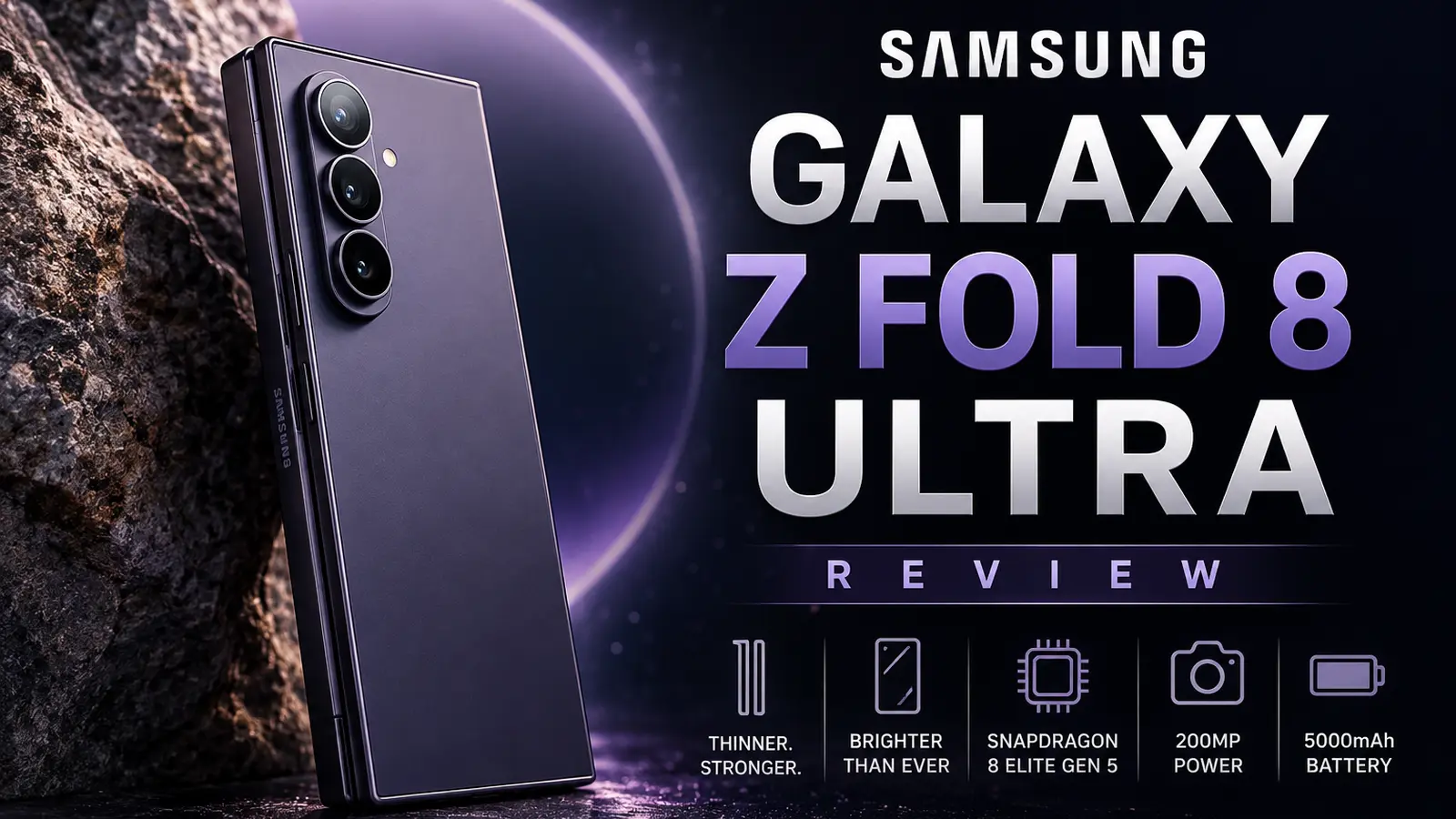
The Galaxy Z Fold 8 Ultra has been my constant companion for roughly ten days now, from work meetings to weekend trips, from late-night gaming sessions to seemingly endless hours scrolling through the news. When I opened the box, my first reaction was honestly a mix of excitement and a little skepticism. By introducing the Ultra suffix to the Fold family, Samsung has effectively signed an unwritten contract with users: this is no longer just another foldable phone, it is a statement. Now, after ten days of living with this €2,200 device, and that is only the starting price, it is time to take an impartial look at whether that statement actually holds up or whether it is simply an expensive marketing slogan.
Let me make one thing clear from the start: I love the foldable form factor, but that does not mean I am willing to overlook its shortcomings. In 2026, with Chinese rivals such as Honor and Oppo changing the rules of the game with thinner phones and periscope cameras, Samsung needs to prove that the Ultra badge represents a genuine upgrade rather than just another number added to the price tag. So, step by step, from design to battery life, let us put this phone under the microscope.

Design and Build Quality; When Engineering Becomes an Art Form!
The first time I took the Z Fold 8 Ultra out of the box, what caught my attention more than anything else was its weight and thickness. Samsung has managed to bring the unfolded thickness down to an astonishing 4.1 mm. At first glance, that may not seem dramatically different from the 4.2 mm of the previous generation, but once you hold the phone, that subtle reduction can be felt if you pay close attention. It feels as though Samsung has finally understood that in the world of foldables, every tenth of a millimeter is an engineering battle of its own.

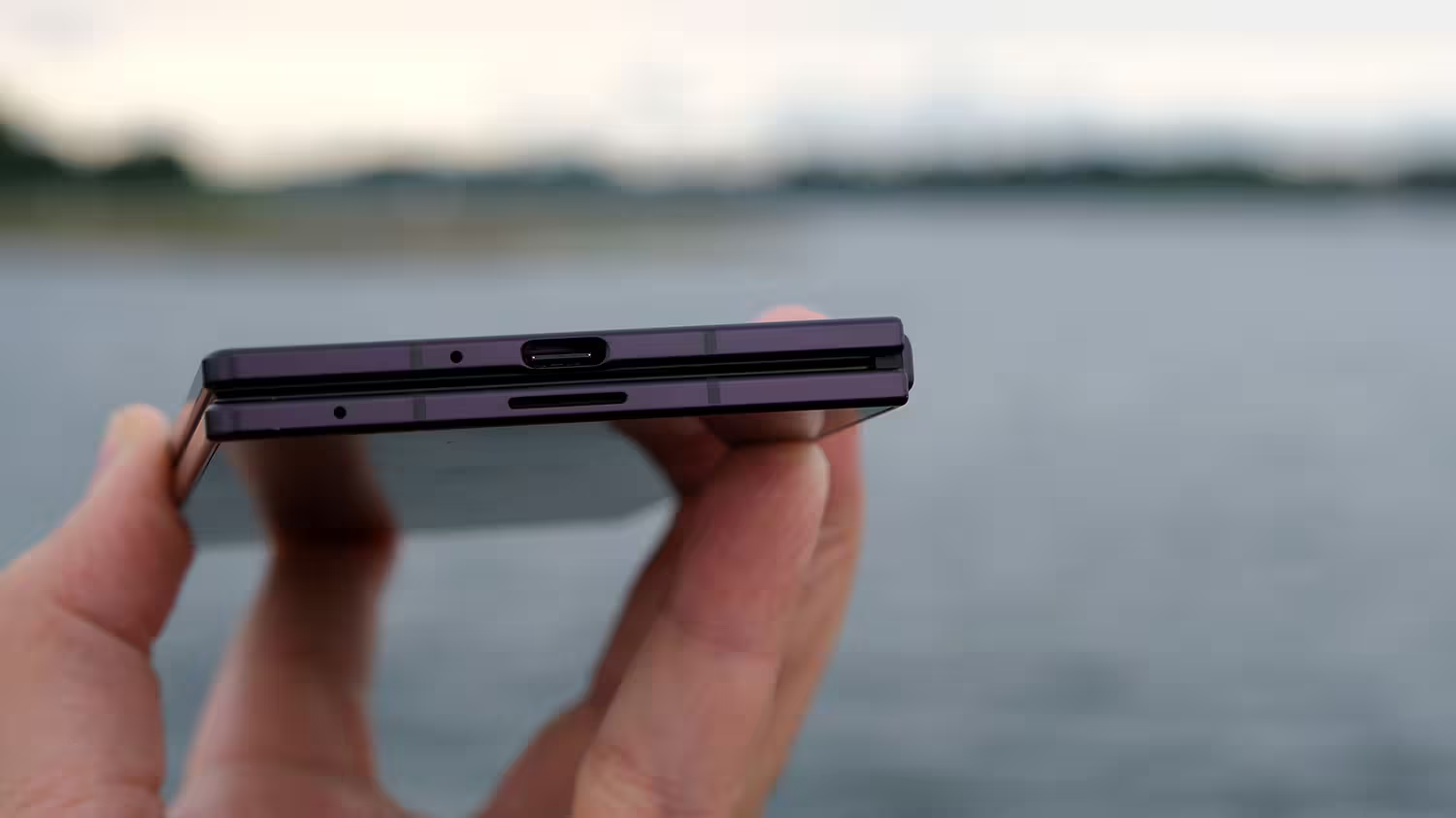 |  |
What genuinely surprised me, however, was the experience of opening the phone with one hand. Samsung's engineers have introduced a tapered cut along the edges of the chassis and redesigned the hinge in such a way that the first 10 percent of the unfolding motion is now remarkably smooth. During the first few days, before my hand had even become fully accustomed to the new phone, I repeatedly found myself opening it almost subconsciously with a single finger. That is exactly what an 8-inch foldable should be able to offer, yet very few devices have truly managed to achieve it until now. That said, I should admit that opening it this way is not necessarily effortless or entirely risk-free!

The next thing I have to be honest about is the unusual, elongated aspect ratio of the outer display, a form that is sometimes described in industrial design terms as “sausage-shaped,” and I have to say the nickname is not entirely unfair. The narrow shape makes the phone easier to hold when closed, but when you need to reach the upper parts of the display, especially if you do not have particularly large hands, you will either need to bring in your second hand or shift the phone slightly in your grip. This is a design compromise Samsung still seems unwilling to abandon.
In terms of materials, this generation introduces Flex Titanium technology, a combination of a titanium plate and an alloy film placed beneath the foldable panel, which noticeably gives the device a greater sense of rigidity. To be honest, I have always had an unspoken fear of dropping foldable phones. Every time one slips out of my hand, it feels as though my heart falls with it. But on one occasion, completely by accident, the phone slid off the edge of a sofa and fell from a height of roughly one meter onto the floor. The sound of the impact was enough to make me hesitate for a few seconds before daring to look at the screen. But when I picked it up, there were no visible cracks and no functional issues. That was one of those moments when I genuinely gained a new level of respect for the build quality of this device.

That said, I also need to give a serious warning. The phone's IP48 rating only protects it against solid objects larger than 1 mm, which means that, in practical terms, it has no meaningful protection against dust. I experienced this firsthand during a trip to the beach. After walking along the shoreline for a few hours, I began hearing an unpleasant grinding sound from the hinge whenever I opened and closed the phone, suggesting that tiny grains of sand had made their way into the mechanism. This is exactly the sort of risk that professional users should take seriously in sandy or dusty environments.

Perhaps the biggest criticism I have of the phone's design, however, is its camera bump. It is so large and bulky that every time I put the phone down on a table, it rocks noticeably and prevents the display from lying completely flat against the surface. In my experience with the Galaxy Z Fold 8, the smaller camera bump and the overall shape of the device meant that the protruding lenses were far less distracting.

My conclusion here is straightforward: with the Fold 8 Ultra, Samsung has adopted a strategy of “focused refinement.” This is not a design revolution, but rather a careful polishing of the weak points of the previous generation. And I have to say, in most areas, that refinement has worked.
Display; A Screen Even the Sun Cannot Defeat
If I had to name one feature of this phone as my favorite part of the everyday experience, it would undoubtedly be the display. The Z Fold 8 Ultra comes with an 8-inch inner display and a 6.5-inch outer screen, both using Dynamic AMOLED 2X technology with a 120Hz refresh rate. The result is a device that genuinely feels like carrying a small tablet in your pocket.

What really impressed me, however, was the 3,000-nit peak brightness of the inner display. I have one personal experience that probably illustrates this better than any number on a specification sheet. On a summer afternoon, while browsing the web under direct sunlight, I expected to do what I usually do and use my hand to shade the screen. This time, though, I barely needed to. The new anti-reflective layer Samsung has applied to the inner display is a genuine game changer. Ambient reflections are dramatically reduced, and when combined with the Vision Booster system, outdoor readability goes from being a constant struggle to an almost effortless experience.

The outer display is no less impressive. With brightness exceeding 2,600 nits and Gorilla Glass Ceramic protection, its resistance to scratches is on par with Samsung's conventional flagship smartphones.
Now let us get to the part where I need to be completely honest: the aspect ratio. Because of its elongated shape, the 8-inch inner display produces substantial black bars above and below standard 16:9 video content, which includes most YouTube videos and TV series. This creates an interesting paradox. Despite having a larger display than the standard Fold 8, the actual size of the video you are watching is not dramatically different from the base model. More than once while watching a series, I caught myself wondering why, despite all this screen real estate, I did not really feel as though I was benefiting from the extra space.

But there is an interesting twist here. The same elongated aspect ratio that can feel slightly disappointing for video works brilliantly for everyday productivity. Scrolling through long documents, browsing web pages and working within the new One UI 9 interface all feel much more natural in this vertical format than on wider displays. It almost feels as though Samsung deliberately chose to prioritize productivity over entertainment.

And then there is the crease in the middle of the screen, the eternal nightmare of foldable phones. I have to admit that this generation has genuinely improved. Thanks to Flex Titanium technology and a redesigned hinge with microscopic spacing adjustments around the edges, running your finger across the center of the display reveals far less unevenness than on the Fold 7. The crease has not disappeared completely, and perhaps it never will, but it is really only visible when you look at the screen from sharp angles under direct light. In everyday use, you practically forget that it is there.

Hardware and Performance; Power Trapped Inside a Delicate Body
At the heart of the Z Fold 8 Ultra is the Snapdragon 8 Elite Gen 5 for Galaxy, paired with RAM ranging from 12GB in the base model to 16GB in higher-end versions. The unit I reviewed was the 512GB model with 12GB of RAM. In everyday use, from opening applications to moving between several demanding apps simultaneously, the phone showed no noticeable slowdown. To be honest, after a few days I stopped thinking about the fact that I was using a foldable at all. Its speed and fluidity felt remarkably similar to a conventional flagship.
For more serious testing, I moved on to demanding games. In titles such as Call of Duty Mobile, the phone ran smoothly at a stable 120 frames per second, and I genuinely enjoyed the experience. The large 8-inch display combined with the wider field of view gave gaming a completely different feel from what I have experienced on conventional slab phones.

Even in a game such as Shadow Fight 4, with its heavy data requirements and exciting one-on-one battles, the quality of the display genuinely impressed me. In fact, it almost felt like a perfectly legal cheat during combat, helping me win!
But when I launched Wuthering Waves, a game that really pushes both the CPU and GPU, the story changed slightly. After around 15 to 20 minutes at maximum settings, I could clearly feel the chassis heating up, particularly around the camera bump. Gradually, frame drops and performance throttling began to appear. This is exactly where one of the structural weaknesses of the device becomes apparent. Unlike the S26 Ultra, which uses a large vapor chamber for thermal management, Samsung has not implemented an equally advanced cooling system in the Z Fold 8 Ultra.
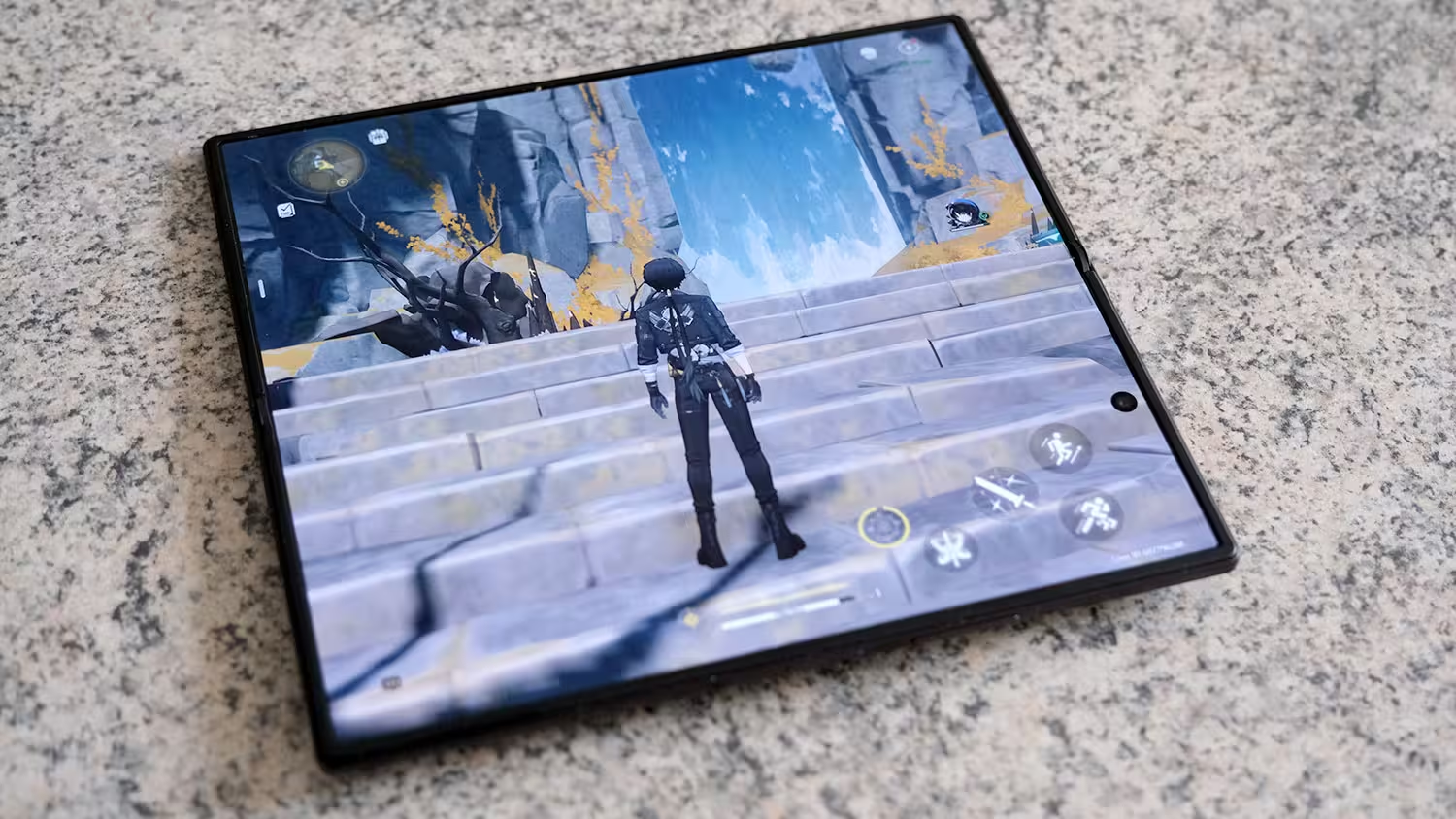
From the perspective of a real-world user, I found a practical solution by setting the graphics level to medium-high rather than maximum. With those settings, I still enjoyed satisfying visuals while avoiding the irritating heat and frame drops. But I have to be honest: when a phone carries the “Ultra” label, you expect to be able to use the full potential of its hardware without worrying about thermal limitations. Naturally, on a product such as the standard Fold 8, which does not even have the same level of cooling hardware, heat and frame-rate drops are likely to be more pronounced. That said, perhaps not even one percent of users will ever think about playing games like this at maximum graphics settings for long periods. As a product reviewer, I simply wanted to push the device hard enough to see where its limits really are!
One positive point worth adding is that compared with the Fold 7, which would occasionally crash or unexpectedly close applications under similar conditions, this generation is significantly more stable. But that stability appears to come mainly from the improved efficiency of the new chipset and smarter software management rather than better physical heat dissipation. And that leads to an important question: could repeated thermal cycles under heavy processing loads negatively affect the long-term health of this phone's silicon-carbon battery?

Ultimately, for users looking for serious multitasking, web browsing, document work and heavy everyday use, the hardware performs flawlessly. But if you are a serious gamer and expect sustained performance at the highest graphics settings, you need to understand that the slim foldable chassis remains a physical bottleneck. This phone still cannot replace a dedicated gaming smartphone with active cooling.
Camera; A Champion With an Achilles' Heel
The camera system on this phone probably gave me the most mixed feelings. On one hand, the 200MP HP2 main sensor genuinely shines. The level of detail it captures in daylight is excellent, colors are rich, and there is enough resolution to crop into images without any noticeable loss of quality. The ultrawide sensor has also received a major jump to 50MP and is now at a similar level to the S26 Ultra, making it a genuine upgrade for content creators and vloggers.

But now we come to the part that disappointed me somewhat: the telephoto sensor. Samsung is still using the same aging 10MP sensor with 3x optical zoom that we have seen in previous generations for years. I personally tried using this lens several times on recent trips to photograph distant scenery, and I have to say that the quality gap compared with the S26 Ultra is clearly noticeable. For a phone costing more than $2,000, this kind of hardware stagnation is difficult to defend. It almost feels as though Samsung deliberately wants to preserve the S26 Ultra's advantage in optical zoom, just in case the Fold Ultra becomes a little too Ultra!

Night photography produced mixed results. Colors tend to shift toward cooler tones, and in very low light, the autofocus system can visibly struggle to lock onto a subject. I encountered this several times while taking photos of friends in a dimly lit restaurant. The phone would take a few seconds before capturing the image, and sometimes the final focus point was not exactly where I wanted it. But in near-total darkness, if you are willing to be patient, the phone can capture images that your own eyes simply cannot see, and I found that genuinely fascinating.
On the positive side, even though the telephoto hardware itself has remained unchanged, Samsung's software-based zoom processing has noticeably improved compared with the Fold 7. Zoomed images now have better contrast and clarity. And unlike the standard Fold 8, which does not have a telephoto lens at all, this Ultra model is the only device in the new Fold family to offer true optical zoom, something potential buyers should keep in mind.
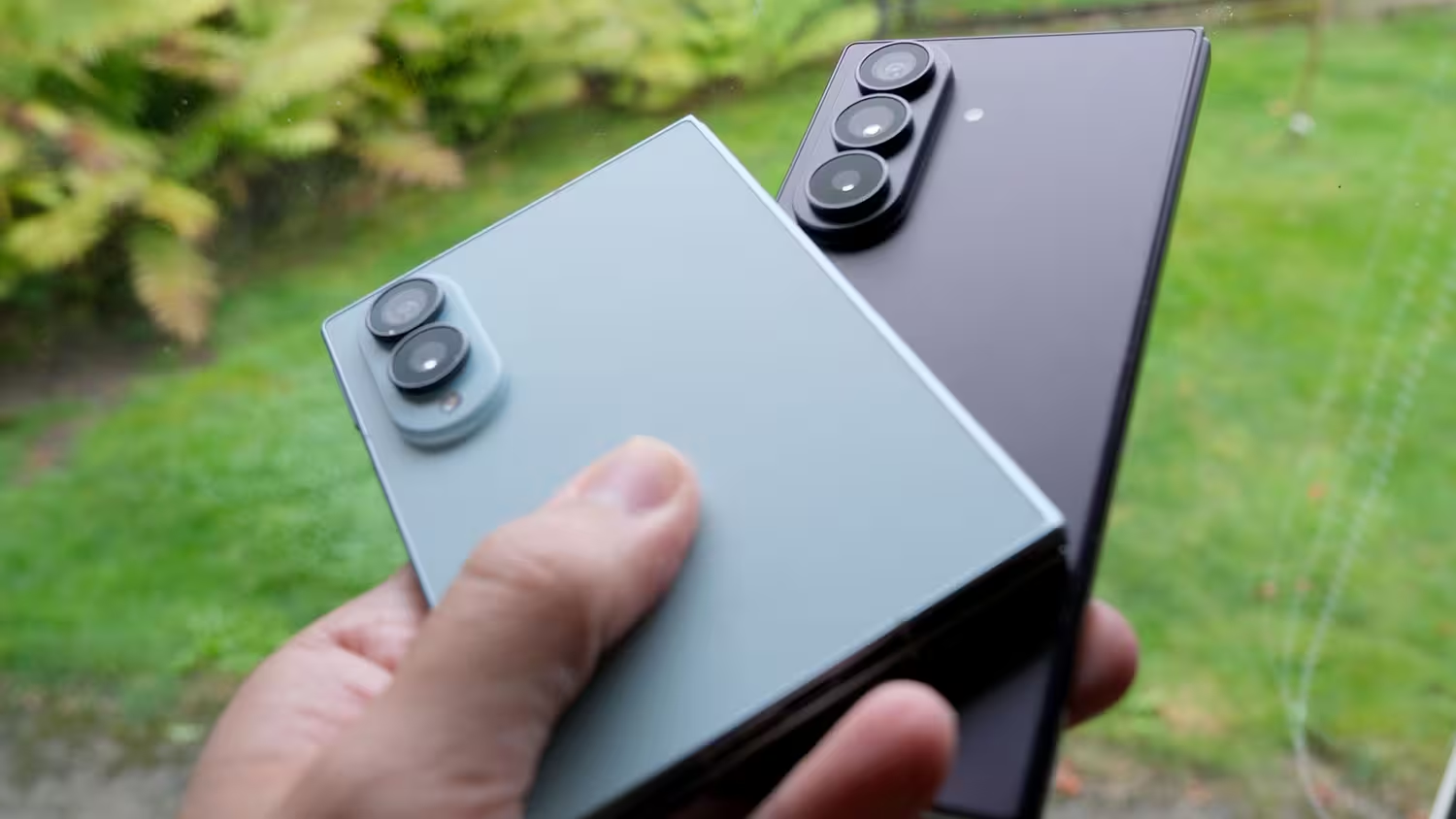
For selfies, the under-display camera, or UDC, embedded beneath the inner screen still suffers from the same familiar limitations: low detail and relatively soft results, especially in poor lighting. To be honest, I almost never used this camera for taking photos and treated it primarily as a webcam for video calls. What proved far more useful was using the 200MP main camera for selfies and vlogging while using the outer display as a viewfinder. Thanks to the dazzling 3,000-nit brightness and anti-reflective coating, the experience remained exceptionally clear and effortless even under direct sunlight.
One additional point is worth mentioning. Because the chassis uses Flex Titanium and is backed by an IP48 rating, I could keep the phone half-open on a table without too much concern and use the rear cameras for group selfies, something conventional slab phones simply cannot do. However, the same elongated “sausage-shaped” form I mentioned in the design section occasionally made framing slightly more difficult here as well.

For filmmakers, support for 8K Log recording and direct LUT loading is a genuinely professional feature. But the same thermal issue I described in the hardware section appears here too. Long 8K recording sessions quickly push the phone into its thermal limits.
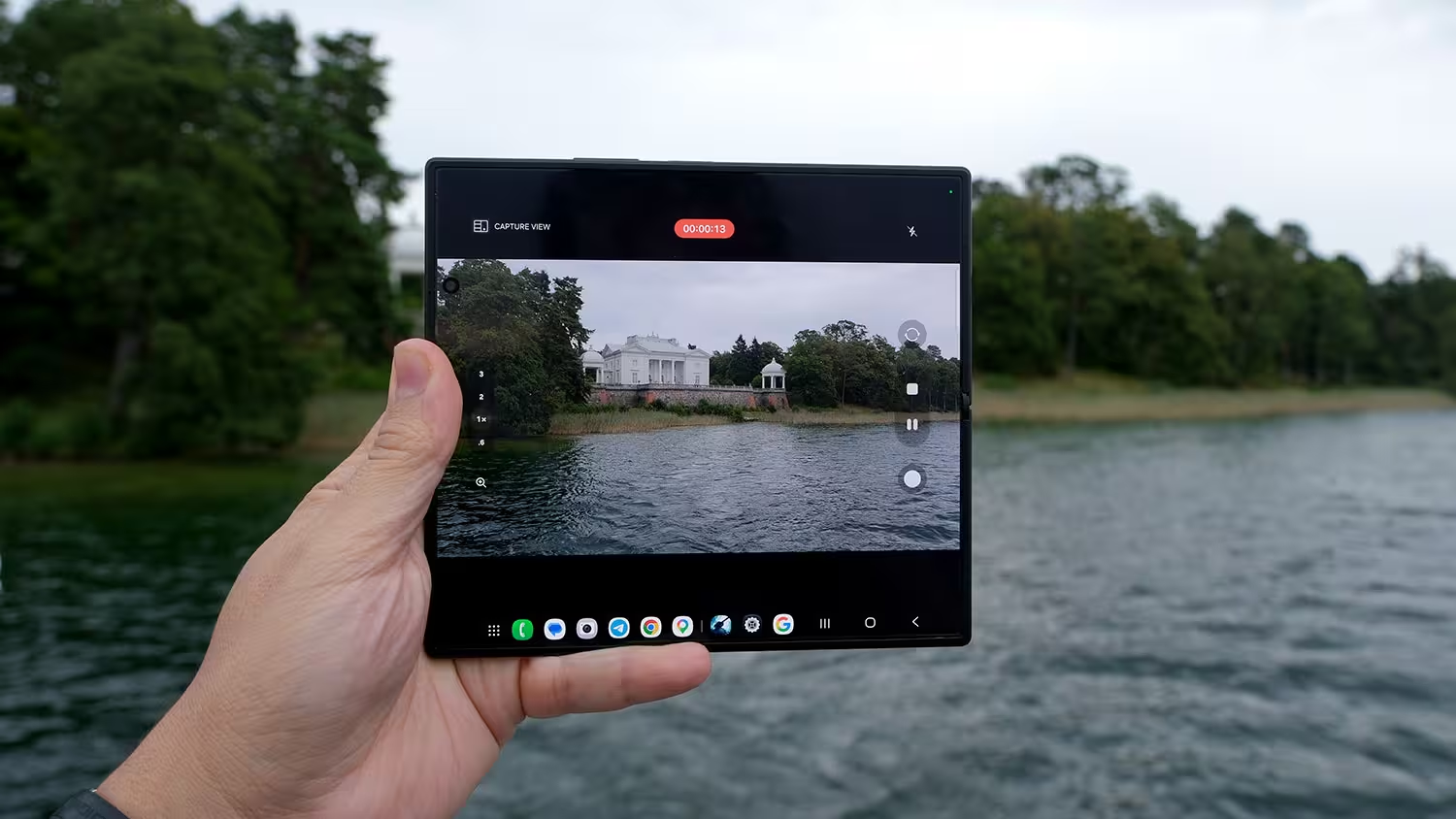
My overall conclusion on the camera is this: if you are a professional photographer and better optical zoom is your top priority, the S26 Ultra remains the better choice. But if your focus is content creation, everyday photography and vlogging, the combination of the powerful main sensor and bright outer display delivers a highly satisfying experience.
Below, you can see some of the photos I captured with this phone under different lighting conditions.

 |  |  | .avif) |
 |  |  |  |
 |  |  | .avif) |
User Interface and AI; When Software Tries to Save the Hardware
If I am being honest, One UI 9 on this phone gave me one of the best software experiences I have had on any Android device to date. Samsung has clearly invested a lot of time in making proper use of the large 8-inch display, and the results are immediately noticeable.
The first feature that transformed the way I worked was the ability to run three fully functional applications side by side. A typical working day for me now looks something like this: in one column I have charts and web articles open, in the middle I am writing a report, and in the third column I may have a video call running or occasionally one of my favorite games! This is exactly the kind of setup that, a few years ago, I thought would only be possible on a laptop, and a powerful one at that. Now I have it in my pocket. The Quick Flip feature, which lets you quickly switch between apps by dragging the divider bar toward the edges of the display, has practically reduced switching delays to zero, keeping applications constantly ready in the background.
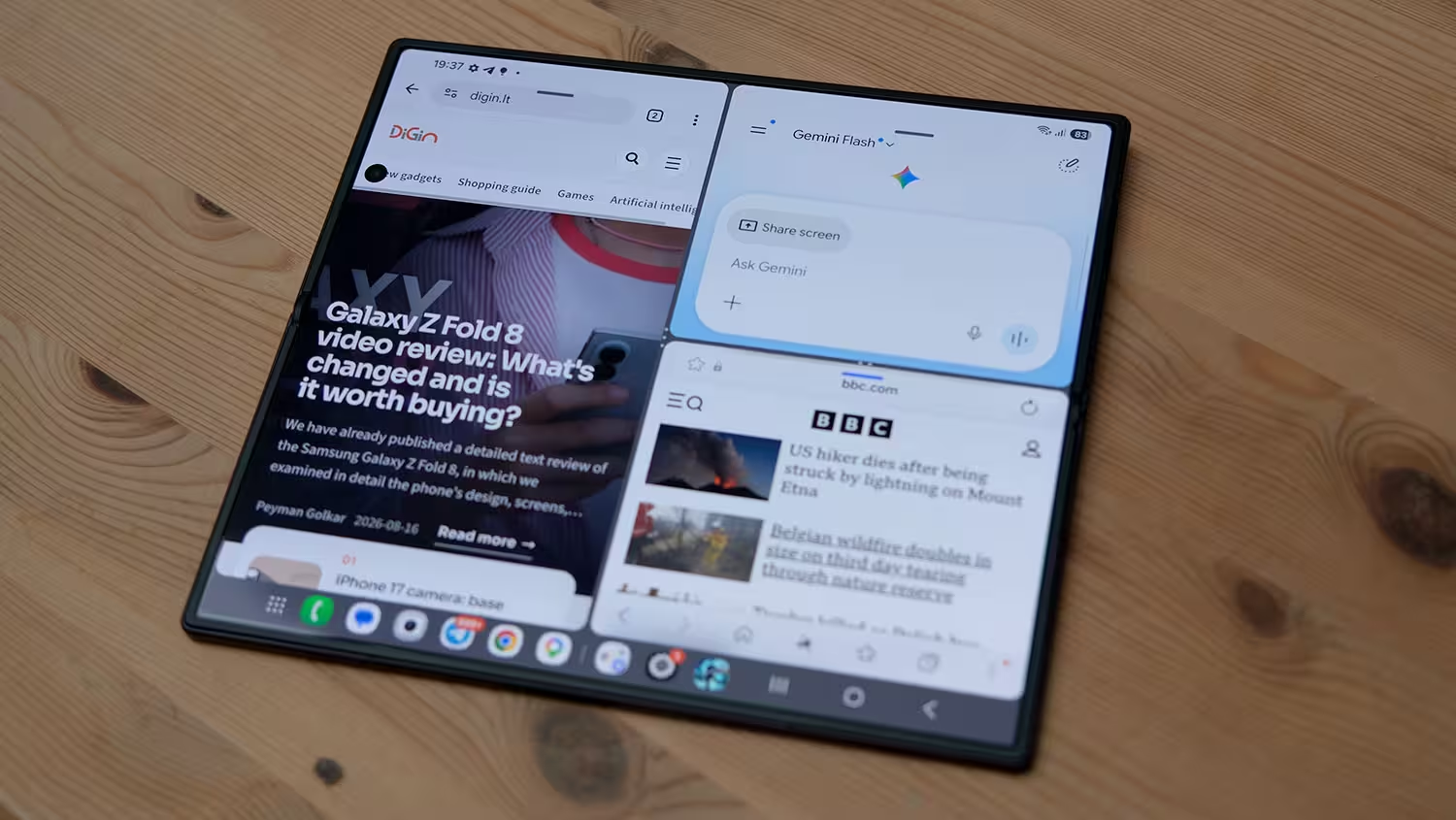
The Now Nudge AI feature is another interesting idea. By analyzing the content of messages through Samsung Keyboard, it can suggest actions such as adding an appointment to your calendar. There is one limitation, however: Now Nudge is completely dependent on Samsung Keyboard. If, like many users, you are accustomed to Gboard, you effectively lose access to this feature.
Another feature I liked was the smarter management of floating windows. In the past, whenever I kept a video or map floating on top of the screen, it would always cover part of my main workspace and become mildly irritating. In this generation, that interference has been noticeably reduced, and floating windows adjust themselves more intelligently around the content beneath them.
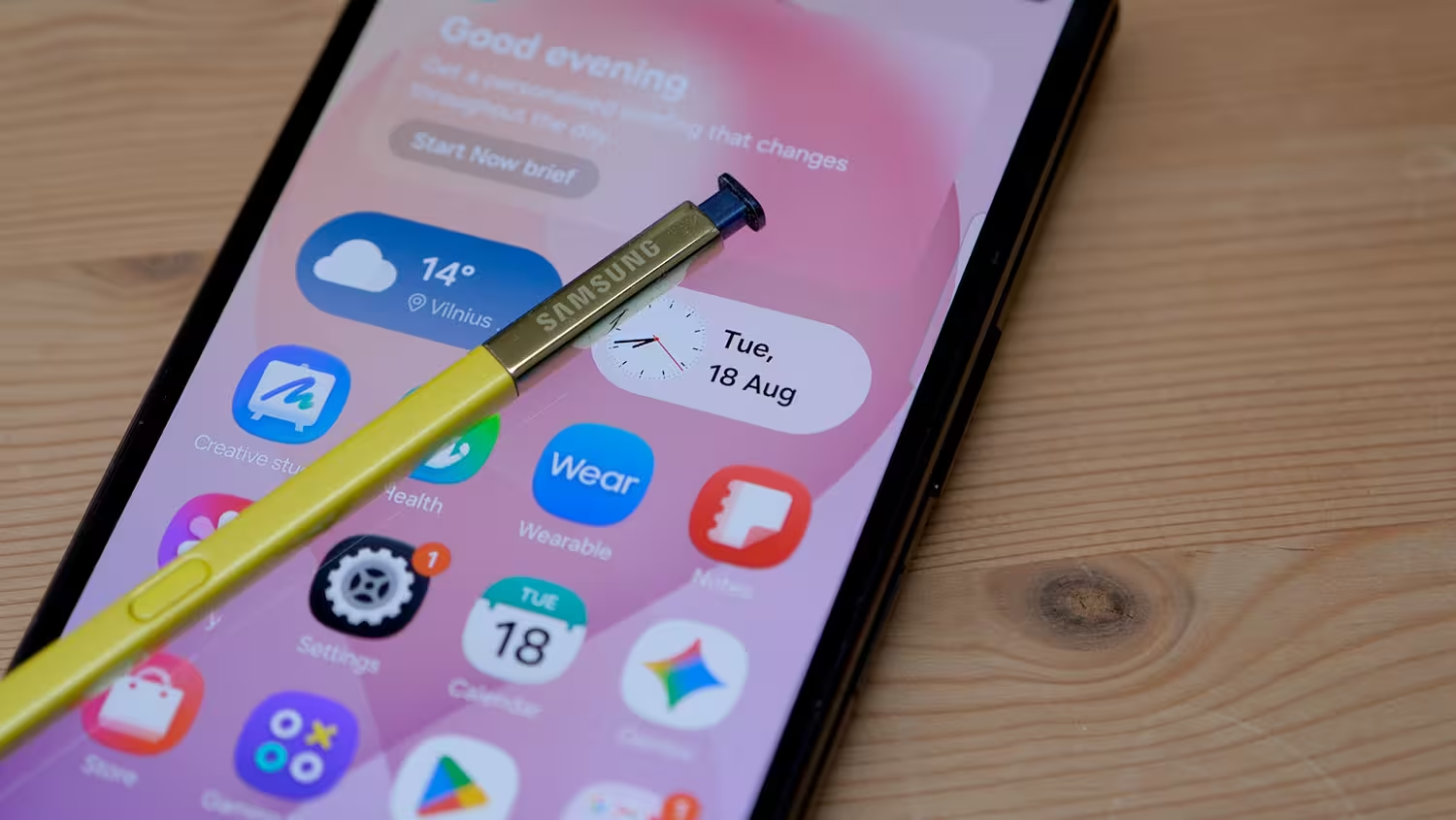
And then we come to one of the hottest topics surrounding this generation: the lack of S Pen support. Contrary to what many users, including myself, expected, this phone does not support Samsung's digital stylus at all. Only ordinary capacitive styluses work with it. For a device with such a large display and an Ultra badge, this feels like an obvious missed opportunity, particularly for users who want to take precise notes or draw on the expansive screen.
As for biometrics, the side-mounted fingerprint sensor is fast and accurate, even when my fingers were slightly damp. Overall, I also prefer its position on the side to an in-display implementation, especially on a device where you are dealing with multiple screens!

Battery and Charging; The End of Battery Anxiety or Just a Small Step Forward?
This may be one of the areas that mattered most to me in practical terms, because having to recharge in the middle of a workday has always been one of my biggest concerns with foldable phones. In this generation, Samsung has finally adopted silicon-carbon battery technology, and that shift has made it possible to fit a 5,000mAh battery inside such a thin chassis, a significant increase from the previous generation's 4,400mAh capacity.
With lighter everyday use, including reading, web browsing, messaging and text-based work, the phone easily lasts a full day. On most normal days, I would go to bed with around 20 to 30 percent battery remaining. But when my usage became more mixed, with some gaming, some camera use and a bit of navigation, that figure dropped noticeably. Screen-on time fell from the idealized eight hours you see in promotional material to something closer to six hours. Even so, for a foldable phone with two large displays, that is still a respectable result.

During heavy gaming, such as the Wuthering Waves sessions I mentioned earlier, the battery drained considerably faster and could be completely depleted in less than four hours of continuous play. That is a clear sign that the large inner display remains a ruthless power consumer, even with the improved efficiency of the new chipset.
As for wired charging, the upgrade from 25W in the previous generation to 45W is noticeable. In my testing, a full charge from zero to 100 percent took roughly one hour, which is perfectly reasonable for everyday use. But when you compare that figure with the triple-digit charging speeds offered by Chinese rivals such as the Honor Magic V6, it becomes clear that Samsung is still behind in this area. For a phone at this price, expecting a bigger leap in charging speed would have been reasonable. The 20W wireless charging is useful on a desk as well, although nowhere near as exciting.

Should You Really Spend €2,200 on This Phone?
After ten days of living with the Galaxy Z Fold 8 Ultra, I have come to the conclusion that this phone is less of a revolution and more of a “targeted, polished evolution.” Instead of making radical changes, Samsung has focused precisely on the areas Fold 7 users were dissatisfied with: an overly stiff hinge, a slightly thick body, limited battery capacity and software instability.
The strengths of this phone are genuinely impressive: a dazzlingly bright display that can tame even direct sunlight, a titanium-reinforced body that survived a real-world drop, a silicon-carbon battery that finally brings meaningful capacity to a foldable, and One UI 9, which turns professional multitasking from a futuristic idea into something you can use every day.

But the weaknesses are impossible to ignore: the 10MP telephoto sensor that has remained unchanged for years, the absence of an advanced cooling system that reveals itself through frame drops under sustained heavy workloads, and the complete lack of S Pen support, which will be a major deciding factor for many potential buyers.
So, should you buy it? If you already own a Fold 7, I genuinely do not think the upgrade is necessary. But if you are moving from a conventional slab phone or have been using an older Fold for three or four years, the combination of an excellent display, durable construction and outstanding productivity creates an experience that is difficult to find elsewhere.
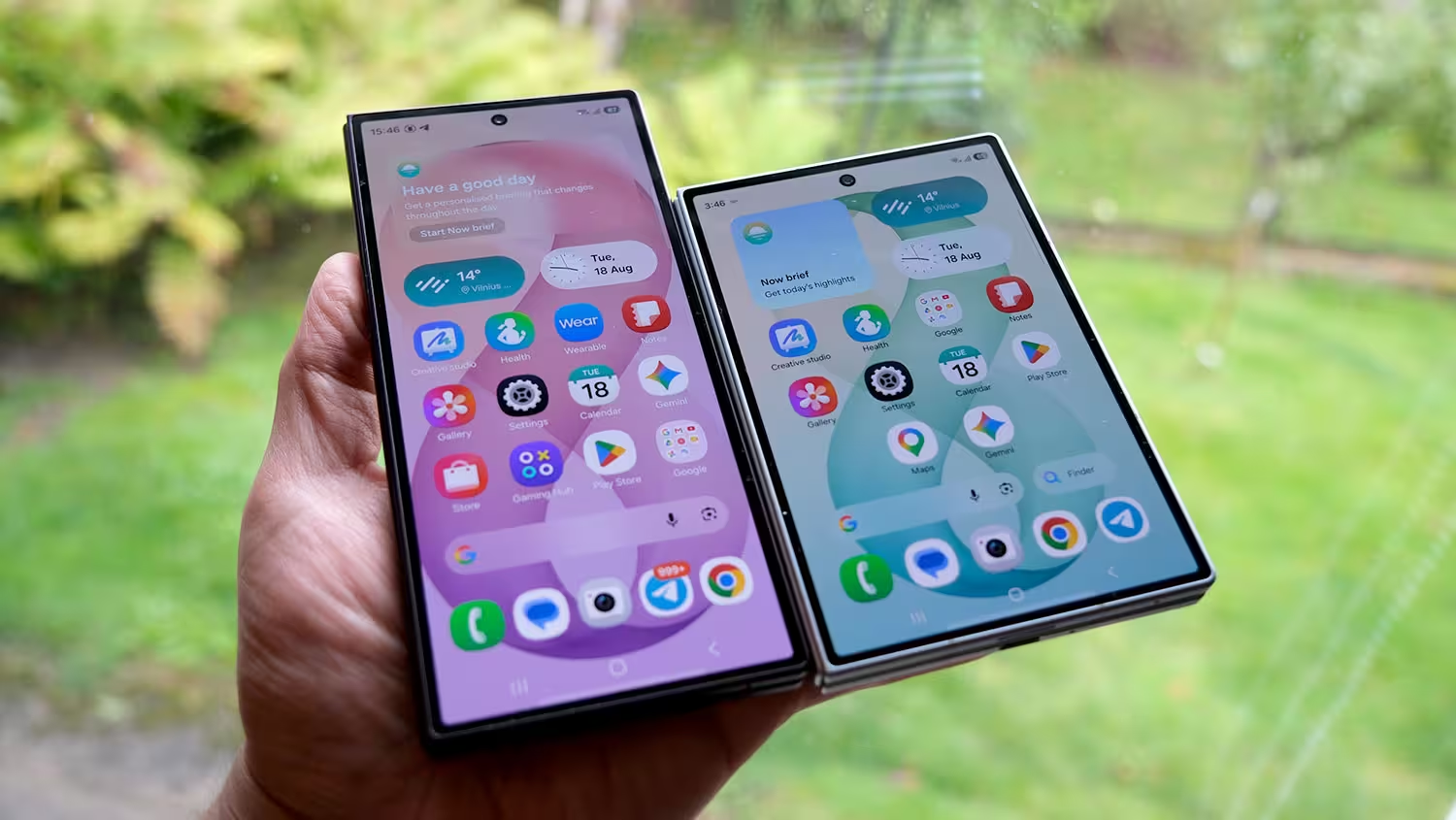
The Galaxy Z Fold 8 Ultra may be the most extensively engineered foldable on the market in terms of build quality, but because of its uneven upgrades in areas such as the camera and cooling system, it still falls short of being the completely flawless and revolutionary product that would fully justify the “Ultra” name. Even so, for users who value stability, premium build quality and genuine productivity more than risky experiments with form factor, it remains one of the strongest foldable options available this year.
Related Posts






Leave a Comment
Comments (7)
Love the display details, solar-level brightness wow 😅. Still, no S Pen is a major miss, and that crease never fully goes away
Feels overhyped but okay , they polished hardware yet held back on zoom and cooling. 45W charging meh compared to Chinese rivals
Pretty balanced take. Love the multitasking bit, 3 apps side by side sounds dreamy. But 3x telephoto lagging behind is odd
I had a Fold 3, sand in hinge ruined it so the IP48 thing worries me a lot. 1m drop survived tho, impressive. Hmm
Is the thermal throttling really that bad longterm? Feels like Samsung left cooling on purpose to protect S26 Ultra sales?
Makes sense tbh, nice battery gains but no S Pen?? weird choice, and that telephoto is lazy.
Wow didnt expect the brightness to be THAT good… 3,000 nits feels unreal. But that camera bump tho, big yikes. Still curious if worth €2.2k