
Google has unveiled Gemini 4 Neon, a new version of its Gemini 4 family tuned for programming and enterprise workflows. The company says the model aims to deliver leader-class reasoning and fast, comprehensive completion of complex engineering, knowledge-driven, and scientific tasks.
Google reported that Gemini 4 Neon reached an Artificial Analysis score of 61 at the xhigh reasoning level and placed third overall in that benchmark, behind larger, slower models. In the Vals benchmark it scored 70.9 percent and ranked second (Claude Fable 5.2 holds first). Google also says Neon earned second place in a new Agent Arena metric for adapting to mid-task user edits. Google further claims Neon recorded the lowest hallucination rate among its internal tests.
Performance in enterprise and scientific tasks
Google describes typical enterprise workflows as flowing through spreadsheets, PDF documents, charts, audio and video files. Gemini 4 Neon can ingest all of those inputs in a single one-million-token context window and produce structured outputs. In independent evaluations, the model ranked first on legal and tax benchmarks and led in areas including finance, accounting, and spreadsheet modeling.
On scientific and mathematical reasoning tests Neon delivered top-in-class results on several reputable benchmarks: Terminal-Bench Science at 70.5 percent, RiemannBench at 84 percent, and HLE-Diamond at 71.3 percent.
The model is optimized for long-running intelligent agent workflows. It can operate autonomously or act as a fast coordinator to direct parallel Gemini 4 Hydrogen subagents inside Google Antigravity. In coding-agent tests, Neon took first place on the Artificial Analysis agent-coding metric with a score of 58.6 and achieved 39 percent on the SWE-sweep benchmark within the Antigravity environment.
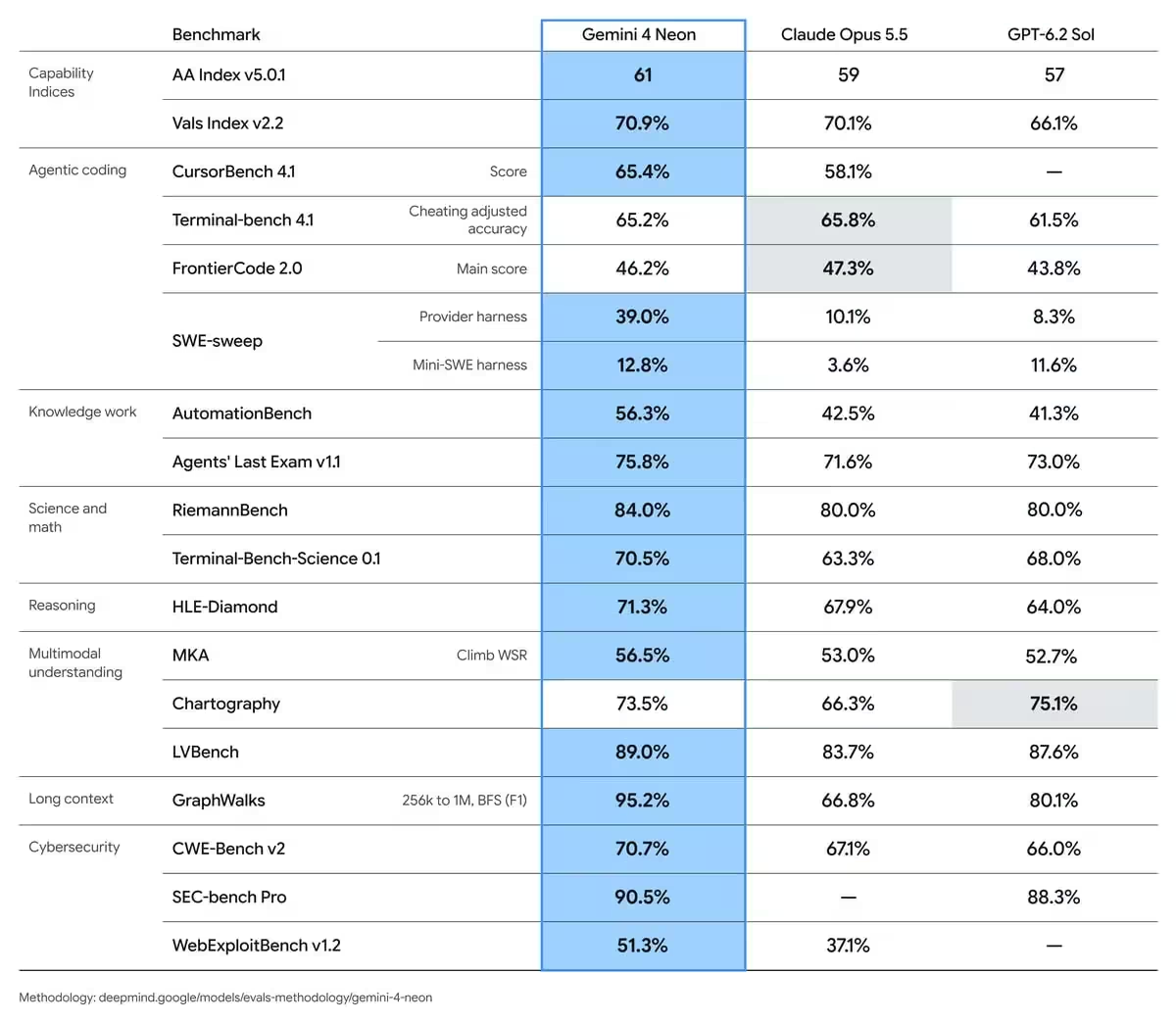
Google also announced a cybersecurity-specialized Neon for vulnerability discovery, risk validation, and patch generation. That edition scored 90.5 percent on SEC-bench Pro and showed a zero percent success rate for indirect command-injection attacks on the Gray Swan benchmark.
Google positions Neon within the Gemini 4 family as a midpoint: Gemini 4 Carbon is intended for the heaviest, longest-running projects, Hydrogen for fast everyday tasks, and Neon as a balance between reasoning depth and cost efficiency.
Pricing for the Neon API is competitive, according to Google: input tokens are priced at $3 per one million tokens; cached input tokens at $0.15 per one million tokens (a 95 percent discount); and output tokens at $15 per one million tokens. Google published a demo video showing an interactive experience created with the model.
Gemini 4 Neon is now available. Developers can access it through the paid Gemini API in Google AI Studio and Android Studio. Paid subscribers to Google AI Pro and Ultra can use Neon in the Gemini app and in Google Antigravity. Google says the cybersecurity edition will be available to members of the Fairwind program in the coming days.

Leave a Comment
Comments
No comments yet. Be the first.