

4 Minutes
Bitcoin miner margins dip to historic lows as $60,000 support is tested
Bitcoin mining profitability has slumped to record lows while BTC struggles to hold the $60,000 floor, raising questions about potential sell pressure from miners and the broader implications for price discovery. This article analyzes miner revenues, hashrate concentration, and the shifting incentives pushing mining operators to diversify into AI infrastructure.
Key takeaways
- Miner margins are at all-time lows, incentivizing some operators to liquidate BTC or repurpose power for AI workloads. - Institutional spot Bitcoin inflows significantly outpace miner supply, making macro and institutional demand drivers crucial to price behavior. - Weak on-chain activity, falling miner revenue, and concentrated mining pools add layers of risk for BTC price support around $60K.
Mining profitability collapse and its market impact
Mining returns have recently deteriorated sharply. The estimated daily return for 1 terahash per second (TH/s) fell to a historic low of $0.028 — down from $0.039 just a month earlier. To illustrate, the projected monthly gross profit for an Antminer S21 XP Hydro (assuming $0.07 per kWh) has declined from $192 to roughly $137.
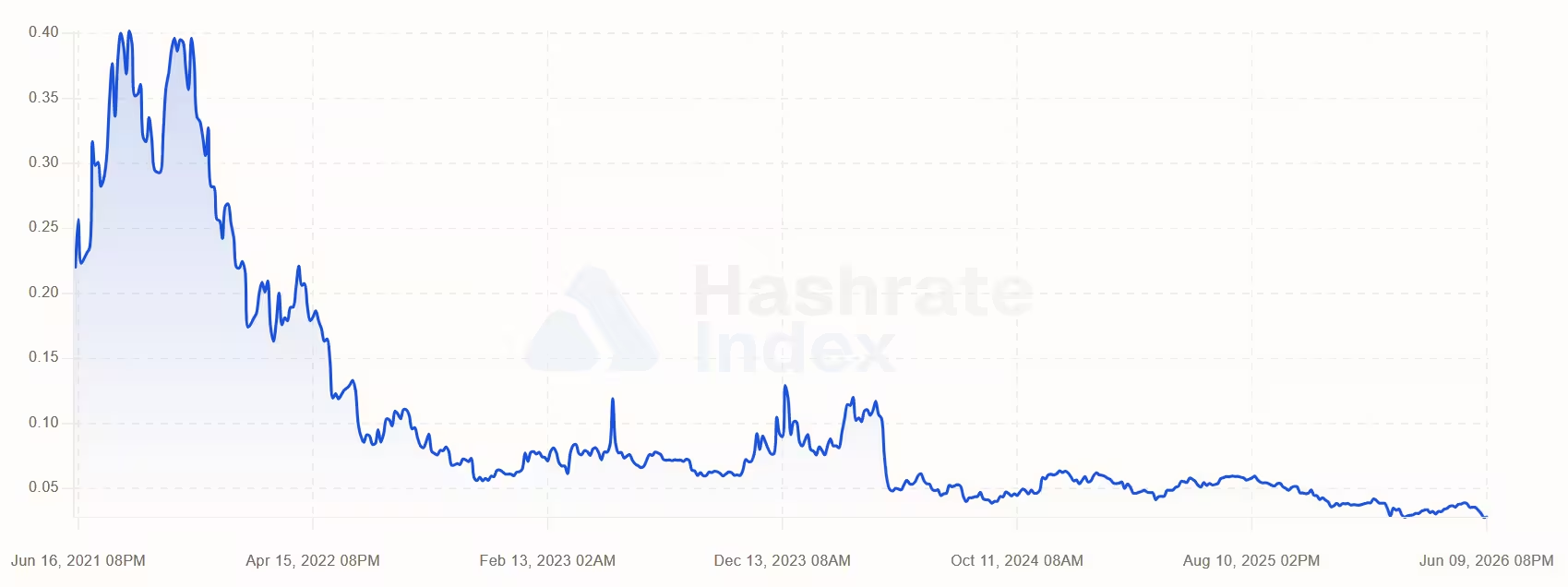
1 TH/second of hashing power per day returns, USD.
Lower BTC miner revenue reduces the buffer miners have against operational costs and can lead to increased selling of mined coins to cover electricity, debt, or capital expenditures. As miners consider reallocating energy capacity to AI data center workloads — a sector seen as more stable and potentially more lucrative — on-chain supply dynamics may change materially.
Miner positions, sell pressure, and institutional flows
On-chain metrics show a sustained net outflow of Bitcoin from miner-controlled addresses. The 14-day average net position change for Bitcoin held by miners and mining pools flipped negative in early May and has remained so. Whether these sales are funding operations, reducing leverage, or financing AI expansion, the cumulative effect weighs on BTC price discovery.

The 14-day average net position change for Bitcoin held in miner and mining pool addresses flipped negative in early May and has remained negative since. Whether these liquidations are intended to fund ongoing operations, reduce debt leverage, or bankroll expansion into AI data center computing, the net effect remains a heavy drag on Bitcoin’s price discovery.

That said, institutional spot Bitcoin flows have surged and currently far exceed miner output. This divergence means macro trends, ETF inflows, and institutional appetite for spot BTC will likely play a larger role than miner profitability alone in the coming months.
Hashrate concentration and the AI pivot
Hashrate concentration among a few large pools is a recurring concern for network decentralization. Recent seven-day data show Foundry USA, AntPool, and F2Pool controlling roughly 59% of the network's hashrate, up from a combined 44% in 2022. High concentration can amplify coordinated responses to profitability shocks and influence on-chain behavior.
The high concentration of Bitcoin hashrate among the three largest mining pools is a frequent target of analyst criticism. The latest 7-day data show that Foundry USA, AntPool, and F2Pool control a combined 59% market share. In contrast, the top three Bitcoin mining pools held a combined 44% hashrate market share back in 2022.
According to Bernstein analysts, the main bottleneck for scaling AI data centers is access to electricity, not chips. As a result, some miners are repurposing power infrastructure for AI compute — effectively shifting capital from ASIC-based BTC mining to GPU-heavy AI workloads.

Production costs vary widely across operators
Estimates for breakeven production cost differ. Charles Edwards of Capriole Investments places an average production cost (including depreciation and amortization) at about $62,650, with a bare-bones electricity break-even near $50,120. However, some publicly listed miners report substantially lower operational costs — American Bitcoin Corp reported roughly $36,200 per BTC in Q1 2026 — due to access to efficient ASICs and favorable energy contracts.
Because costs vary by geography, equipment, and contracts, some miners purposely mine at a loss for tax or strategic reasons, while others mothball rigs when prices fall below their thresholds. Historically, Bitcoin has traded below estimated production cost for extended periods (e.g., 2019, 2023) without permanently altering its longer-term trajectory.
What traders and investors should monitor
- Miner net position changes and miner revenue: persistent selling from miners can add sustained supply into the market.
- Institutional spot flows and ETF demand: these can offset miner supply and dictate direction.
- Hashrate concentration and operational pivots to AI: repurposing energy could reduce future BTC issuance or shift miner balance sheets.
- Macro risk and liquidity: investor risk appetite will determine whether $60K holds as a structural support.

Bottom line: falling miner margins are a legitimate concern, but institutional spot demand, macro dynamics, and the evolving incentives around AI infrastructure will largely determine whether Bitcoin’s $60K floor remains intact.

Leave a Comment
Comments (2)
Feels a bit dramatic. Margins tight, concentration real, but ETFs and macro flows might mask miner selling. Pivoting to AI isnt instant, permits, contracts, logistics take time. Chill
Wait, miners selling to fund AI? If they're flipping power and dumping BTC, 60k could be at risk. But are inflows really covering that? hmm