

BYD patents undercarriage detection to boost parking safety
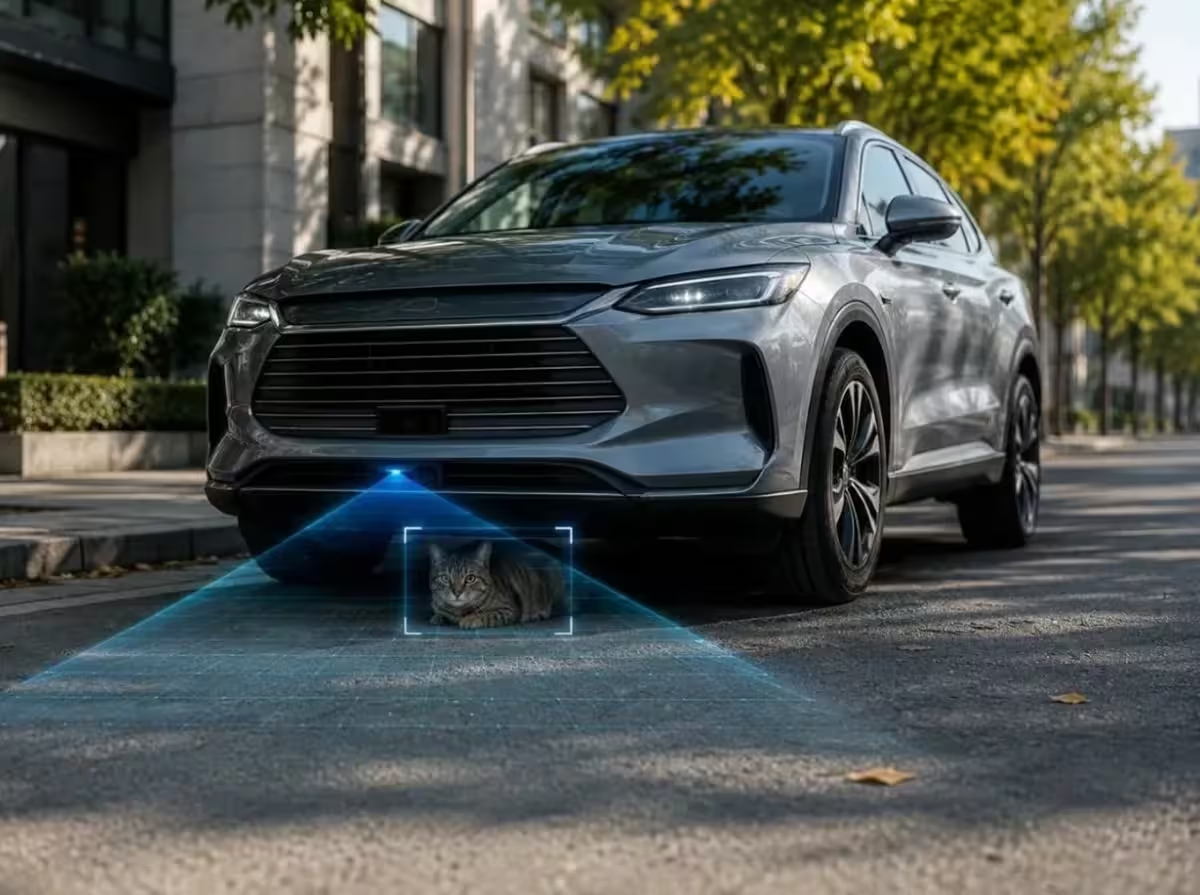
Chinese EV maker BYD has filed a fresh patent for a computer-vision system that detects living beings beneath parked vehicles. Published by China’s National Intellectual Property Administration on June 12 under application CN122200729A, the invention represents a practical step beyond traditional driver-assist features: it specifically targets the challenging environment under the car, where children, animals or other living things can go unnoticed.
How the system works: a baseline image and focused comparison
At the heart of BYD's approach is baseline imaging. When the vehicle is switched off, the system captures and stores a reference image of the undercarriage. Subsequent live images are compared against that reference to identify only the regions that have changed. Instead of continuously analyzing the entire underbody, the method first isolates discrepant zones for deeper analysis. Fixed elements such as suspension parts, battery enclosures, aerodynamic panels and structural components are treated as constant to minimize unnecessary processing.
Once a changed region is flagged, the system extracts feature information and runs detection algorithms to determine whether the difference is caused by a living target. This two-stage pipeline improves accuracy while reducing false positives caused by static objects or harmless environmental shifts.
Addressing a difficult detection environment
Detecting movement below vehicles presents unique difficulties compared with in-cabin monitoring. Underbody spaces are affected by variable lighting, deep shadows, road debris, dirt build-up and uneven ground surfaces. Conventional motion-detection systems often struggle to separate harmless environmental changes from genuine biological activity. BYD’s reference-image approach creates a tailored map for each parked vehicle, enabling more robust discrimination between animals, humans or other living objects and background noise.
Key advantages of this method include:
- Focused processing that conserves compute resources and reduces power usage.
- Fewer false alarms from static items or transient lighting changes.
- Better detection reliability in cluttered urban or roadside parking scenarios.
Part of a broader vehicle-monitoring strategy

The undercarriage detection patent is one piece of a broader safety strategy. BYD has also disclosed a separate invention aimed at identifying occupants inadvertently left inside a cabin. That system analyzes radar channel impulse response, frequency-domain features and angle-of-arrival data to decide if a person remains inside the vehicle.
Together, these systems cover both ends of the car: cabin monitoring to catch forgotten passengers, and underbody vision to spot animals or people in vulnerable positions. BYD appears to be building an integrated sensing ecosystem that combines computer vision, radar processing and intelligent monitoring.
Market context and what it means for EVs
This development aligns with BYD's wider technology push. In May 2026 BYD revealed a sulfide solid-state battery with higher energy density, and in June the company launched a 1500 kW ultra-fast charging station in Germany. BYD also plans to build 3,000 dedicated charging stations across Europe, signaling that advanced sensing and charging infrastructure are central to its global expansion.
For fleet operators, parking facility managers and automakers, undercarriage detection could become a valued safety feature that reduces accidents and liability. In crowded urban environments and family-oriented vehicle segments, the technology may offer a meaningful competitive edge.
'BYD's patents show how automotive safety is evolving beyond collision avoidance to include micro-level monitoring around and inside the vehicle,' an industry analyst might say.
Outlook
Commercial rollout timing and integration into production models remain unclear, but the patent demonstrates BYD's intent to diversify its in-house sensing capabilities. As carmakers race to equip EVs with richer perception stacks, solutions that reliably detect living beings around parked vehicles will likely attract attention from regulators and consumers alike.
By combining vision and radar techniques and linking them with wider EV innovations, BYD is positioning itself not just as a battery and vehicle maker, but as a provider of safer, smarter mobility technologies.

Leave a Comment
Comments (2)
Is this even practical? Baseline pics will get dirty fast, shadows change all the time, whats the update cadence gonna be? sounds useful but needs real world proof.
Wow this is clever! Could actually stop so many accidents, especially with kids or strays hiding under cars. Hope they nail the false positives tho, sensors gotta be rock solid.