
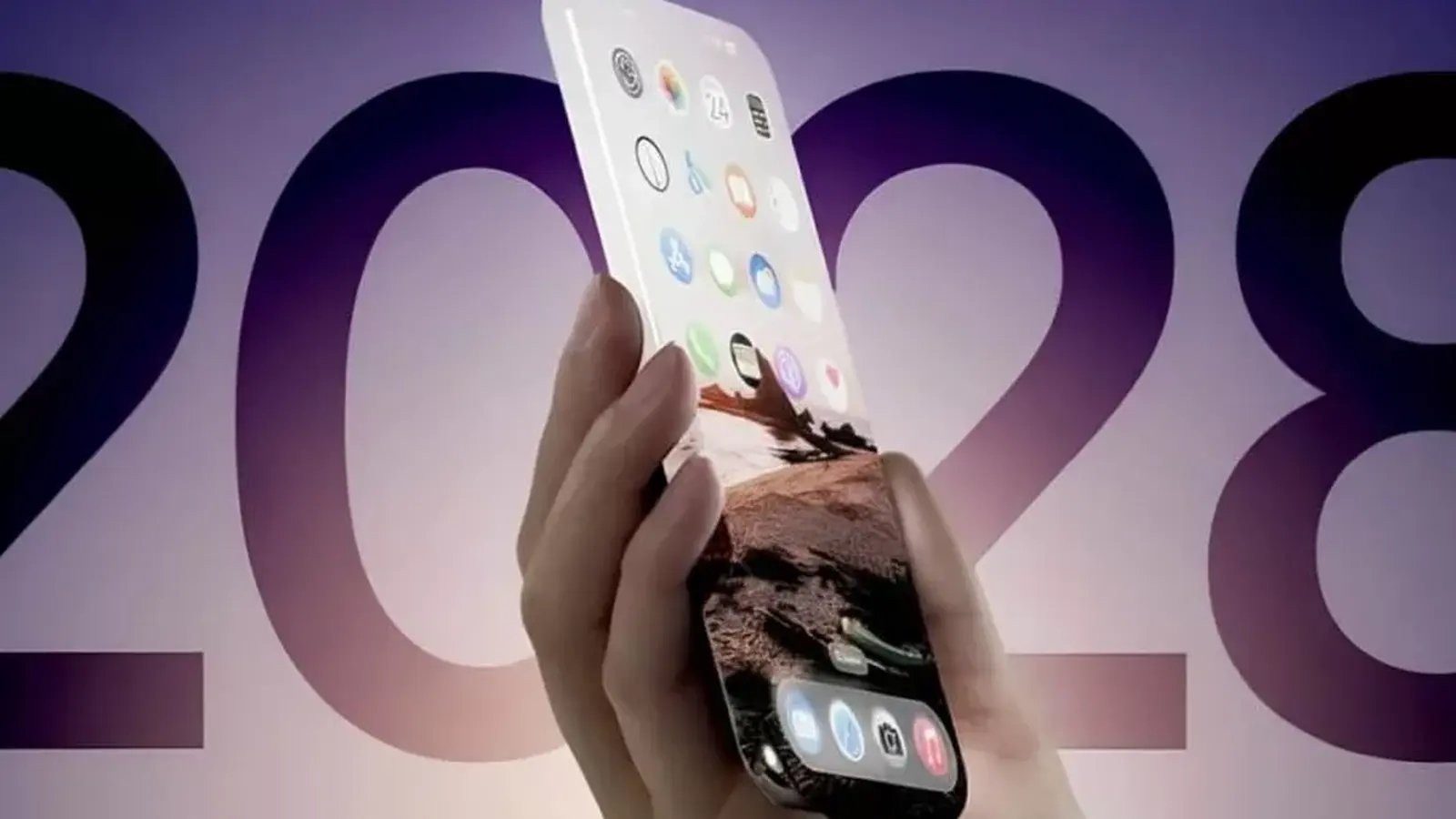
Apple isn’t chasing gimmicks. It’s polishing the details that actually matter. Imagine the 2027 iPhone’s fully glass shell and waterfall display as a rough sketch — 2028 is the artist’s final pass, smoothing the brushstrokes until the device looks and feels like a single, uninterrupted surface.
First up: the screen. The curved, four-edge panel introduced last year solved one problem and created another — visible dimming and image distortion where the glass folds over the frame. Apple’s answer, according to industry whispers, is a shift in cathode material: moving from a magnesium-silver alloy to a clearer indium‑zinc‑oxide (IZO) layer. Expect more uniform brightness along the curves, fewer heat hotspots, and a cleaner image where the display bends toward the edges.

Can a notch disappear? Maybe. Face ID under the display has been a technical holy grail, but analysts like Ross Young say it probably won’t be ready by 2027. That leaves 2028 as the likeliest candidate to take the next step: either a tiny pinhole for front sensors or a true under-display Face ID implementation that tucks the camera and sensors beneath the glass. Small change. Huge impact on the perception of an all-screen phone.
That cleaner front is tied to materials work, too. Using IZO gives engineers finer control over the panel stack. Translation: slimmer bezels. Apple could trim the visible frame further than the 2027 model, edging closer to a genuinely edge-to-edge experience without compromising touch accuracy or display integrity.
Display evolution doesn’t stop at chemistry. After experimenting with Tandem OLED in the M4 iPad Pro, Apple reportedly has its sights set on tandem stacks for the iPhone. Two separate organic emissive layers stacked together. The result is brighter panels that age slower and use power more efficiently than single-layer OLEDs. LG Display has pitched a “simplified tandem” approach that doubles up only the blue subpixels to balance complexity and cost. Apple will ultimately pick the trade-offs that matter most to battery life and peak brightness.
The silicon story is equally forward-looking. The flagship 2028 models are rumored to run the A22 Pro, a 1.4-nanometer chip built on TSMC’s A14-derived lithography. That jump could deliver roughly 15% more performance than the 2nm chips or, if performance stays level, cut power draw by as much as 30%. TSMC remains the primary supplier, but Apple is said to be quietly evaluating other fabs — including Intel — for backup capacity. A familiar arms race, but faster and leaner chips change how phones handle everything from AI tasks to video capture.

Speaking of capture: yes, the camera is getting a leap. Prototypes reportedly use a 200-megapixel periscope sensor. That’s not just a marketing number. A sensor that large allows dramatic crops without visible quality loss and opens doors for high-resolution prints and advanced computational stacking. Morgan Stanley analysts have signaled that a 200MP module is in Apple’s roadmap for 2028, though bringing a periscope system into the mainstream iPhone footprint is a tricky engineering puzzle.
Put together, these changes add up to a phone that’s less about flashy new icons and more about a cohesive, refined experience — cleaner panels, thinner edges, stronger low-power performance, and camera capabilities that push mobile photography into new territory.
Will Apple pull every thread at once? Unclear. That’s the dance of supply chains, yields, and user expectations. But if the rumors hold, 2028 won’t be a revolution so much as a meticulous reinvention — the kind that you don’t notice until you can’t live without it.

Leave a Comment
Comments
No comments yet. Be the first.