
Tiny type has been the Achilles’ heel of many image generators. Imagine Image 2.0 aims to change that. xAI has quietly rolled out a new version of its image creation and editing model, and the update is available now in Quality Mode on Grok’s website and in the Grok chatbot apps for Android and iOS, with an API release soon on the horizon.
What sets this release apart is an obsessive attention to typography and layout. The model renders multi-part compositions with surprising clarity, keeping small text crisp and readable even when it appears as a minor element within a complex scene. Think of it as an experienced typesetter with an AI brain: it understands scale, spacing, and legibility in ways earlier models struggled to.

Editing workflows got practical upgrades too. A new Magic Wand tool lets users modify a selected area without disturbing the rest of the image. Separate segmentation and Background Removal produce clean, transparent cutouts for collages or asset libraries. Need to mix references? Multi-Reference Editing accepts up to five input images and blends them into a single output, saving you from manual compositing.
Resizing is smarter now as well. Smart Resize handles aspect-ratio changes by filling newly exposed space in a way that respects the original content, rather than stretching or leaving blank margins. For teams on deadline, xAI ships a suite of preset templates for product photography, professional portraits, photo edits, icon design, and game asset creation—time savers that nudge outputs toward production-ready quality.
The model also preserves visual style across sequential edits. That means you can iterate on a character, place, or prop and keep a consistent aesthetic across dozens or hundreds of images—a useful feature for studios building large, coherent asset packs or pre-visualizing scenes for AI-assisted video production. xAI frames this as an important step toward creating unified visual worlds.
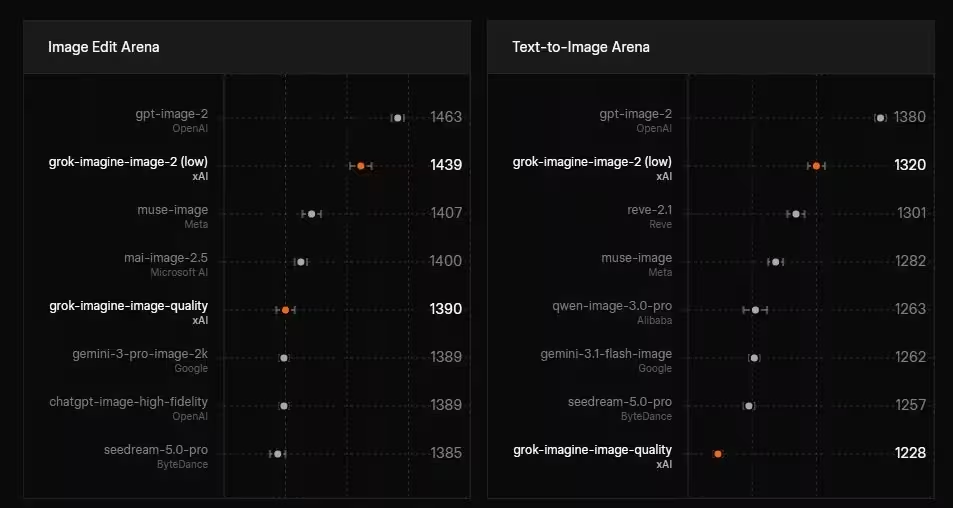
On the Arena Leaderboards, Imagine Image 2.0 sits impressively at second place worldwide in both image editing and text-to-image generation, trailing only OpenAI’s GPT-Image-2.
There’s a practical feel to these improvements—less flash, more polish. The result is not just prettier pictures, but workflows that scale for real projects. Curious if it fixes the last mile of readability and consistency in your creative pipeline? Try the Quality Mode in Grok and see how much detail you can actually read at a glance.


Leave a Comment
Comments
No comments yet. Be the first.