
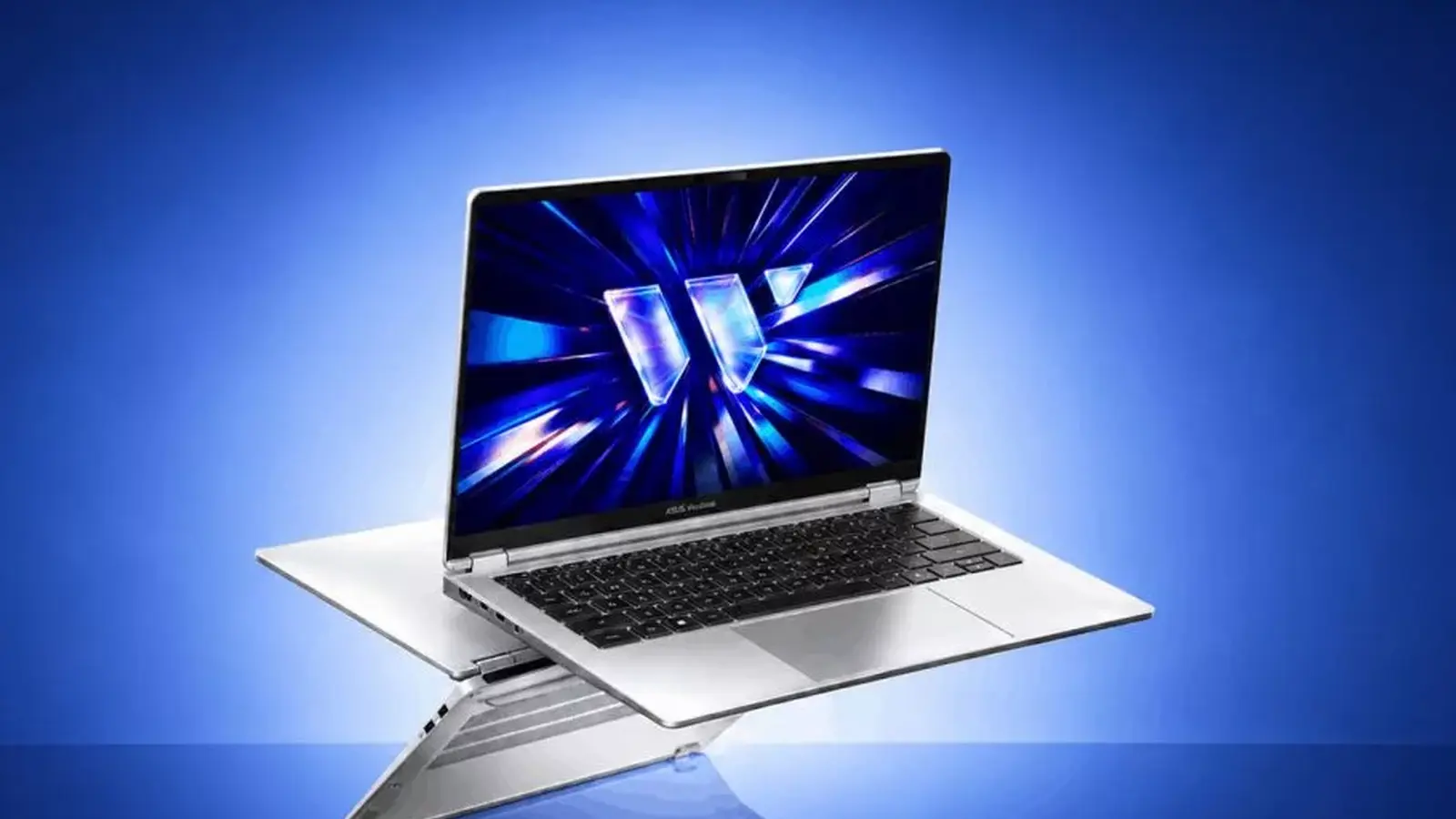
Thirty-three hours on a single charge. Bold claim. But Asus isn’t just throwing numbers at the wall — the company has unveiled the VivoBook Pro 14 (2026) and packed it with components that justify the headline.
Think of this as the compact sibling to Asus’s 16-inch VivoBook Pro announced earlier this year. That larger model leaned on AMD’s Ryzen AI 9 H465 and aimed squarely at content creators and heavy multitaskers. The new 14-inch version takes a different route: Intel silicon, a slimmer footprint and a sharper focus on battery life without sacrificing screen quality.
Under the hood the top-tier configuration uses Intel’s Core Ultra 7 356H. It’s built around 16 physical cores and 16 threads with turbo frequencies up to 4.7 GHz, and it pairs with Intel Xe 3 graphics. Translation: real-world responsiveness for productivity, photo work and light to medium creative tasks — and a little casual gaming when you want a break.

The display is where this laptop earns many of its credentials. A 14-inch OLED panel with a 2.8K (2880 x 1800) resolution runs at 120 Hz. Colors are vivid — full DCI-P3 coverage — while 0.2 ms response and up to 1,100 nits of peak brightness make it useful outdoors and precise for color work. It won’t match the 165 Hz panel of the 16-inch model for hardcore gamers, but for social-video editing, photo grading and streaming it’s a sweet spot.
Memory and storage push the machine into modern pro-laptop territory: up to 32 GB of LPDDR5X RAM and a 1 TB PCIe 4.0 drive in the highlighted build. Asus also includes two empty M.2 slots for expansion. A heads-up for builders: the M.2 bays have some compatibility limits, meaning certain thicker or double-sided drives may not fit — check dimensions before buying upgrades.
- CPU: Intel Core Ultra 7 356H (16 cores / 16 threads, up to 4.7 GHz)
- Display: 14" OLED, 2880 x 1800, 120 Hz, 0.2 ms, DCI-P3, 1100 nits
- Memory/Storage: Up to 32 GB LPDDR5X, 1 TB PCIe 4.0, two M.2 slots
- Battery & charging: 80 Wh, 100 W USB-C fast charge, claimed 33 hours
- Ports: 2x USB-C (Thunderbolt 4), 2x USB-A, HDMI 2.1, 3.5 mm jack, IR camera
- Weight & size: 1.39 kg, 17.9 mm at thickest point
The connectivity list is practical: dual Thunderbolt 4-capable USB-C ports that handle display output, two USB-A ports, HDMI 2.1, a headphone jack and an IR camera for Windows Hello. The chassis manages to stay light — about 1.39 kilograms — and under 18 mm at its thickest, which is rare for a machine that promises such endurance.

As for price, the entry-level configuration (16 GB RAM, 512 GB storage) has surfaced in China at roughly $1,155. Asus hasn’t released global pricing or regional availability yet, so international buyers should expect staggered launches and possible configuration differences.
All in all, the VivoBook Pro 14 (2026) feels like a careful balancing act: premium OLED quality, substantial battery life, and a portable chassis that doesn’t try to be a desktop replacement. If you prioritize long runtime and color-accurate screens in a lightweight package, this one deserves a close look once it reaches your market.


Leave a Comment
Comments
No comments yet. Be the first.