

3 Minutes
Stablecoin outflows cool while liquidity concentrates on Binance
Data from market analytics firm CryptoQuant shows a sharp slowdown in stablecoin outflows from centralized exchanges (CEXs), even as broader indicators continue to point to subdued market conditions. Over the past month, net stablecoin withdrawals from CEXs have amounted to roughly $2 billion, suggesting capital is consolidating within the ecosystem rather than rapidly exiting it.
Flows stabilize after early bear-market redemptions
CryptoQuant highlighted that the start of the bear market saw substantially larger redemptions — about $8.4 billion in outflows in late 2025 — whereas current monthly outflows are markedly lower. Nick Pitto, CryptoQuant’s marketing head, summarized the trend: investors aren’t fleeing crypto en masse; instead, funds are pooling, particularly on major venues.
Binance now controls the lion’s share of CEX stablecoin liquidity
According to CryptoQuant, Binance holds approximately $47.5 billion in the two largest stablecoins, Tether (USDT) and Circle’s USDC. That equates to an estimated 65% of the total USDT and USDC reserves parked on centralized exchanges — a rise from $35.9 billion a year earlier, signaling increasing reserve concentration at a single exchange.
Other major exchanges trail far behind. OKX ranks second with roughly $9.5 billion (about 13% of CEX stablecoin reserves), while Coinbase and Bybit hold roughly $5.9 billion (8%) and $4 billion (6%) respectively. CryptoQuant’s takeaway: capital isn’t leaving the crypto markets so much as it’s centralizing, with Binance emerging as the primary liquidity hub.
USDT dominates Binance reserves
Binance’s reserve composition skews heavily toward USDT. The exchange reportedly holds $42.3 billion in USDT versus $5.2 billion in USDC. Year-on-year, USDT liquidity on Binance has increased by around 36%, while USDC levels have remained comparatively flat.
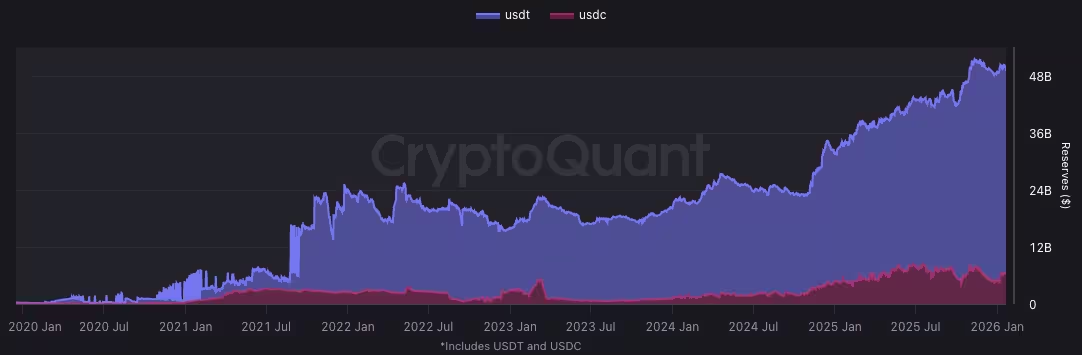
Binance USDT and USDC reserves since January 2020.
What this means for traders and the market
The consolidation of stablecoin liquidity on Binance has implications for market depth, trade execution, and systemic concentration risk on centralized platforms. A larger share of USDT and USDC on one exchange can improve liquidity for trades executed there but also concentrates counterparty and operational risk.
Outlook: consolidation does not equal recovery
CryptoQuant cautioned that slower outflows and liquidity concentration do not automatically imply a bullish market shift. Analysts noted that Bitcoin may still move lower before finding a true bottom. CryptoQuant reiterated a realized-price support level for Bitcoin near $55,000, a floor that has yet to be retested as of their latest assessment.
At the time of reporting, Bitcoin traded near $68,206, down roughly 1.3% over the prior 24 hours per CoinGecko. For traders and institutional participants, monitoring stablecoin reserves across CEXs — especially USDT and USDC balances on Binance — remains a key signal for liquidity flows and potential market reallocation.














Leave a Comment
Comments
No comments yet. Be the first.