

4 Minutes
Bitcoin under dual scrutiny: quantum computing and leveraged shorts
Bitcoin is drawing renewed institutional attention as concerns about quantum computing collide with crowded derivatives positioning. Market data and on-chain analytics indicate that a roughly 10% upside move from current levels could flip the derivatives landscape, forcing concentrated short liquidations and accelerating a short squeeze. At the same time, governance questions about post-quantum cryptography and developer upgrade paths are emerging as major considerations for large custodians and ETF issuers.
Where the liquidation risk concentrates
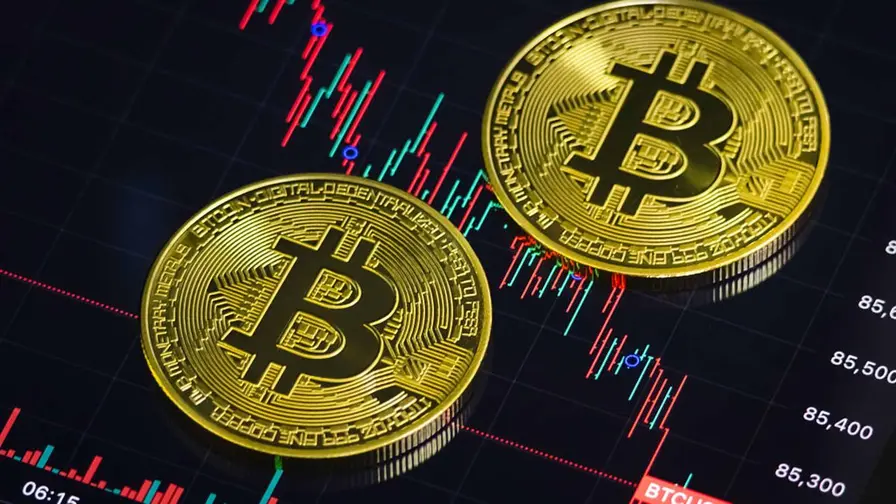
Derivatives heatmaps from platforms like CoinGlass reveal clusters of open interest and leveraged short exposure around round-number strikes roughly 10% above spot. Reduced liquidity during weekend sessions exacerbates the risk: lower order-book depth can let modest flows cascade into aggressive price moves. Traders monitoring leverage say that because short positions currently outweigh vulnerable longs, an upward shock may provoke rapid short covering and a sharper-than-expected rally.
CME gap and round-number dynamics
Market participants flagged a nearby Chicago Mercantile Exchange (CME) futures gap that could act as a magnet for price action, particularly if weekend liquidity remains thin. Gaps on CME charts often coincide with rapid fills as spot markets move to close open futures imbalances, adding a mechanical element to any squeeze. Open interest clustering near psychological strikes adds another layer: when many leveraged contracts rest at the same levels, price movement can trigger mass liquidations faster than in a fragmented market.

On-chain signals: SOPR and short-term holder behavior
On-chain indicators point to easing short-term selling pressure after a recent drawdown. The Spent Output Profit Ratio for Short-Term Holders (STH-SOPR) briefly dipped below the 0.95 capitulation zone before rebounding toward the neutral 1.0 mark. That metric tracks whether short-term coins are being spent at a profit or loss; a sustained move above 1.0 typically suggests selling pressure has been absorbed and can support a technical bounce.
Implications of SOPR recovering

If STH-SOPR maintains levels above 1.0, analysts expect that absorbed selling could extend a rally, particularly if derivatives positioning forces shorts to cover. Conversely, failure to hold the threshold would likely return the market to range-bound behavior. Analysts note the recent drawdown lacked the severity of past capitulation events, such as the significant drop seen on August 5, 2024, when SOPR approached 0.9.
ETF inflows, custody concentration, and governance pressure
Institutional ownership through spot Bitcoin exchange-traded funds (ETFs) and large custodial balances is reshaping the power dynamics around Bitcoin development and security upgrades. Reports suggest funds like BlackRock’s iShares Bitcoin Trust and Fidelity’s Wise Origin have been net buyers during recent retail sell waves, supporting the price. CryptoQuant and other analytics providers show retail sell pressure on exchanges like Binance coincided with institutional accumulation on ETF platforms, highlighting a bifurcation in market drivers.
Venture capital and research voices warn that concentrated capital via regulated vehicles could translate into governance pressure on developers to prioritize certain upgrade paths, including potential moves to post-quantum cryptography. These conversations are framed less as an immediate technical fault and more as a governance and upgrade-management challenge for an open-source ecosystem now hosting large institutional treasuries.
What traders and developers are watching next
Short-term market structure signals, ETF flows, and the derivatives ledger are all being monitored for signs that shorts will be forced to cover. Key trigger levels identified by traders could open a path to higher price bands if breached. Conversely, failure to defend nearby support — especially in the presence of CME gaps — could reintroduce gap-fill scenarios and downside risk for leveraged longs.
For developers and security teams, the quantum conversation has moved from speculative theory to a governance topic that institutions expect to be addressed as their allocations grow. While an immediate cryptographic collapse is unlikely, the industry is discussing upgrade paths and mitigation strategies to future-proof Bitcoin against hypothetical quantum advances.
In short, the market sits at the intersection of short-term technical mechanics and multi-year structural questions. Traders focused on volatile events should watch open interest clusters, liquidation maps, CME gap zones, SOPR thresholds, and ETF flows. Institutional stakeholders will likely keep pushing the dialogue on cryptographic resilience and governance as their footprint in Bitcoin enlarges.
Bottom line

Bitcoin’s immediate price action will probably be driven by derivatives positioning and liquidity conditions, with a 10% move capable of triggering significant short covering. Over a longer horizon, the rise of spot ETFs and large custodial holdings brings governance debates on quantum-resistant upgrades into sharper relief. Both dynamics are now integral to how investors interpret risk and opportunity in the crypto market.










Leave a Comment
Comments (2)
Post-quantum talk matters, sure, but calling it imminent catastrophe feels overhyped. derivatives squeeze seems the short term play imo, watch CME gaps and open interest
Is the quantum fear real or just FUD? also those clustered shorts sound scary, but weekends are always thin... feels like a setup for a pump or dump, who knows