

Bitcoin breaks away from tech rally as capital flows to AI
Bitcoin (BTC) abruptly lost momentum this week, sliding roughly 7% after failing to decisively reclaim the $67,200 mark. The pullback triggered about $330 million in liquidations of long leveraged positions, underscoring how quickly bullish sentiment can evaporate when broader market flows shift. The move was especially notable because it occurred while the Nasdaq 100 continued rallying, trading only about 1% below its record highs — a divergence that highlights a rotation of capital toward artificial intelligence stocks and away from non-yielding crypto assets.

Nasdaq 100 futures (left) vs. Bitcoin / USD.
Macro drivers: dollar strength and elevated Treasury yields
Several macro factors are pressuring Bitcoin and other risk assets. A firmer US dollar, bolstered by sustained economic optimism and a resilient labor market, is weighing on commodities and cryptocurrencies alike. The US 5-year Treasury yield remained elevated around 4.21%, making fixed income relatively more attractive for yield-sensitive investors and reducing the appeal of assets with no cash yield.

Gold / USD (left) vs. US dollar strength index (right).
Fed messaging has also contributed to the mood. Comments from Federal Reserve Chair Kevin Warsh, repeatedly invoking "price stability," have led market participants to anticipate a vigilant Fed that may tolerate tighter policy for longer. That hawkish posture is typically negative for high-duration, non-yielding assets such as Bitcoin and gold.
Leverage, ETFs and the evolving institutional story

The recent volatility exposed waning demand for bullish leveraged BTC positions — funding rates and perpetual futures metrics have cooled since June 4, reflecting thinner conviction after the rapid crash from about $73,700 to $61,300 in three days. Yet the structural adoption story for Bitcoin is far more mature than in previous cycles: US-listed spot Bitcoin ETFs have amassed over $102 billion in assets, and major banks like Morgan Stanley, Bank of America and Goldman Sachs now offer Bitcoin-related client services and products.
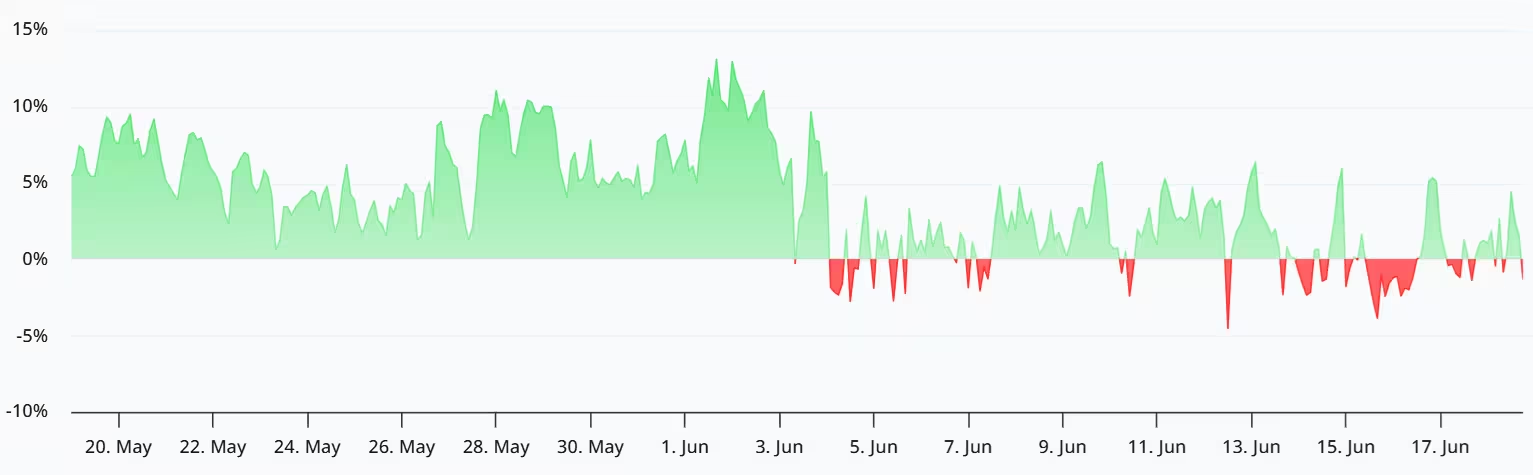
Bitcoin perpetual futures annualized funding rate.
Even so, if institutional flows slow or rotate toward high-growth AI names and fresh IPOs, price action could test lower support ranges. Market participants should not rule out a retest of $60,000 given the confluence of macro headwinds and equity-led capital rotation.
AI boom versus blockchain narratives
The AI sector is currently drawing massive investor attention and capital. Recent market moves were supported by geopolitical and economic developments — a memorandum of understanding between the US and Iran eased oil concerns, driving crude prices down to roughly $74 a barrel, the lowest in about 15 weeks. Meanwhile, steady US jobless claims reinforced the idea of a resilient US economy, helping equities outperform in the near term.
High-profile events and company actions have amplified the AI narrative. SpaceX’s IPO created blockbuster market capitalization moves, while chip makers and memory producers saw sharp gains after strategic partnerships and supply-chain developments. Intel jumped after an announcement about processor development, and firms like Micron and SK Hynix have continued to gain market value amid the AI hardware demand surge.
That momentum contrasts with the fracturing narratives that have lately supported some Bitcoin buyers. As noted by market commentators, confidence in crypto narratives — from macro hedging to digital-gold storytelling — has been strained, and traders’ sentiment around BTC is, in some views, worse than during previous industry shocks.
What traders and institutions should watch
Key indicators for the coming weeks include spot ETF flows, futures funding rates, and US Treasury yields. If ETF inflows remain steady and large institutions continue offering Bitcoin access to clients, support around $60,000 could hold and recovery scenarios remain plausible. Conversely, if AI-driven equity momentum keeps accelerating and fixed income stays attractive due to higher yields, BTC may face renewed downside pressure.

In short, Bitcoin’s price trajectory will increasingly reflect where institutional capital chooses to allocate — between the growing AI ecosystem, traditional tech leaders, and digital assets. Traders should monitor macro signals, liquidity metrics, and ETF activity closely to gauge whether a $60,000 retest is a temporary pullback or the start of a deeper consolidation.

Leave a Comment
Comments (2)
Wow didn’t expect AI to suck money outta crypto this fast. liquidations brutal, holding some but lowkey nervous, if that keeps up... could test 60k
So BTC drops while Nasdaq pumps into AI? feels like capital rotation, ETFs might help but who’s actually long at 60k? weird liquidations, watch yields.