
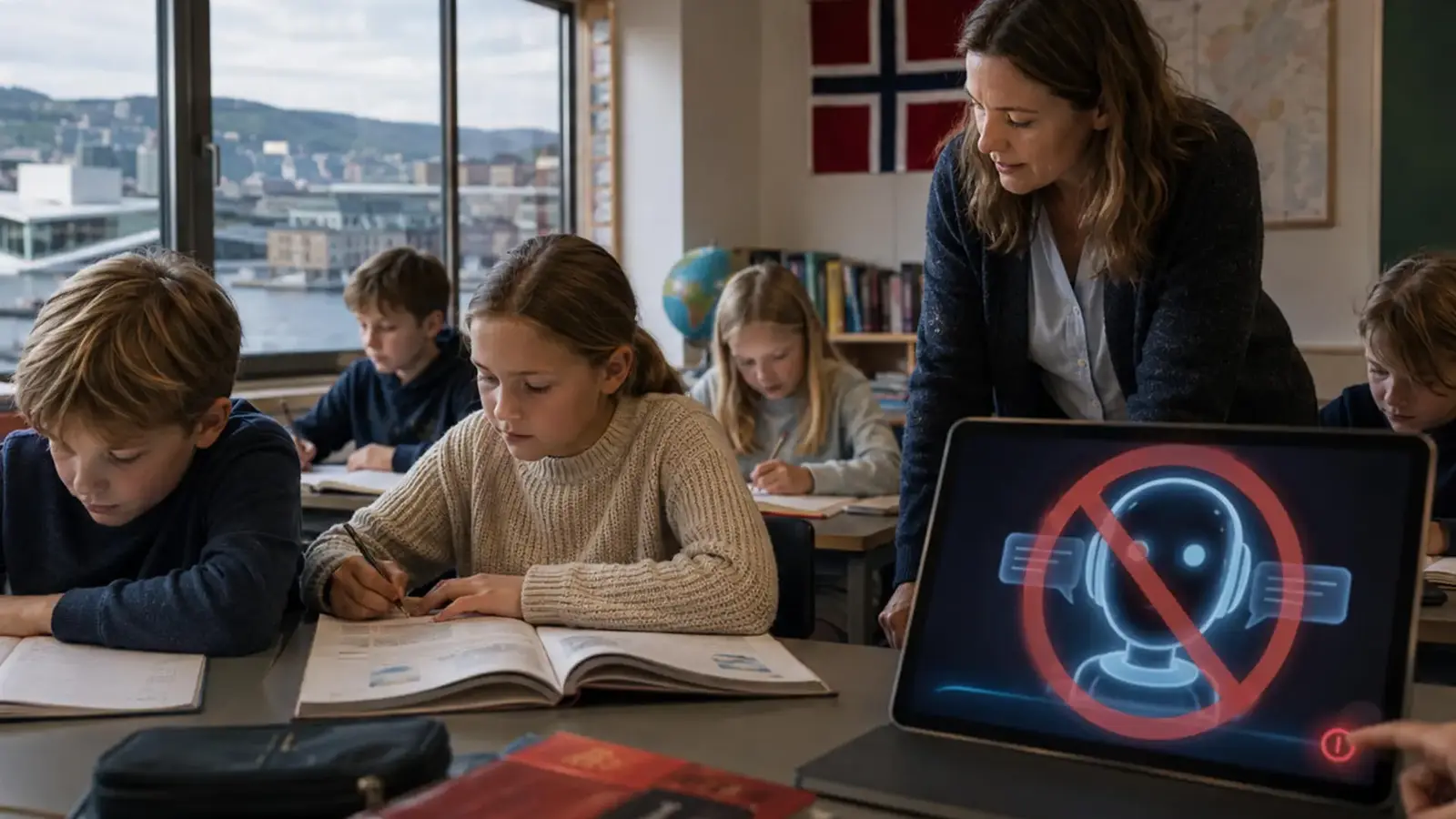
Norway just slammed the brakes on classroom AI. A sharp policy shift landed this week and it wasn’t subtle.
From the start of the new school year in late August, generative artificial intelligence tools will be almost entirely banned for primary pupils and tightly controlled for older students. The government frames this as a defense of fundamentals: reading, writing and arithmetic.
The most important thing at school is that our children learn reading, writing and mathematics.
Prime Minister Jonas Gahr Støre has warned that easy access to AI risks short-circuiting crucial learning stages. So the rules are age-tiered. Children in grades 1–7 — roughly ages 6 to 13 — are expected, as a general rule, not to use generative AI at school. For 14- to 16-year-olds, AI will be allowed only under direct teacher supervision. And for 17- to 19-year-olds, the policy pivots: schools must teach responsible, practical AI use to prepare students for higher education and the job market.

It’s not an isolated gesture. The ban follows a 2024 prohibition on smartphones in classrooms and measures that expanded teachers’ disciplinary authority. Government officials cite a worrying slide in standardized test scores as part of the rationale — a signal they believe today’s digital tools might be eroding basic skills.
There’s historical irony here. Norway was an early classroom-computing adopter in the 1990s, then embraced tablets after iPads arrived in 2010. Textbook use dwindled as devices multiplied. Now the state is proposing funds to bring textbooks back into the classroom, nudging the system toward a more traditional pedagogy.
The push goes beyond AI. Authorities have floated restrictions on social media use for children until age 16, aligning with similar debates in Australia and elsewhere about delaying heavy smartphone exposure for young people.
Policymakers say the aim is simple: guard the building blocks of learning while introducing AI at stages where guidance and adult judgment can shape its use. Others will see it as a cautious step that risks delaying digital fluency. Which view wins out will tell us a lot about how education systems balance skills and safety in an age of powerful tools.


Leave a Comment
Comments
No comments yet. Be the first.