
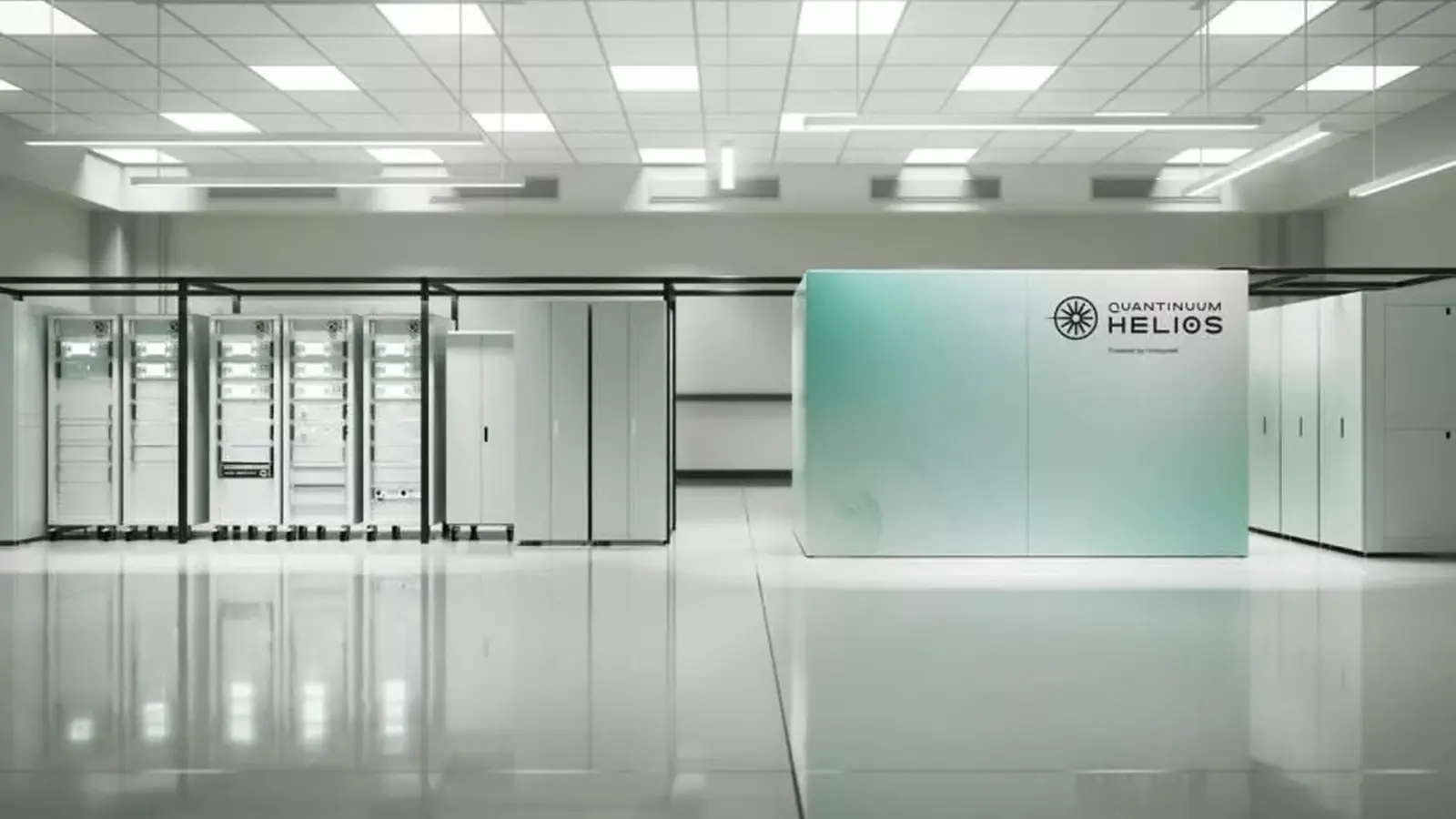
Quantinuum and Sandia National Laboratories have pushed quantum accuracy to jaw-dropping new heights with Helios — a machine that shrinks the gap between laboratory curiosity and practical quantum hardware.
Single-qubit operations on Helios reached 99.9975% fidelity. Two-qubit gates hit 99.921%. Those numbers aren’t incremental improvements; they are seismic. Why does that matter? Because fidelity is the currency of quantum usefulness. The closer operations get to 100%, the fewer errors cascade through a calculation and the more viable real-world quantum workflows become.
Helios is built on trapped-ion technology and packs 98 physical qubits, mapped into about 50 logical qubits through error-suppression techniques. The system also uses integrated photonics to shuttle quantum information along microscopic optical channels at light speed, a design choice that helps scale the machine while keeping power consumption modest — around 40 kilowatts, according to the team. That’s remarkably efficient for a system of this class.
Sandia’s role went beyond validation. Researchers there applied and refined advanced benchmarking tools to probe Helios’ error landscape, including a new method to evaluate mid-circuit measurements — the ability to read and react to qubits mid-run. Mid-circuit measurement is a technical but pivotal capability: you can’t build robust, fault-tolerant quantum algorithms without it. The new evaluation techniques give engineers a clearer map of where errors hide and how to suppress them.

Helios shows that practical, low-error quantum processors are no longer just a theoretical target — they’re becoming engineering reality.
Quantinuum calls Helios its largest and most reliable commercial system to date, and customers can access it through cloud subscriptions. Still, the team is frank: this isn’t the endgame. A general-purpose, error-corrected quantum computer that routinely outperforms classical supercomputers remains a future milestone. But closing in on sub-0.01% error rates for single-qubit gates and sub-0.1% for two-qubit gates puts that milestone on a much shorter roadmap.
Practical implications are already clear. Higher fidelity expands the scope of feasible simulations and algorithms — from virtual drug discovery and materials design to advanced energy modeling and next-generation cryptography research. Tasks that today’s best classical machines struggle with could slip into reach once low-error quantum modules scale and stitch together into larger logical fabrics.
Helios’ results were documented in Nature and mark an important inflection point: not just higher numbers on a benchmark, but demonstrable progress on the engineering problems that stand between theory and application. The race is on to translate these hardware wins into software, error-correction codes, and full-stack systems that deliver tangible advantages.
So what comes next? If fidelity keeps improving at this clip, the list of problems quantum machines can tackle will grow fast — and the innovators ready to deploy them will define the next era of computing.

Leave a Comment
Comments
No comments yet. Be the first.