

BIS warns stablecoins could fragment the global monetary system
The Bank for International Settlements (BIS) has issued a stark warning about the rapid growth of stablecoins and private digital tokens, arguing they risk fragmenting the global monetary system and eroding sovereign monetary control. In its Annual Economic Report, the Basel-based institution assessed the roughly $316 billion stablecoin market and concluded that many private tokens fall short of the institutional, legal and operational requirements needed to serve as reliable money at scale.
Stablecoins can offer speed and programmability, but the BIS emphasizes that these advantages do not automatically make privately issued tokens a safe substitute for central bank money. The report highlights structural vulnerabilities in reserve asset management and raises the prospect that a significant shift from commercial bank deposits into private digital tokens would reduce traditional bank funding, limiting credit provision to households and businesses and threatening financial stability.
Why tokenized central bank and bank money matters
Rather than treating stablecoins as the backbone of the future monetary system, the BIS urged policymakers and the financial sector to accelerate work on tokenized central bank digital currencies (CBDCs) and tokenized commercial bank deposits running on regulated infrastructure. Tokenization of central bank and bank money could preserve the benefits of programmable payments and faster settlement while maintaining legal protections, settlement finality and institutional accountability that underpin monetary sovereignty.
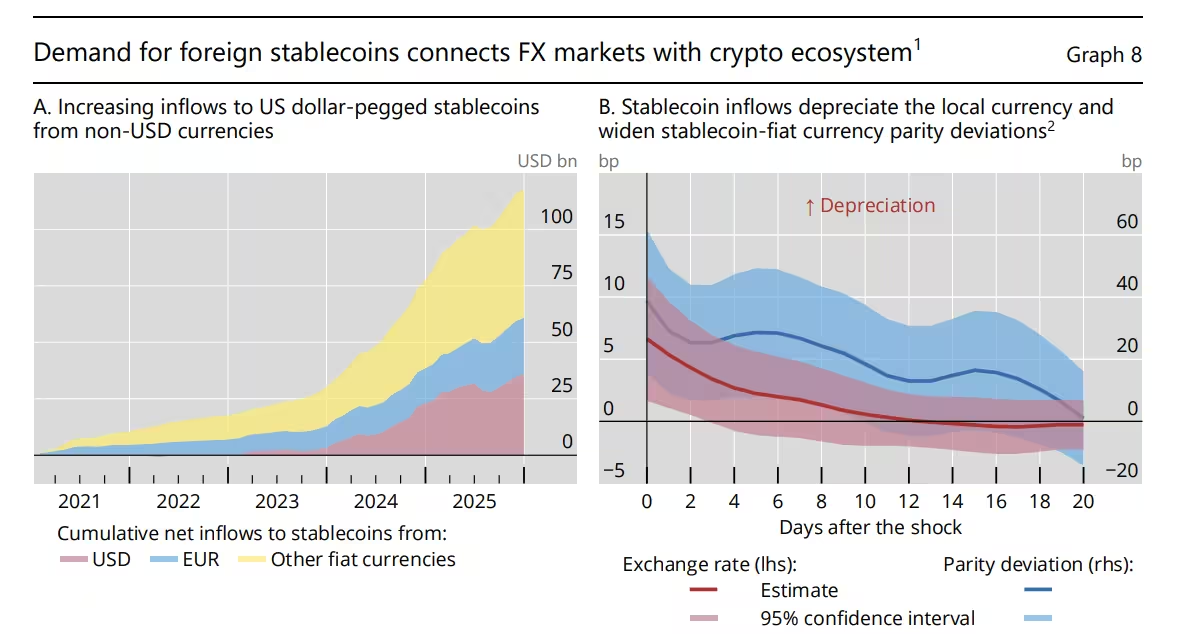
Demand for foreign stablecoins connects FX markets with crypto ecosystem.
Stablecoin dollarization: a threat to monetary sovereignty
The report pays particular attention to the phenomenon of "stablecoin dollarization," where dollar-pegged stablecoins are increasingly used in countries with weaker domestic currencies. This cross-border adoption links foreign exchange markets directly with the crypto ecosystem, which in turn can undermine a country's monetary policy effectiveness. BIS warns that widespread use of foreign-denominated stablecoins may erode monetary sovereignty, reduce the potency of domestic policy tools, weaken bank intermediation and expose emerging markets to volatile cross-border capital flows.
Policymakers should therefore consider how crypto regulation, capital controls and the design of tokenized central bank money interact to protect macroeconomic stability. Comprehensive regulatory frameworks for stablecoins, including reserve transparency, redemption guarantees, and robust custody and auditing standards, will be critical to mitigate systemic risks.
BIS raises fresh concerns about public blockchains' limits
The BIS also delivers a pointed critique of public, permissionless blockchains such as Bitcoin and Ethereum when evaluated as the foundation for systemically important financial infrastructure. The report stresses that decentralized networks, which rely on distributed validation and lack a central governance authority, struggle to meet the scalability, legal accountability and settlement finality required by regulated finance.

BIS raises concerns on rising fragmentation across layer 1 and layer 2 networks.
Economics of consensus and the limits of permissionless networks
A core element of the BIS critique targets the economics of decentralized consensus: as transaction volumes climb, validators are compensated through fees that can rise sharply, turning congestion, longer confirmation times and higher costs into recurring structural features rather than temporary hiccups. This dynamic undermines the efficiency and strong network effects needed for a unified monetary system. The institution also points out that without a clearly accountable entity to manage governance, resolve disputes and ensure compliance with anti-money laundering and other standards, public blockchains face steep obstacles to hosting large-scale regulated financial activity.
Unified ledger approach: combining tokenization with institutional safeguards
Importantly, the BIS does not reject tokenization itself. Instead, it advocates a "unified ledger" architecture: tokenized CBDCs, tokenized commercial bank deposits and tokenized financial assets operating on programmable platforms within regulated legal and institutional frameworks. This model aims to retain the benefits of tokenization—programmability, speed and atomic settlement—while preserving monetary stability, financial integrity and public trust.

The BIS report is a clear signal to central banks, regulators and the private sector that faster development of CBDCs, regulated tokenized deposits and tighter crypto regulation are needed to modernize payments without sacrificing financial stability. For market participants and policymakers navigating DeFi, stablecoins, and tokenized assets, the message is unmistakable: innovation must be paired with robust institutional safeguards to support a resilient global monetary system.

Leave a Comment
Comments (2)
Makes sense: tokenized CBDCs could keep programmability without risking stability. Still implementing that at scale will be messy, and slow.
Is BIS right or just scared of losing control? Stablecoins are messy, sure, but killing innovation? hmm… regs need balance, not panic.