
Boot up an older PhysX-heavy title and you might expect stuttering, missing effects, or the old workaround of bolting on a second NVIDIA card just to handle physics. Not anymore. ZLUDA v6 has quietly changed that script, letting AMD Radeon GPUs shoulder PhysX workloads and restore those dramatic visual flourishes without a second GPU.
ZLUDA started as an audacious open-source effort to bring CUDA compatibility to non‑NVIDIA hardware. It grabbed attention fast, then ran into legal and funding headwinds because some upstream requirements weren’t met. The original project team no longer takes commercial backing, but the lead developer hasn’t abandoned the codebase; instead, development continues in a slower, more personal rhythm—weekend sprints and focused fixes aimed squarely at Windows ML, textures, and PhysX support.
Technically speaking, v6 adds 32‑bit PhysX support—largely via a long-running pull request (#651 that hasn’t been fully finalized). That means older games that relied on 32‑bit CUDA for physics can now offload those tasks to AMD hardware. The payoff isn’t subtle. You get higher frame rates and richer effects: detailed destructible environments, convincing fire and particle systems, and fluid sims that finally look like they should.
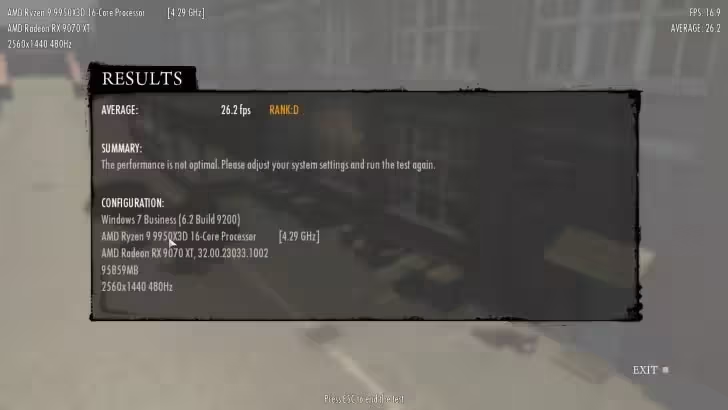
In practice, ZLUDA v6 can push PhysX titles to roughly three times the frame rate on AMD cards compared with running without it.
Look at Mafia II as a practical example. On the same system, a Radeon card produced about 26.2 FPS with PhysX disabled through ZLUDA. Flip the switch and ZLUDA’s PhysX support lifted that to roughly 80.2 FPS. That’s not a marginal gain; it turns a playable-but-laggy experience into a smooth, authentic one. Until now the usual fix was to add an NVIDIA card just for PhysX/CUDA 32‑bit processing—a solution that worked, but only if you were willing to pay for a second GPU.
Curious detail: NVIDIA had removed 32‑bit CUDA support from its newest Blackwell architecture, only to re-enable it for a handful of titles later. Whether Blackwell-era silicon will see the same dramatic benefit with ZLUDA v6 remains to be tested, but the fact that alternative tooling can now route PhysX to AMD opens a lot of doors for retrofits and budget builds.

This is not a flawless switch, though. ZLUDA’s optimizations are a work in progress. Users report occasional graphical glitches in fluid simulations, and injecting the runtime into games launched via Steam can still be hit-or-miss. The good news is that ZLUDA is open source, so anyone with patience and skill can tweak the stack, submit fixes, and try it across a variety of titles.
The project’s scope is widening beyond pure CUDA translation. What began as a Linux-first effort now has explicit plans to improve Windows friendliness: clearer installer messages for missing ROCm libraries, compiler bug fixes, and stronger compute libraries. Texture support has also been added, which pairs nicely with PhysX work and workflows in tools like Blender.
The developer warns that future releases will arrive less frequently, but they will continue. Expect slower cadence, not silence. For gamers, modders, and retro enthusiasts, that means incremental stability and broader support over time. So dust off those PhysX-era classics and see what your Radeon can do—surprises await.


Leave a Comment
Comments
No comments yet. Be the first.