

4 Minutes
Bitcoin investors hit with average unrealized losses as on-chain cost basis rises
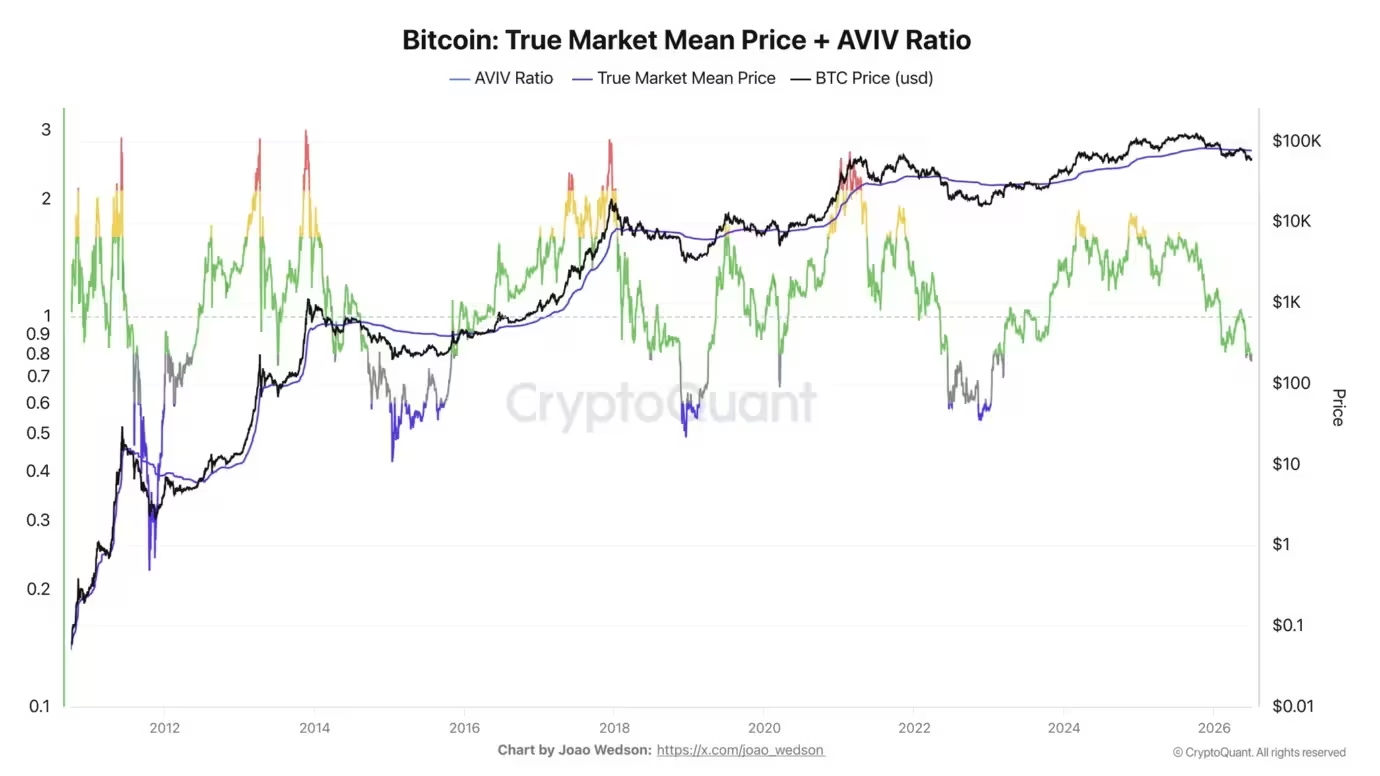
Bitcoin holders are currently sitting on roughly a 20% average unrealized loss as a key on-chain cost-basis metric — CryptoQuant’s True Market Mean (TMM) — has climbed to about $76,700. The TMM measures the acquisition price of actively traded coins by excluding long-dormant or partially lost supply, making it a clearer gauge of the cost basis for active holders rather than the network’s full circulating supply.
At press time on July 4, Bitcoin traded near $62,596, up about 1.67% in 24 hours, but still well below the active-holder TMM. That gap leaves many active investors underwater and has created a psychological and technical resistance zone around the $76.7k level, according to CryptoQuant analyst Darkfost.
AVIV ratio highlights valuation discount for active holders
Darkfost points to the Active Value to Investor Value (AVIV) ratio — which compares Bitcoin’s market value to the cost basis of active holders — as another on-chain signal that investors should watch. The AVIV ratio is hovering around 0.8, indicating a valuation discount relative to the active-holder cost basis and implying the roughly 20% average unrealized loss for current active investors.
Historical AVIV readings at previous cyclical lows fell to approximately 0.5–0.6, a range associated with average losses closer to 40%–50%. While current on-chain metrics show meaningful losses and selling pressure around the TMM, Darkfost says the market has not yet revisited those deeper bear-market extremes.
Resistance, selling behavior and potential recovery
Analysts note the $76.7k area has acted as a sell-to-break-even zone in the past: when prices approached this region previously, many holders reduced exposure instead of holding for longer-term gains. That behavior amplifies resistance and can dampen momentum even when macro conditions are supportive. Still, Darkfost argues Bitcoin might not need to retest the deepest historical discounts before staging another recovery, partly because adoption and capital inflows have been stronger in this cycle.
Institutional demand, ETF flows and the capital needed for the next leg up

CryptoQuant’s broader on-chain research also highlights that achieving the next major Bitcoin rally could demand substantially more fresh capital than in prior cycles — potentially more than $1 trillion — given the asset’s larger market capitalization today. Since 2022, approximately $697 billion of inflows have entered Bitcoin, generating cumulative gains near 689%, but those gains represent smaller relative returns than earlier cycles due to scale.
Recent weeks have seen softening institutional appetite: several U.S. spot Bitcoin exchange-traded funds recorded sustained net outflows, stoking questions about whether fresh institutional capital will return fast enough to power a pronounced advance. ETF inflows and outflows remain a key driver of near-term price action and liquidity.
Corporate treasuries and yield strategies
Corporate adoption continues to evolve. Large public holders with substantial treasuries — a single major publicly traded corporate holder has amassed more than 847,000 BTC — are exploring ways to generate liquidity or recurring income without outright selling. Options-based strategies and conservative lending are being discussed as ways to monetize holdings while maintaining long-term exposure to Bitcoin.
Blockchain, stablecoins and AI-driven payments
Beyond institutional treasuries, blockchain infrastructure and stablecoins are attracting interest from companies building artificial intelligence systems. Industry participants expect future machine-to-machine payments and autonomous AI agents will likely require programmable payment rails and predictable settlement — roles blockchain payment systems and stablecoins could fulfill over time, even though large-scale adoption of such architectures may still be several years away.
What investors should watch
Traders and long-term holders should monitor on-chain indicators such as the TMM and AVIV ratio, ETF flow reports, and corporate liquidity strategies to gauge market stress and potential turning points. While current metrics point to widespread unrealized losses among active holders and notable resistance around $76.7k, stronger institutional adoption and new liquidity tools could support a recovery without revisiting the deepest historical bear-market valuations.
Overall, on-chain signals underline caution: active-holder cost bases and AVIV readings matter for short- to medium-term price dynamics, even as broader adoption trends continue to strengthen Bitcoin’s long-term narrative.


Leave a Comment
Comments (2)
Pretty balanced take. The $1T+ capital thing hits hard, if inflows dont return price could stall, but corporate strategies might help a bit
is this even true? TMM at 76.7k makes active holders look trapped, ETFs outflows scary. who bails first..?