

3 Minutes
Tom Lee Says Ethereum Will Bridge Traditional Finance and Crypto
Veteran market analyst Tom Lee has reiterated his long-standing bullish view that Ethereum will become the central infrastructure as traditional finance and cryptocurrency markets converge. Lee made the comments in a post on X, responding to a reminder from Carrie Presley of Fundstrat Capital about their conversation nearly six years ago in which she expressed optimism about Ethereum and blockchain technology.
Lee’s view is grounded in both macro adoption trends and corporate treasury behavior. He argues that as regulatory clarity improves and payment rails evolve, Ethereum — particularly its layer-2 scaling networks — will increasingly underpin settlement, tokenized assets, and programmable payments across financial services.
Bitmine’s Growing Ethereum Treasury Reinforces the Thesis
The timing of Lee’s comments coincides with Bitmine’s expanding corporate holdings of ETH. The company recently disclosed it holds 5,742,237 ETH — approximately 4.8% of circulating supply — and reported total assets (crypto, cash, marketable securities, and investments) of roughly $11.1 billion. Bitmine’s weekly purchases, including an additional 27,084 ETH in its latest update, underscore a steady accumulation strategy.

Beyond ETH, Bitmine’s balance sheet lists 206 BTC, $527 million in cash and marketable securities, and equity positions in several public companies. Institutional accumulation like this signals growing confidence in Ethereum as a strategic asset class and infrastructure provider.
Regulation and the CLARITY Act: A Key Catalyst
Lee has repeatedly linked Ethereum’s long-term outlook to the regulatory environment in the U.S. He believes proposals such as the CLARITY Act, if enacted, would reduce legal uncertainty for smart contract platforms and tokenized financial products. Clearer rules could accelerate institutional use of Ethereum for custody, settlement, and programmable payments, making the ecosystem more attractive to banks, asset managers, and payment processors.
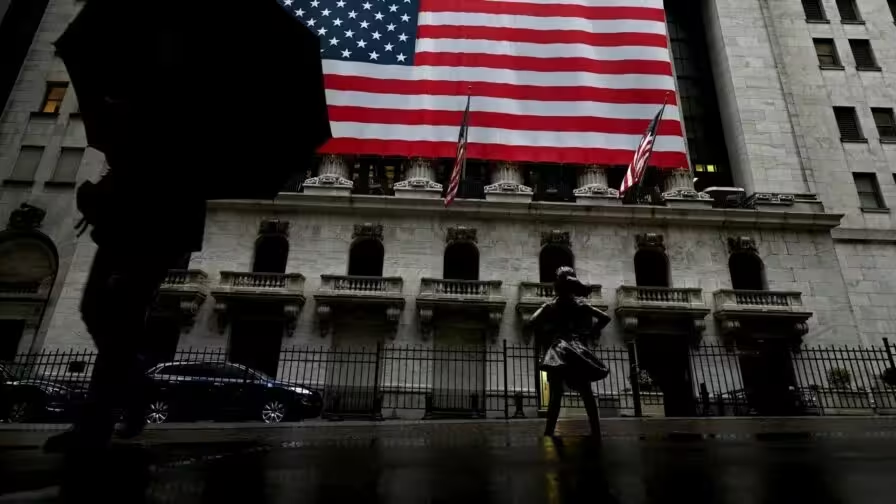
Legal clarity matters for enterprise adoption, and Lee contends that a more predictable regulatory framework would unlock new use cases for Ethereum beyond pure speculation.
Layer-2 Payments, USDC and Real-World Use Cases
A practical element of Lee’s thesis is already visible: commercial activity on Ethereum layer-2 networks. Major firms including Visa and Shopify process USDC transactions and other payment flows via Ethereum scaling solutions, demonstrating real-world utility for stablecoins and tokenized funds.
By shifting high-throughput payments and settlement flows to layer-2, Ethereum can offer lower fees and faster finality — features that are attractive to payment platforms and merchants. This off-chain/on-chain hybrid model supports a future in which traditional payment infrastructure interoperates with blockchain rails.
What This Means for Investors and Markets
If Lee’s prediction comes to pass, Ethereum would function as a shared settlement layer connecting legacy financial institutions and decentralized finance (DeFi) services. Institutional treasuries accumulating ETH, expanding layer-2 activity, and regulatory progress are three interlocking indicators to watch:
- Institutional accumulation: Large corporate treasuries increasing ETH holdings signal confidence in long-term value and utility.
- Layer-2 adoption: More payment volume routed through Ethereum scaling networks shows practical, scalable use cases for USDC and other tokenized assets.
- Regulatory clarity: Legislation like the CLARITY Act could lower barriers to institutional participation and product development.
At press time Ethereum traded near $1,800, roughly flat over 24 hours and up 2.2% over the prior week. For traders, investors, and institutions watching the intersection of blockchain and traditional finance, Lee’s viewpoint highlights Ethereum’s potential role as the protocol linking the two worlds.
Key Takeaway

Tom Lee’s renewed conviction positions Ethereum as the likely foundation for a merged financial ecosystem — one where smart contracts, tokenized payments, and established financial services operate on shared blockchain infrastructure. With large-scale ETH accumulation by firms like Bitmine, increasing layer-2 payment activity, and the prospect of clearer U.S. regulation, the case for Ethereum as a bridge between Wall Street and crypto looks increasingly credible.

Leave a Comment
Comments (2)
wow, imagine Visa + Shopify routing payments on layer2s — kinda thrilling, kinda scary. If they pull it off, finance will never be the same
Regs might help, but is the CLARITY Act actually gonna pass? Institutional ETH buys look big, but custody, UX and real settlement plumbing still need work. Not convinced yet.