
5 Minutes
a tacit shift toward crypto settlements
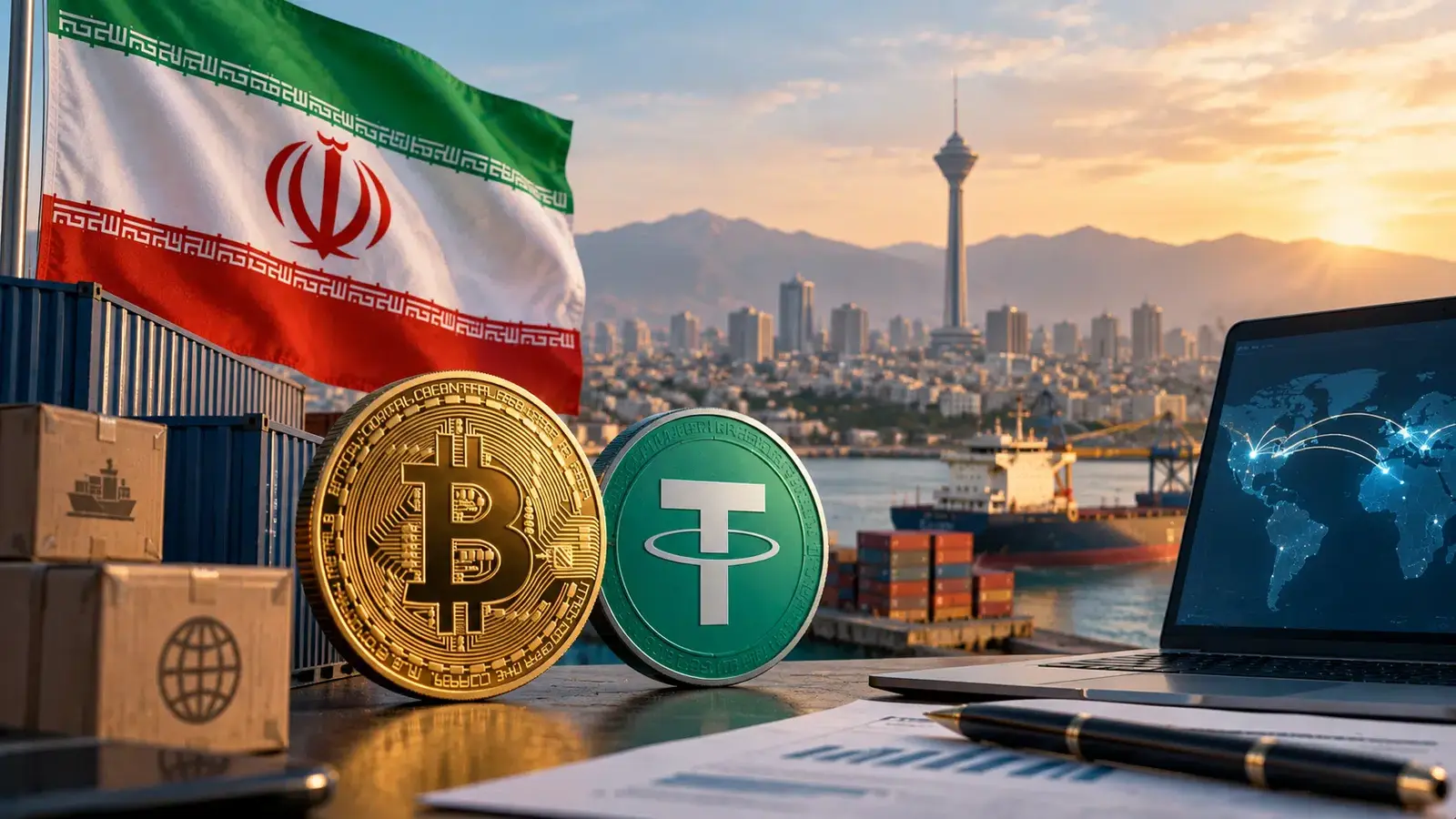
Iran’s central bank has reportedly relaxed foreign-exchange controls and turned a blind eye to some cryptocurrency-based export settlements as businesses search for alternatives to traditional banking channels restricted by U.S. sanctions. Sources cited by the Financial Times say exporters increasingly use stablecoins and other digital assets to receive cross-border payments, with USDT (Tether) the most commonly used token.
This developing practice is framed as an enforcement shift rather than a formal legal change: no public directive from the Central Bank of Iran (CBI) has officially legalized crypto settlement for all exporters. That distinction leaves firms with operational flexibility but without full legal certainty.
How exporters are using crypto for trade
Practical mechanisms
Exporters reportedly repatriate foreign currency by routing receipts through domestic cryptocurrency exchanges, converting assets on open markets, or directly using export proceeds to buy imports. These workarounds reduce dependence on the state-controlled foreign-exchange system, which historically required repatriation through supervised channels—often at less favorable official rates compared with parallel market rates.
Multiple routes are in play:
- Stablecoins such as USDT provide dollar-pegged value without needing a dollar-denominated bank account.
- Bitcoin and other cryptocurrencies serve as an alternative settlement rail for certain counterparties.
- Domestic exchanges and OTC desks facilitate conversion into rials or import financing.
An executive at a government-affiliated company told the Financial Times that accepting export payments in crypto has effectively become normalized for some firms, though the source was not named and the CBI did not confirm the claims when approached for comment.
Networks and costs
Tron-based USDT is commonly used for Iranian cross-border transfers because of low transaction fees and broad liquidity. The speed and programmability of stablecoins make them attractive for trade settlement, particularly when traditional correspondent banking relationships are limited or blocked by sanctions.
On-chain volumes and TRM Labs findings
Blockchain analytics firm TRM Labs attributed roughly $9.9 billion in cryptocurrency activity to Iranian-linked services and entities during 2025. That estimate—covering both incoming and outgoing flows—was lower than the approximately $11.4 billion linked to Iran in 2024, but still substantial. TRM characterizes the sustained volume as reflecting structural demand for payment and liquidity solutions rather than purely speculative trading.
Analysts caution that blockchain attribution is an estimate that can change as researchers identify additional addresses or correct linkages. Still, the figures underscore that digital assets are already being used for savings, trading, settlement and cross-border transfers by Iranian individuals and firms.
Bitcoin mining also remains a relevant channel: historical estimates from Elliptic suggested Iran accounted for around 4.5% of global hash rate in 2021. While historical, that figure demonstrates the range of crypto-related activity in the country beyond stablecoin transfers.

Even with near-$10 billion in on-chain flows, crypto remains relatively small compared with Iran’s total trade and wider economy. Digital assets can improve access to settlement corridors, but they do not fully replace banking relationships, trade finance facilities or large foreign-exchange markets required for major import-export operations.
Sanctions exposure and enforcement risks
U.S. and international constraints
Domestic tolerance for crypto does not neutralize foreign sanctions. The U.S. Treasury treats Iranian digital asset exchanges as financial institutions subject to blocking when they fall under U.S. jurisdiction. The Office of Foreign Assets Control (OFAC) has warned that U.S. persons generally may not transact with designated Iranian crypto platforms without authorization, and that non-U.S. entities can face secondary sanctions for materially supporting these exchanges.
In June, U.S. authorities designated several Iranian exchanges—including Nobitex, Wallex, Bitpin and Ramzinex—alleging they operated in Iran’s financial sector and facilitated activity linked to sanctioned entities. TRM estimated those four platforms processed about $7.7 billion, or 78% of the blockchain volume attributed to Iran in 2025, with Nobitex reportedly handling more than half of inflows.
Stablecoin controls and asset freezes
Stablecoins add settlement convenience but also centralized controls. Tether, the issuer of USDT, can freeze addresses and token balances when required by law enforcement or compliance obligations. In April 2026, Tether froze about $344 million in USDT across two Tron addresses that U.S. authorities linked to Iranian state and military networks, according to enforcement announcements.
That freeze demonstrated a critical point: blockchain transfers do not automatically place funds beyond the reach of sanctions enforcement. Centralized issuers, compliant intermediaries and regulated exchanges retain the ability to block or restrict assets if authorities identify prohibited activity.
Implications for exporters and foreign counterparties
The Financial Times’ reporting suggests an operational shift that helps Iranian exporters access FX liquidity and route payments more directly. However, the absence of a formal regulatory change means companies still face legal and compliance uncertainty domestically. Transactions may remain subject to domestic reporting, tax and foreign-exchange requirements.
For foreign exporters, exchanges and payment providers, the risks are different and often more acute. Even if Iran tolerates crypto settlements at home, overseas counterparties must independently evaluate exposure to U.S. and European sanctions regimes, the risk of asset freezes, and potential secondary sanctions. Firms should conduct rigorous due diligence on counterparties, validate on-chain footprints, and consider licence requirements before engaging in crypto-enabled trade with Iranian actors.
What to watch next
Key near-term developments will hinge on whether the Central Bank of Iran issues formal guidance—either to codify permissible channels, set reporting rules, or license specific domestic platforms for settlement. A public directive would reduce legal ambiguity for exporters, but it could also prompt stronger international enforcement or new sanctions targeting specific on- and off-ramps.
Policymakers and market participants will monitor further enforcement actions, stablecoin issuer responses, and changes in on-chain attribution by analytics firms. The evolving mix of informal tolerance and external sanctions makes Iran a test case for how cryptocurrencies can aid trade when conventional finance is restricted—and how quickly regulatory and enforcement responses can limit those options.
Until formal rules are published, claims that crypto payments are fully normalized should be treated cautiously. They reflect industry testimony and anonymous sources rather than confirmed legal reform. Businesses engaging with Iran-linked digital asset flows must keep compliance a priority, balancing operational needs against ongoing sanctions and enforcement risk.


Leave a Comment
Comments (1)
Is this even real? clever workaround but Tether freezes + sanctions risk make it fragile, foreign firms could get burnt, not just theory..