

Look at your network dashboard right now. Chances are machines already outnumber people by a wide margin. Cloudflare's latest analysis suggests that this is just the beginning: within five years, non-human web traffic could swell to as much as one thousand times the volume generated by humans.
Thomas Seifert, Cloudflare's chief financial officer, laid out the startling projection during the company's second-quarter earnings call. He was blunt. If current trends persist, human-generated traffic will become a rounding error next to the torrent of automated requests. That isn't because humans stopped browsing. It's because AI agents have learned to browse on a scale and at a pace no person can match.
Matthew Prince, Cloudflare's CEO and cofounder, had already warned that bot traffic would overtake human traffic by 2027. The surprise? That crossover happened far sooner—earlier this year—underscoring how rapidly the landscape is shifting.
What makes today's agents different from the web crawlers and fraud bots of the past is subtle but consequential. Traditional bots follow predictable, narrow patterns. AI agents, in contrast, act more like people—navigating pages, pulling data, comparing options—but they do it with machine speed and an appetite for scale. A single request to an assistant can spawn thousands of network calls. Where a human shopper might check five online stores, an AI agent can breeze through five thousand in a heartbeat.
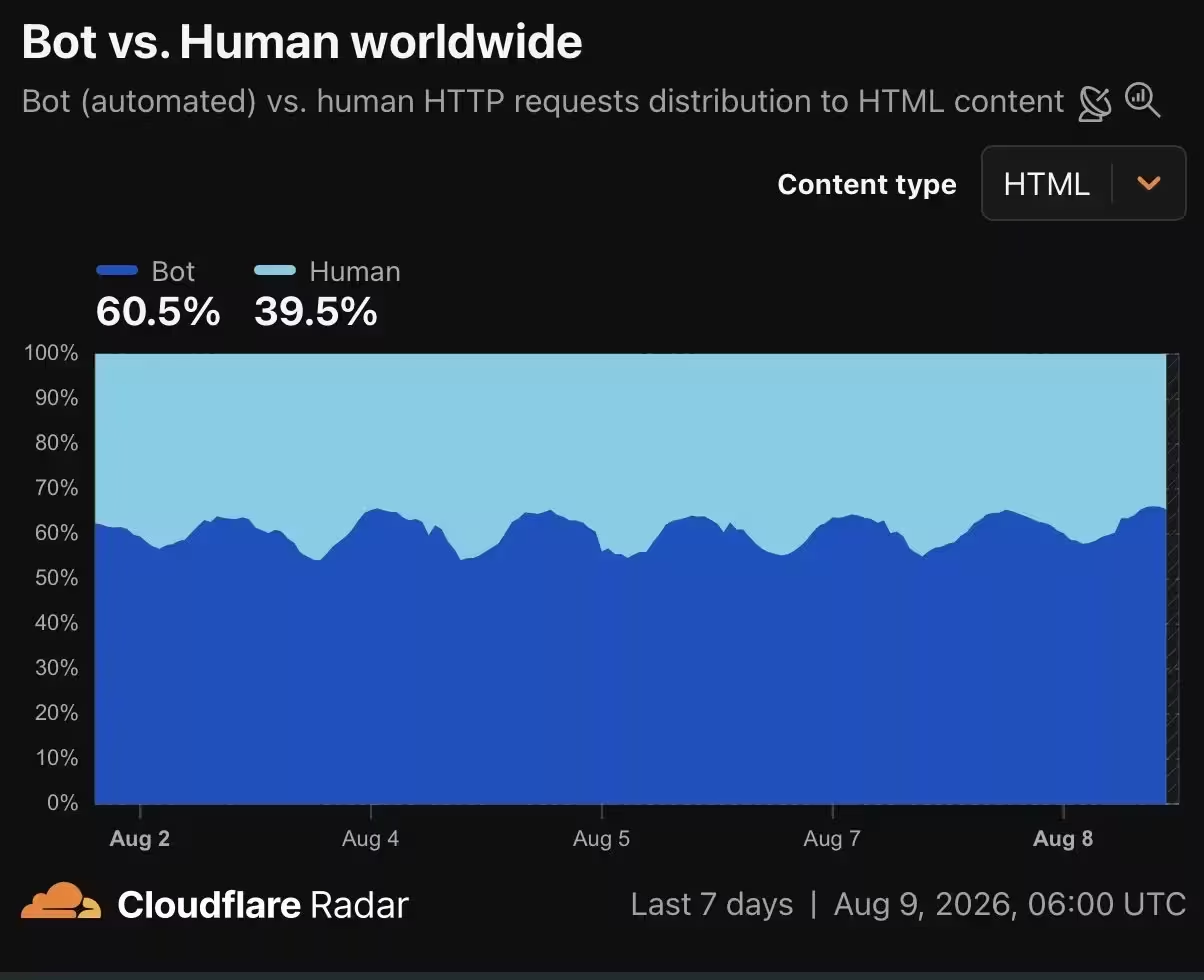
Now imagine millions of users leaning on those agents for price comparisons, research, ticket searches, data aggregation, or article summaries. Multiply the thousand-fold behavior across millions of interactions, and the math becomes terrifyingly simple: human traffic shrinks to a sliver of the total web chatter.
Seifert was careful to note that his past predictions haven't always landed perfectly. Still, the evidence piling up shows the network evolving faster than many expected. The consequences ripple outward—analytics skewed by automated queries, ad ecosystems warped by non-human impressions, infrastructure strained by massive request volumes, and a privacy landscape rewritten by machine intermediaries.
Web operators and platforms face a choice: treat this as a nuisance and hope patterns stabilize, or redesign systems for a machine-first internet. That could mean stricter rate controls, smarter bot verification, API-first architectures, and new billing models that account for agent-driven load. Short-term fixes won't be enough; we need durable strategies that accept automation as a central actor on the web stage.
The web is being rewritten by machines—are you ready?


Leave a Comment
Comments
No comments yet. Be the first.