

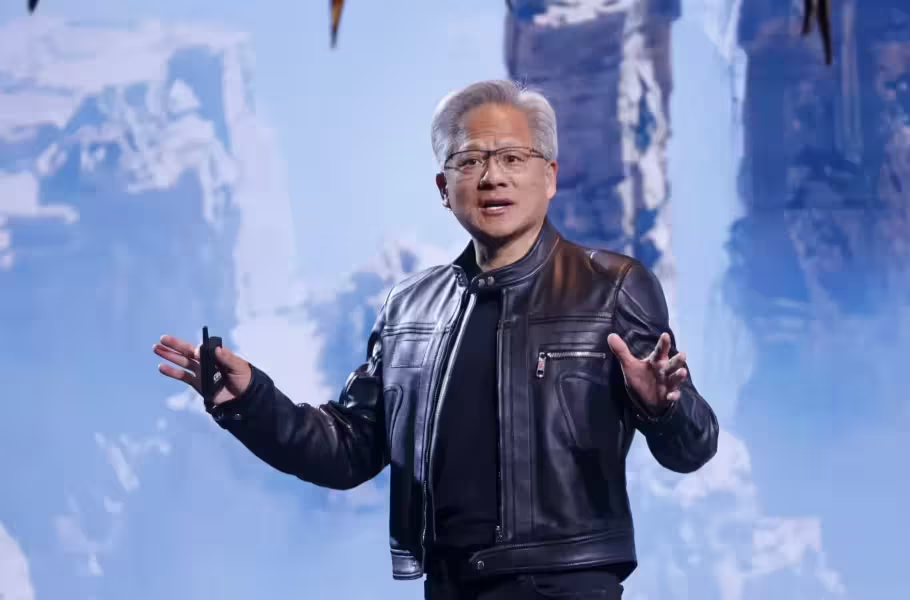
Nvidia chief executive Jensen Huang rejected recent warnings that artificial intelligence could lead to human extinction and said some AI company leaders may be frightening the public for other motives. In an interview he told CBS Sunday Morning he assigns a zero percent probability to an AI-driven end of the world by 2030.
Huang rejects existential risk claims
Huang said concerns about AI safety are broadly legitimate, but that warnings framing the technology as an extinction-level threat are not grounded in science. He acknowledged that AI can have "terrible uses" and must be developed "safely," but argued that portraying 2030 as the end of the world is inaccurate. "However you describe it, 2030 will not be the end of the world. The probability that it is the end of the world is zero percent," he said.
Recent industry debate and regulatory requests
Huang's remarks came amid renewed public debate about AI risks. Earlier this month a former Anthropic researcher said many employees at leading AI companies "really believe this technology could kill us all by the end of the decade." That comment helped prompt calls from industry figures for slower development and stronger safety measures.
- Dario Amodei, Anthropic chief executive, called for slowing research, national testing programs, and increased safety measures.
- Sam Altman, OpenAI chief executive, supported slowing research and the company urged governments to impose mandatory safety requirements.
- A former Anthropic researcher warned that many employees believe AI could pose an existential threat by the end of the decade.
Motives, enforcement of existing laws, and practical safety measures
Huang suggested some industry leaders may be exaggerating existential risk for political reasons or to attract attention. He also argued that recent calls for more regulation could reflect attempts to avoid consequences for breaching existing rules, especially in light of recent security incidents. "Do not let this apocalyptic narrative allow anyone to be exempted from the laws that already exist. They are not really asking for more laws. They want to be exempt from the laws we have," he said, and added, "First enforce the existing laws."
Huang recommended that AI safety evolve toward the practical, procedural approach used in commercial aviation. As technologies mature, he said, engineers typically shift focus from simply operationalizing systems to ensuring safe operation through verification, testing, assessment, and standardization. "Do the practical stuff first and then we can talk about the theoretical stuff. But do not talk about the theoretical stuff without doing the practical stuff," he said.


Leave a Comment
Comments
No comments yet. Be the first.