

BTC slides under $80,000 ahead of key macro events
Bitcoin (BTC) fell back beneath the $80,000 mark on Oct. 26 as a mix of leveraged long liquidations, spot Bitcoin ETF outflows and mounting macro uncertainty pressured prices. With the Federal Reserve policy meeting and a large Bitcoin options expiry looming this week, traders braced for renewed volatility.
At the time of reporting, crypto.news pricing data showed BTC trading near $79,947, down about 1.02% over 24 hours and touching an intraday low of $79,332. Market capitalization hovered around $1.61 trillion as trading volume reached roughly $17.55 billion over the previous 24 hours.
Why BTC dropped: accelerated long liquidations and ETF withdrawals
Liquidations amplified downside
The recent pullback forced significant forced selling as exchanges liquidated positions that failed to meet margin requirements. CoinGlass data recorded around $154.23 million in crypto liquidations over the last 24 hours, impacting more than 62,000 traders. Long positions bore the brunt of losses, with roughly $117.99 million liquidated versus $36.23 million in short liquidations.
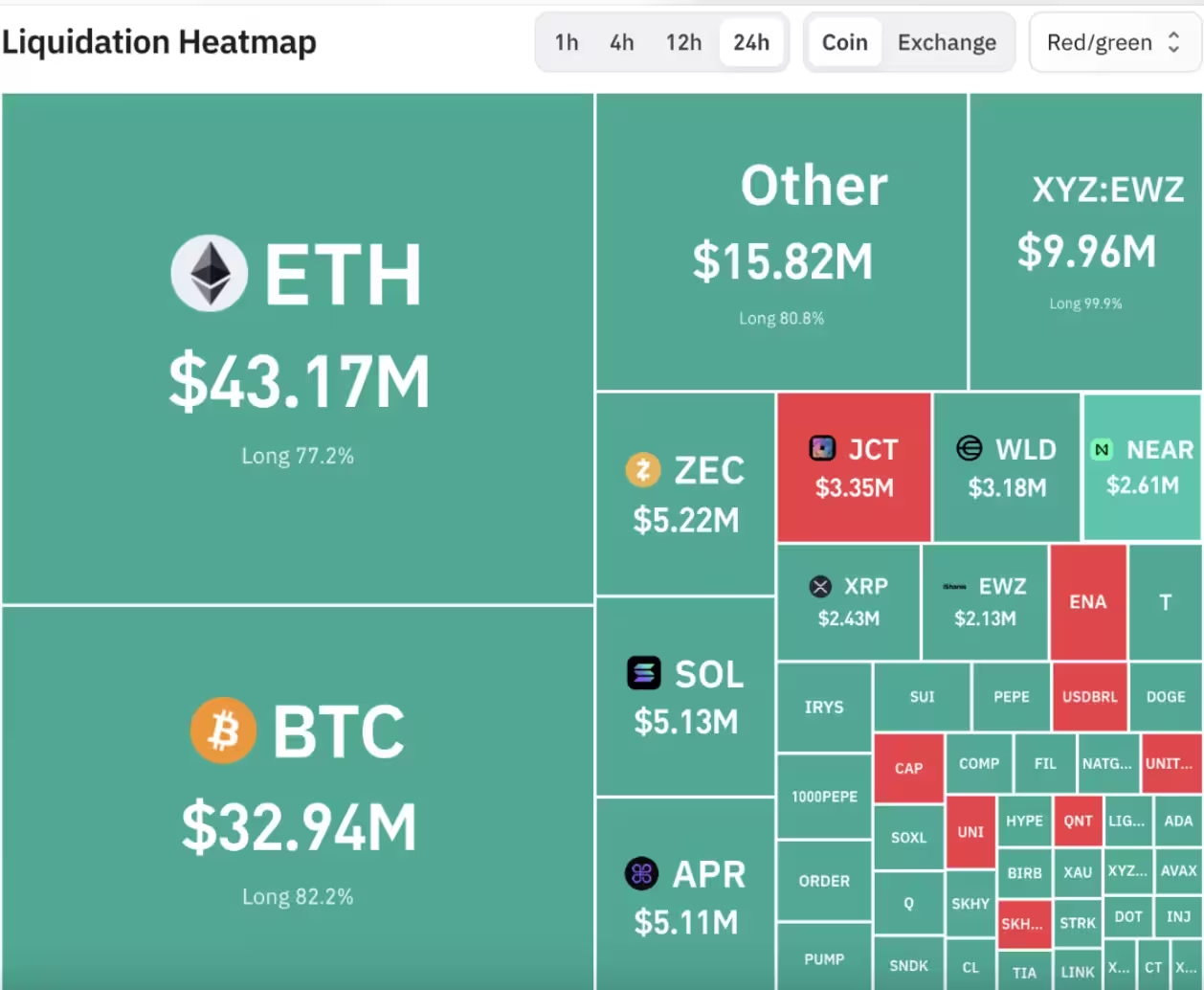
Ethereum posted the largest single-asset liquidation figure at $43.17 million, with Bitcoin next at about $32.94 million — a sign that bulls using leverage were hit hardest in the short-term unwind.
Market participants had warned that growing futures exposure while spot price stalled could set the stage for another liquidation wave. Bitcoin’s repeated failures to sustain moves above $83,000–$85,000 earlier in the month left many leveraged positions vulnerable to rapid downside pressure.
Spot ETF redemptions dent demand
Institutional flows also weakened sentiment. U.S. spot Bitcoin exchange-traded funds reversed a three-day inflow streak and recorded combined outflows of approximately $773.5 million over two trading sessions. Farside Investors’ numbers show $635.6 million of withdrawals on Oct. 22 and a further $137.9 million on Oct. 23.

BlackRock’s IBIT and Fidelity’s FBTC accounted for about $471.6 million of the Oct. 22 redemptions, forming nearly three-quarters of the single-day total. Even so, the five-day ETF balance stayed positive by roughly $301.2 million, and fund outflows do not necessarily translate into immediate spot market sales.
Macro calendar: Fed meeting, PCE and big options expiry
The macro schedule is central to the market’s near-term direction. Investors expect the Federal Reserve to hold the federal funds rate steady at 3.75%–4.00% during its Oct. 27–28 meeting, according to consensus estimates. CME FedWatch probabilities placed the chance of a rate hike this week near 9%, while the risk of another increase in December remained elevated.
Key dates this week include the September personal consumption expenditures (PCE) inflation report on Oct. 29 and an estimated $11 billion Bitcoin options expiry on Oct. 30 — both capable of producing large intraday moves.
Geopolitical headlines also briefly influenced risk sentiment. President Donald Trump’s Oct. 25 announcement that the United States would not attack Iran that day provided a short-lived relief rally for equities and energy markets, though Bitcoin largely remained pressured around the $80K area.
On-chain flows: retail inflows rise while whales pull back
On-chain analytics show a split between smaller retail traders and larger holders. CryptoQuant analyst Darkfost highlighted that retail-sized Bitcoin inflows to Binance hit a six-month high, with the 30-day cumulative value of retail deposits rising from about $5.5 billion to $10.75 billion. This suggests heightened activity among smaller accounts, possibly reflecting profit-taking after Bitcoin’s prior rebound.
Conversely, exchange deposits attributed to whales fell from approximately $5.9 billion in late August to near $3.8 billion — implying larger holders have been less inclined to send coins to exchanges for sale at current levels. Reduced whale inflows can signal reluctance to liquidate reserves, providing a potential counterbalance to retail selling pressure.
Technical picture: sellers in control for now
Bitcoin’s short-term technical indicators skew bearish. The Relative Strength Index (RSI) sat around 40.94, beneath its short-term moving average of 47.53 and below the neutral 50 threshold, pointing to weaker momentum. The MACD (Moving Average Convergence Divergence) painted a similar bearish image: the MACD line was about -434.42 against a signal line near -55.83, leaving a negative histogram reading around -378.59.

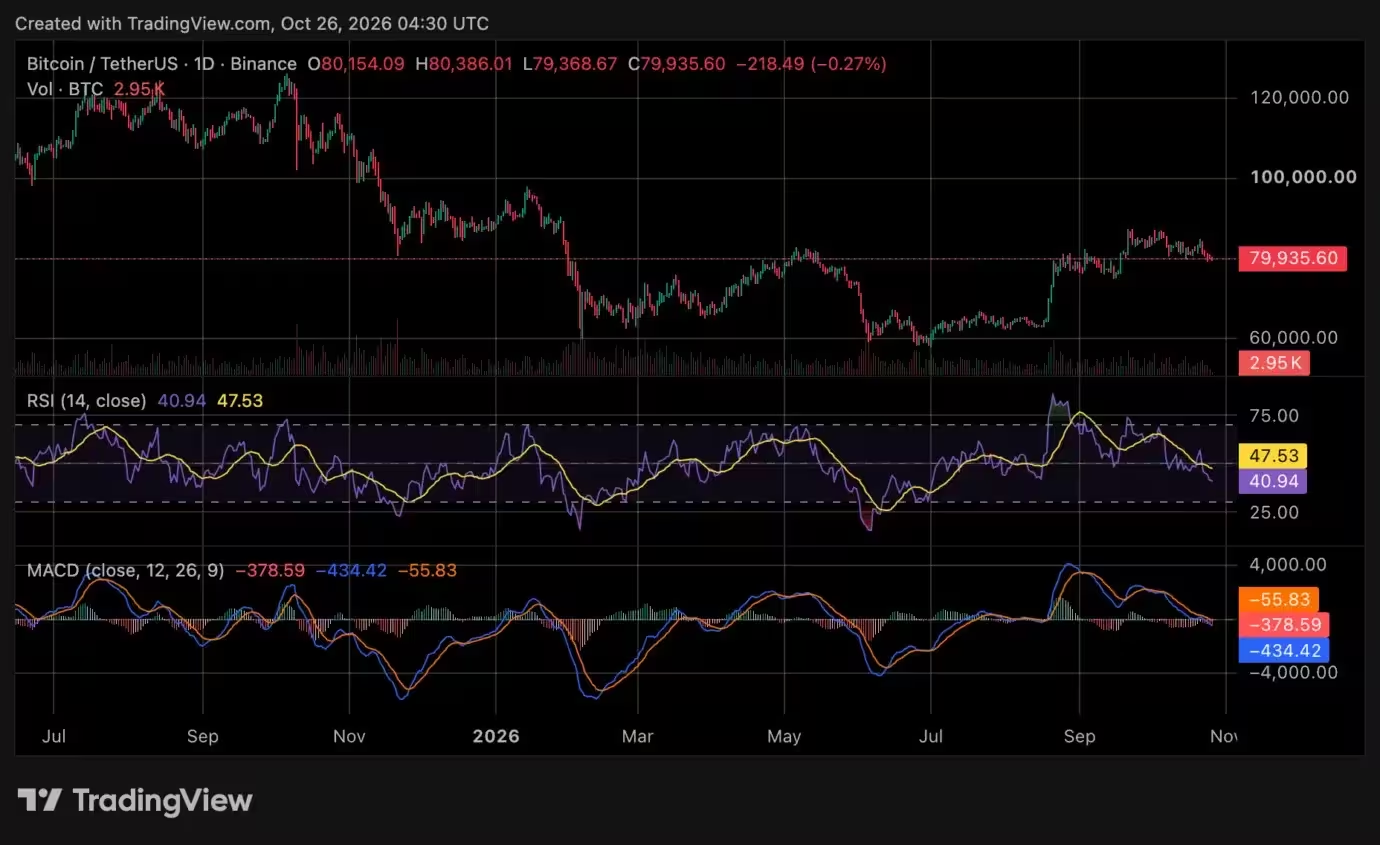
Bitcoin price chart
Immediate support exists in the $79,000–$80,000 zone. If BTC can’t hold that area and prints a daily close below $79,000, technical traders may turn their attention to $75,000 as the next meaningful support, with $70,000 as a further downside target if selling persists.
On the upside, reclaiming $82,000 would provide near-term relief and could help restore momentum, while meaningful resistance lies between $85,000 and $87,000 where prior price action attracts supply.
Longer-term outlook and analyst views
Some analysts maintain a longer-term bullish outlook despite the current pullback. Crypto Patel reiterated a high-level accumulation thesis that identifies $41,000–$56,000 as a potential major accumulation zone for longer-horizon buyers, arguing that the broad bullish structure remains intact. These strategic targets are probabilistic and should not be interpreted as a forecast for October trading ranges.
An earlier October assessment outlined conditional downside scenarios with a potential closing range between $76,000 and $80,000, though that analysis predated several of this week’s developments.
What traders should watch
- Federal Reserve outcome and Chair’s press conference (Oct. 28): Any hint of policy shift, revised forward guidance, or hawkish language could prompt sharp moves across risk assets, including Bitcoin.
- September PCE inflation print (Oct. 29): A hotter-than-expected reading would amplify interest-rate sensitivity and likely pressure crypto markets.
- Oct. 30 options expiry: Large expiries can increase skew and gamma squeezes that intensify intraday volatility.
- ETF flow dynamics: Continued redemptions or renewed inflows into U.S. spot Bitcoin ETFs will affect institutional demand expectations.
- On-chain exchange flows: A sustained rise in retail deposits coupled with declining whale outflows could indicate distribution at current prices.
Bottom line: cautious near-term outlook, but longer-term structure intact
Near term, Bitcoin faces downward pressure as liquidations and ETF withdrawals amplify market fragility ahead of major macro events. Support in the low $79K area is critical; a decisive daily close below that level could open the door to $75K or lower. Conversely, recovering above $82K would be a constructive step and could attract momentum traders back into the market.
For investors and traders, the coming week’s Fed decision, PCE data and the large options expiry are likely to be the dominant drivers of BTC price action. Risk management, position sizing and clear stop rules remain essential while macro uncertainty and derivatives-related flows continue to influence the crypto market.

Author note
This article synthesizes exchange, on-chain and macro data to provide an actionable near-term market view. It is intended for informational purposes and not investment advice.

Leave a Comment
Comments
No comments yet. Be the first.