
3 Minutes
A stray Geekbench entry can do a lot more than raise eyebrows; it can rewrite rumors for an afternoon. That’s exactly what happened when a test linked to a device named 'Google Kodiak' surfaced, hinting at early hardware that could belong to the rumored Pixel 11 family — and, crucially, an unannounced Tensor G6 chip.
The record is odd in a way that attracts attention. Instead of the familiar octa-core layout we saw in the Pixel 10 Pro XL, this entry lists a seven-core configuration. Not a typo. Not a rounding error. A single Arm C1-Ultra core running at 4.11GHz. Four Arm C1-Pro cores at 3.38GHz. Two more C1-Pro cores at 2.65GHz. Clock speeds that outpace the Tensor G5 numbers we’ve seen so far.
Why does that matter? Because core architecture and clock speeds shape how a phone performs under real-world loads — app responsiveness, multitasking, battery behavior. And yet the benchmark paints a conflicting picture. The alleged device posted a single-core score of 845 and a multi-core result of 2657. Those figures sit far below what we expect from a modern flagship, especially one boasting an ultra-fast prime core.
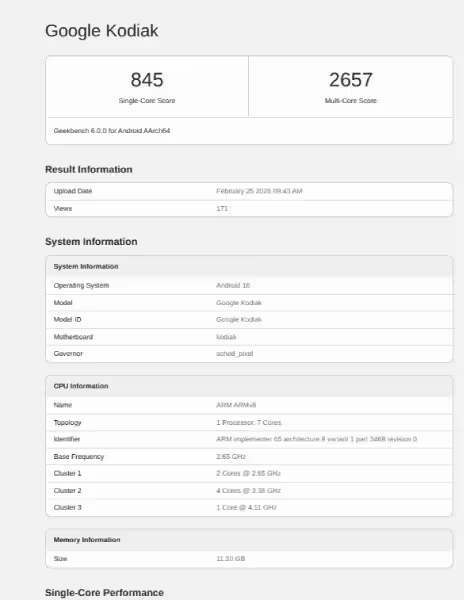
There’s more to the hardware notes than CPUs. The listing also names a PowerVR C-Series CXTP-48-1536 GPU, a change from the PowerVR DXT-48-1536 used in the Pixel 10 Pro XL. That suggests Google may be testing a fresh graphics pipeline, or simply experimenting with silicon pairings during early validation.
Compare this to the Pixel 10 Pro XL: an octa-core SoC with a Cortex-X4 prime at 3.78GHz, five Cortex-A725s at 3.05GHz, and two Cortex-A520s at 2.25GHz. Different designs. Different performance footprints. Different priorities. The 7-core layout implies Google is trying a new configuration — perhaps squeezing performance per watt in a different way.
Before you start penciling this into the timeline, take a breath. Benchmark databases are messy places. Prototypes, mislabeled phones, and even phony entries find their way into public records. Software maturity matters as much as silicon. A chip tested with placeholder drivers or incomplete firmware can underperform dramatically. Treat these numbers as early whispers, not evidence of finished performance.
It’s also worth noting cadence: the Pixel 11 lineup isn’t expected until mid-2026, and Google has not announced a Tensor G6. That leaves room for speculation — and for misdirection. Engineers often spin up multiple internal builds with different core counts and GPUs to chase power, thermal, and cost targets. A single Geekbench row might represent one of those detours, not the final product.
So what should you take away? If the listing is genuine, it shows Google actively iterating on its mobile SoC approach, testing higher clocks and alternate GPU silicon. If it’s a red herring, it’s a reminder to treat early leaks as signals, not blueprints. Either way, the Pixel 11 era is shaping up to be an experiment in trade-offs — and that will make watching the rollout more interesting than usual.


Leave a Comment
Comments
No comments yet. Be the first.