
3 Minutes
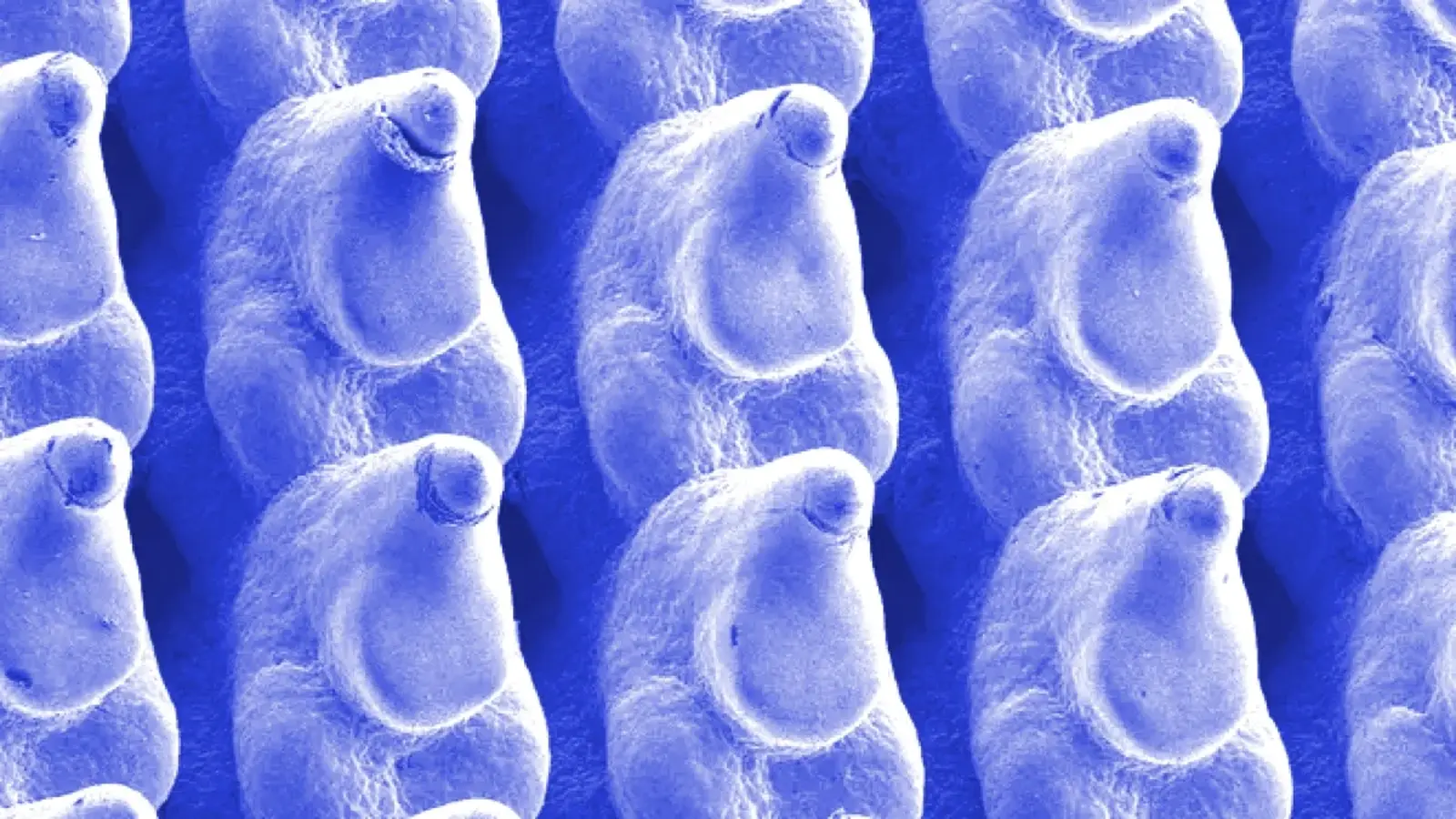
Imagine a miniature forest of copper spines reaching toward a humming chip, each tip carved to siphon away heat. Strange, right? But that image is now the blueprint for a cooling breakthrough that could reshape how data centers eat electricity.
Data centers are swelling with demand. Server energy use in the United States more than tripled between 2014 and 2023 and is forecast to possibly double or triple again by 2028, potentially claiming as much as 12 percent of the nation’s grid load. And it’s not only computation that devours power: cooling and auxiliary systems often account for nearly half of a facility’s energy bill. The arithmetic is stark—better chip cooling isn't just an engineering nicety; it’s a climate and cost imperative.
Enter a new kind of direct-to-chip cold plate from researchers at the University of Illinois at Urbana-Champaign, built in partnership with San Diego manufacturer Fabric8Labs. At first glance it looks odd: instead of smooth, blocky fins, the team produced jagged, razor-like projections in pure copper. The design came from an algorithmic sculptor called topology optimization. Start with a rectangle, let math bend and prune it over many simulated iterations, and you get shapes that human intuition rarely imagines.

Why jagged? Because heat transfer is geometry-dependent. Pointy tips and irregular edges increase the surface area touching the liquid coolant and create flow paths that move heat away more efficiently. And because the engineers treated pumping power as part of the optimization, the result balances two competing needs: move heat fast, while not forcing pumps to work harder. As UIUC’s Nenad Miljkovic put it, the method converges on designs that maximize thermal performance while minimizing pumping power.
Shapes like these, however, pose a new hurdle: how do you make them? Copper conducts heat beautifully but is notoriously tricky in common additive manufacturing methods. The team's solution was electrochemical additive manufacturing, or ECAM. Instead of melting metal, ECAM deposits copper layer by layer through electroplating, producing feature detail down to 30–50 micrometers—finer than a human hair. That precision lets the jagged geometry become a real, usable part rather than a stylized CAD trophy.
The payoff is tangible. Compared with conventional cold plates using simple rectangular fins, the pure-copper, topology-optimized plates delivered up to 32 percent better cooling for the same flow, and cut pressure drop by as much as 68 percent while maintaining thermal performance. Scale those gains across a high-density, next-generation data center and cooling could shrink to roughly 1.1 percent of total energy use, versus roughly 30 percent for some present-day air-cooling arrangements. Those are numbers large enough to change how operators plan capacity and sustainability targets.

There are broader implications, too. Direct-to-chip liquid cooling already appeals to high-performance computing and AI clusters where heat densities spike. But the workflow—topology optimization married to ECAM—can be adapted to diverse cooling challenges across scales, from microelectronics to larger heat exchangers. In other words, this is less a one-off product and more a method for rethinking how we sculpt metal to control heat.
Practical hurdles remain: ECAM is an emerging technique and will need industrial scaling, cost analysis, and long-term reliability testing before it replaces incumbent solutions. Still, the combination of mathematical design and precision electrochemical fabrication makes for a compelling path forward. When chips scream under load, it's not always more silicon that fixes the problem; sometimes it’s sharper engineering.
If data centers adopt these jagged copper plates at scale, how quickly could we redraw the energy map of cloud computing? The tools are in hand — now it's a matter of whether industry will take the plunge.


Leave a Comment
Comments
No comments yet. Be the first.