

A Chinese competitor to Starlink has quietly put a phone call through a satellite — using an ordinary smartphone, no hardware mods required. The experiment wasn’t a gimmick. Reported voice quality reportedly matched terrestrial 5G.
Spacesail says it completed the country’s first Direct-to-cell calls using commercial handsets, routing the audio through its test satellite DTC 01, which launched earlier this month. That matters because most of the company’s earlier launches — more than 200 satellites since 2021 — were built for broadband backhaul, not direct handset connectivity.
Huawei and Xiaomi unveiled satellite calling for some phones in 2024, yes. But those implementations lean on Tiantong-1, a geostationary system managed by China Telecom some 36,000 kilometers up. Spacesail is taking a different tack: a low-Earth-orbit constellation much closer to the ground. Shorter distance. Stronger signals. The result: the possibility of standard 5G phones making satellite calls without retrofitting their hardware. Simple difference. Big consequence.
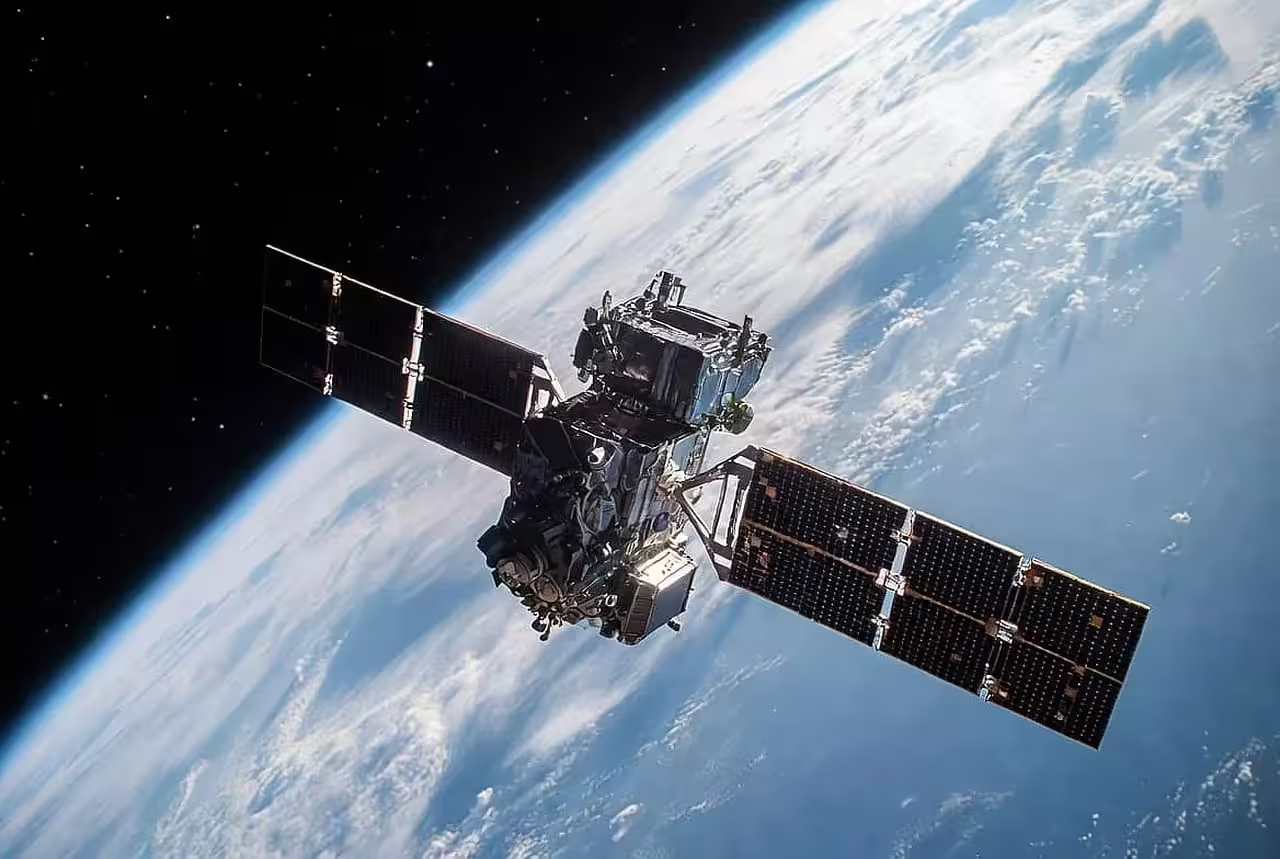
What’s next for Spacesail? The company has laid out an aggressive build plan and an even bolder horizon.
- End of 2026: deploy 324 satellites to establish initial service capacity
- End of 2027: grow the fleet to 648 satellites and complete phase one
- Long-term target: exceed 15,000 satellites for full integration with future 6G networks
Deployment intensified after the constellation entered its official rollout phase in August 2024. Launch cadence picked up markedly; in May 2026, Spacesail completed three launches in 11 days and reported 162 active satellites in orbit by May 17.
How does this stack up against Starlink? By March 2026, SpaceX had about 9,600 satellites in orbit — roughly three-quarters of the world’s active fleet — and plans that scale to 42,000. Starlink’s broadband user base reached 10.3 million subscribers across 164 countries in Q1 2026. Its Direct-to-cell rollout is live in 30 countries with about 7.4 million active monthly devices. But expansion has a price: average revenue per user fell to $66 in Q1 2026 as the company pushed into lower-income markets.
Spacesail’s DTC trial shows LEO networks can deliver phone-grade voice to unmodified devices, and that shifts the strategic calculus for satellite connectivity.
Expect a scramble. Operators will weigh technical trade-offs like latency, link budget and regulatory approvals. Consumers will watch for coverage maps and compatible handsets. Nations will watch for control, standards and spectrum allocation. Will mass-market satellite calling become a new normal — or another battleground for infrastructure and influence? The next few launch manifests should tell the story.

Leave a Comment
Comments
No comments yet. Be the first.