
3 Minutes
Not since Woody first left Andy's room has a Toy Story release felt this unstoppable. Audiences turned out in numbers that, for a summer of flops and stumbles, looked almost defiant.
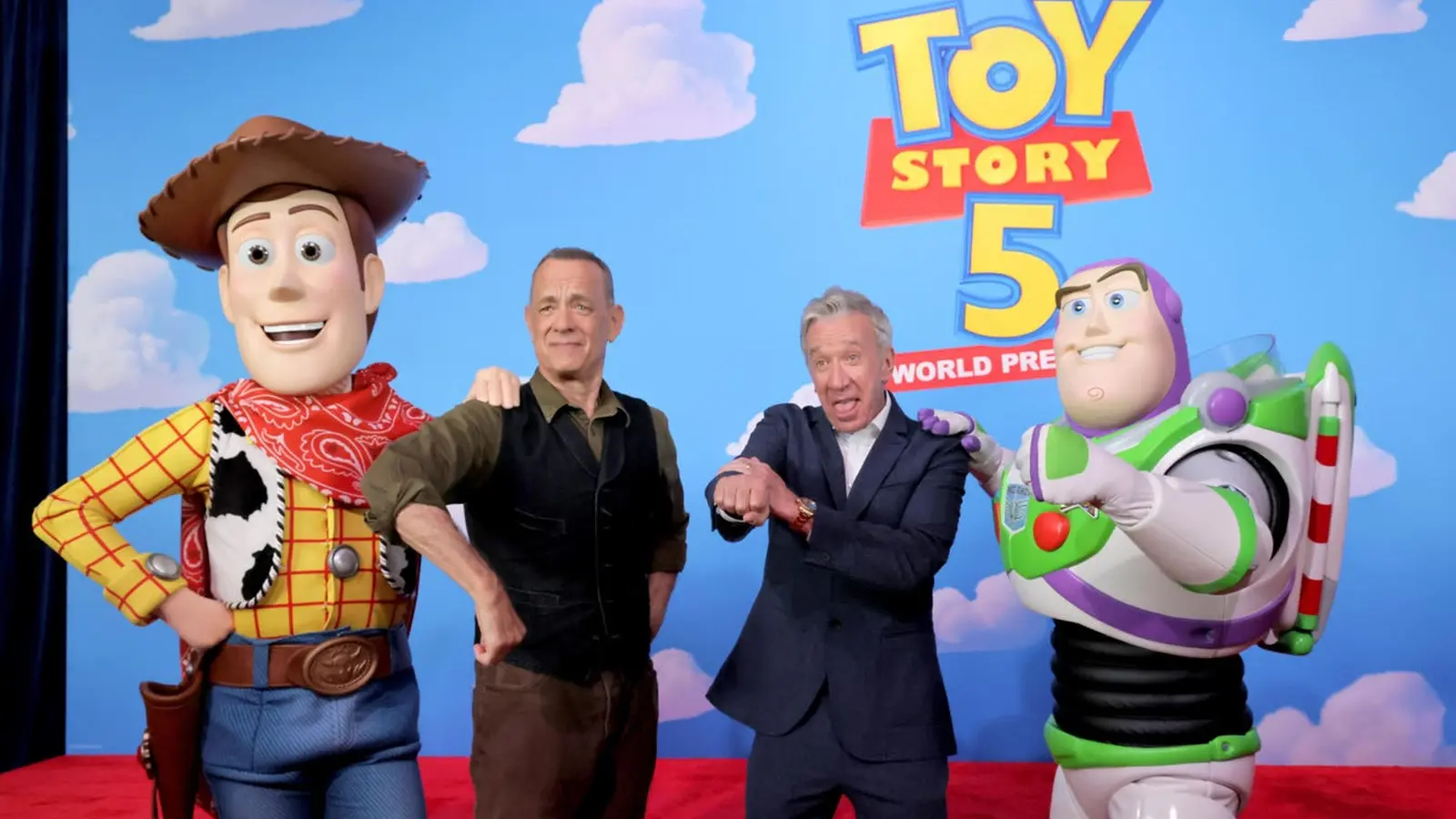
Toy Story 5 opened on June 19 and smashed expectations from day one: $159.7 million in its first three days in North America, the biggest franchise launch yet and the top opening of 2026 so far. Small surprise, then, that studios and analysts are recalibrating their forecasts.
By the start of Sunday in its fifth week, industry trackers expected Toy Story 5 to sit near $958 million worldwide—about $430 million domestic and $528 million overseas. That puts it among the year’s elite performers, behind only the two billion-dollar 2026 titles, The Super Mario Galaxy Movie and Michael; it’s the third 2026 release to clear the $950 million mark.
If it holds, Toy Story 5 could finish around $1.1 billion worldwide—the biggest in franchise history.
To put the climb in perspective: the Toy Story franchise totals read like a study in growing returns—Toy Story (1995) $373.5M, Toy Story 2 (1999) $497.4M, Toy Story 3 (2010) $1.067B, Toy Story 4 (2019) $1.074B, Lightyear (2022) $226.4M—and Toy Story 5, at roughly $958M so far, is closing fast on that billion-dollar club.

Crossing the billion mark would push Toy Story 5 into a rarefied group of films and cement its place as one of Pixar’s highest earners. Only Incredibles 2 ($1.243B) and Inside Out 2 ($1.699B) currently sit ahead among Pixar’s top-grossers, but this sequel is threatening to rewrite the studio’s standings.
Pixar’s recent slate has been a mixed bag. Non-sequels have swung wildly—from Elemental’s $496.4M to Elio’s $153.8M and Hoppers’ $389.4M—yet the studio’s sequels continue to be its financial backbone. The last Pixar sequel that failed to outgross its franchise’s best was Cars 3, back in 2017.
Critics, meanwhile, gave Toy Story 5 a warm embrace but not unanimous adoration. At 92 percent Certified Fresh, it’s still a critical success, though it falls short of the near-perfect scores racked up by earlier entries—Toy Story 4 at 97, Toy Story 3 at 98, and the original pair sitting at 100 each. Lightyear remains the outlier with a 74 percent score.
On the business side, the film’s reported production budget is about $250 million, with a conservative break-even estimate near $625 million. It passed that threshold long ago, meaning studios are no longer watching for survival but for dominance. Given the momentum, Pixar is likely weighing greenlighting another mainline chapter; whether a sixth installment can match or exceed this run is anyone’s guess, but the odds favor profit.
Box office numbers tell one story. Audience affection tells another. And right now, both are heading in the same direction—toward an era where toys still rule the summer screen.


Leave a Comment
Comments
No comments yet. Be the first.