
4 Minutes
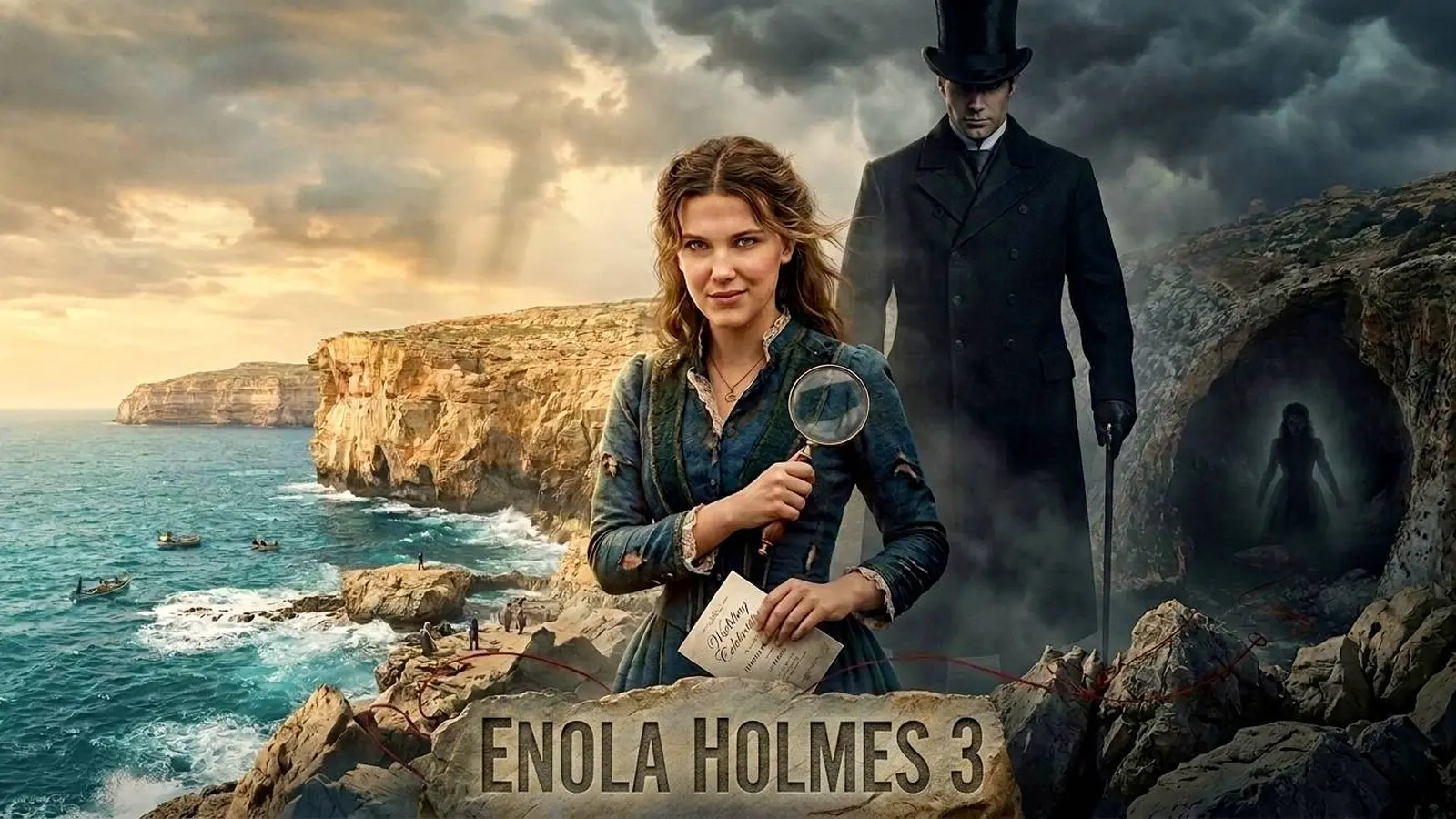
A seaside wedding should feel like a sweet interlude. In Enola Holmes 3 it feels like someone brought a beach ball to a crime scene.
The setup sounds promising enough: Enola, fresh off forging her own life, is preparing to marry Lord Tewksbury on sun-bleached Malta, the island where his parents once wed. Guests arrive. Choirs rehearse. Then, as if on cue, order collapses. Sherlock disappears. The future mother-in-law goes missing. Bodies turn up. Enola, now both bride and investigator, takes the case—except the case often feels like a string of accidental discoveries rather than a true exercise in deduction.

What once defined the franchise—Enola’s razor-sharp reasoning and millennial spark—has been muted. Millie Bobby Brown still pours energy and charisma into every frame, but the script seldom gives her the chance to think her way out of trouble. Instead she’s hurled from chase to skirmish to chase again. Coincidence becomes solution. Coincidence becomes plot device. And a detective story that should hinge on intellect falls back on kinetic momentum to disguise holes in logic.
Is pace a valid tactic to mask plot shortcuts? Sure. For a while it distracts. But momentum can’t substitute for motivation. The more you watch, the clearer the gaps become—convenient arrivals; revelations that land by happenstance; the sense that characters are along for the ride rather than steering it.

Henry Cavill’s Sherlock—once a warming foil in earlier entries—has been flattened into a sullen set piece. Cavill gives the performance he’s asked for: brooding, spare, infrequently useful. The blame sits elsewhere. The screenplay relegates Sherlock to the background, transforming him into a familiar logo on the poster rather than a partner in detection. That missed opportunity deflates what could have been some smart sibling interplay.

And then there’s the villain. The franchise needs a threat that’s as clever as the detectives it opposes. Instead we get a caricature of menace. Moriarty—if you can call this incarnation that—lacks the cerebral menace required to challenge Holmesian minds. The ultimate confrontations trade the intellectual sparring fans crave for clumsy brawls and awkwardly staged action. If you like over-animated fistfights and melodramatic pounding, you might be entertained. If you want the chess match, come back later.


The film’s tendency to break the fourth wall used to feel like a wink. Now it’s a nudge repeated until the charm wears thin. Enola chats to the audience often; sometimes the asides are funny, sometimes useful. Here they’re mostly redundant, delivering information the plot would have shown anyway. Deadpan banter becomes filler. The meta asides stop adding intimacy and start simply filling space.

There are, to be fair, elements that work. The move from foggy London to bright Maltese coast is visually refreshing. Cinematography captures cliffs, blue bays, and honey-hued stone in ways that briefly stop the clock. Malta is almost a character: postcard-perfect, warm, and cinematic. Watch the film for the vistas and you’ll be rewarded.

Millie Bobby Brown remains the film’s anchor. She throws herself into Enola with grit and charm, trying to breathe life into a script that too often forgets the character’s intelligence. Her performance is the chief reason the movie avoids total collapse. Yet even she can’t manufacture the internal growth Enola is supposed to have—there’s a promise of maturity and consequence, but no real emotional change. Enola looks older; she behaves much the same as before. That stasis undermines the film’s stated aim of growing up with its audience.
The filmmakers also attempt to layer in weightier themes: colonial legacies in Malta, questions of citizenship and inequality, and the awkward footprints of empire. Noble in intent. Thin in execution. These threads flicker across the surface without penetrating the story’s messy logic. At times it feels like a political pamphlet pasted onto a romping mystery-comedy wrapper. Some critics welcomed the political gestures; others flagged the mismatch between ambition and craft. Either way, the tone never quite balances.

As a whole, the film scores a 4 out of 10.
That number isn’t just a metric. It’s the gap between a franchise that once felt sly and clever and a sequel that mistakes speed for wit. Fans of Millie Bobby Brown keen to see her in Victorian frocks and throwing punches may still find pleasant moments. Casual viewers hoping for a crafty whodunit, or anyone after a satisfying emotional arc, will likely leave wanting.
If there’s a lesson here for future installments, it’s simple: don’t trade the detective’s brain for a holiday brochure. Keep the charm. Keep the cleverness. And please—let Enola think again.

Leave a Comment
Comments (2)
wow didnt expect that… Millie still carries it, but trading clever sleuthing for nonstop chases? bad move. wish Enola actually grew, not just punched her way thru it
is this even true? sounds like they let action cover lazy writing, Sherlock benched and coincidence after coincidence. Malta looks stunning tho, but that cant hide a sloppy mystery.