
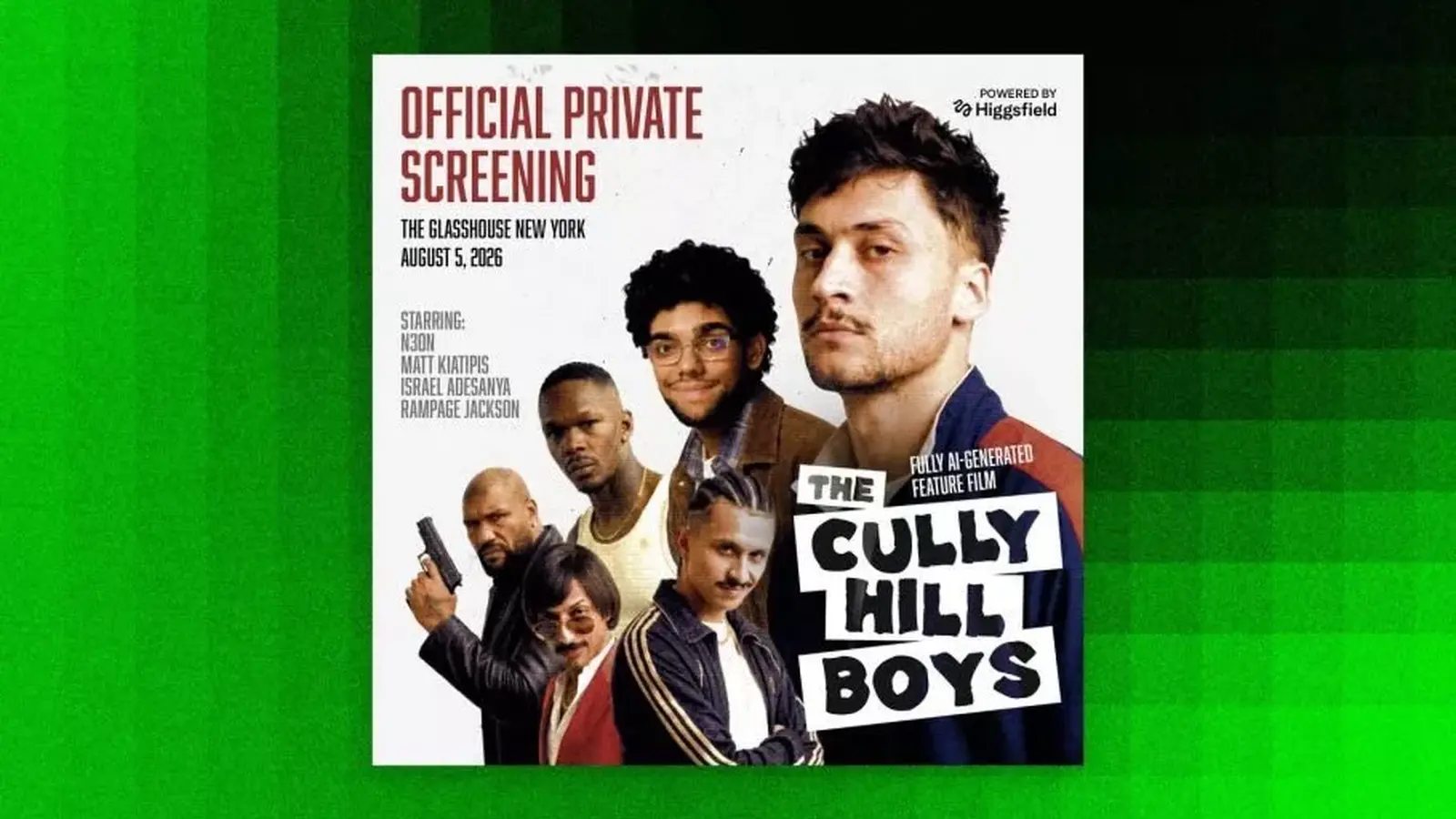
They rolled the screen up in New York, the credits faded, and people blinked. A full-length movie produced with generative AI—every frame, many characters, countless backgrounds—had just been shown to a room of media insiders and creators. The film is called The Cully Hill Boys. It runs 110 minutes. It was made in four weeks on a $2 million budget.
The idea sounded like a provocation. But what Higgsfield AI presented was less a stunt and more a working prototype for how films might be made tomorrow. A 28-person crew, led by nine directors and fronted by Aitore Zholdaskali, stitched together roughly a thousand AI-generated visual elements and about 100 digitally created locations. Forty percent of that crew had never used generative AI before the project began. They learned fast. The results surprised many.
Genre? Comedy-action. Setting? East London. Plot? A rap trio—Cal, Horace and Ollie—stumble upon millions of pounds tucked in an abandoned boat, and promptly find themselves squeezed between rival organized crime syndicates. The tone is kinetic, the stakes are comic, and the pacing leans on bold visual choices that the AI tooling made cheap and repeatable.

Familiar faces arrive on screen—except these are recreated, digitized likenesses. MMA star Israel Adesanya, former UFC champion Quinton Jackson, streamer N3on and streetball personality Mat Kiatipis appear as AI-crafted versions of themselves. That decision is as much business as it is creative: Higgsfield says the company has put in place formal licensing agreements for celebrity likenesses, a move meant to cut down on the flood of unauthorized deepfakes that have circulated online without compensating the talent.
Reactions at the private screening leaned optimistic. Eric Ford, a marketing and media executive who attended, admitted he entered skeptical but left convinced the experiment was more than hype. Did the performances feel exactly like flesh-and-blood acting? Not always. Did the film point to practical, scalable ways to lower production costs and build new revenue streams for recognizable figures? Clearly.

There are ethical, legal and aesthetic questions. Who owns an AI-crafted performance? How will audiences react when a familiar face can be licensed, modified and placed in stories without the traditional overhead of sets or travel? Higgsfield’s proposal—establishing licensed access to celebrity images for generative systems—attempts to answer one of those questions up front. It’s a framework that could either protect talent or, critics warn, normalize commodifying likenesses in ways audiences aren’t ready for.
Whether The Cully Hill Boys is the start of a revolution or merely an ambitious experiment, it is evidence that generative tools are moving from proof-of-concept to production-ready. Filmmakers, studios and platforms will be watching. And audiences? They’ll decide, frame by frame.
So what do you think: a brave new cinematic toolkit, or a fork in the road for storytelling?

Leave a Comment
Comments
No comments yet. Be the first.