
Nvidia beats expectations, sending tech and crypto higher
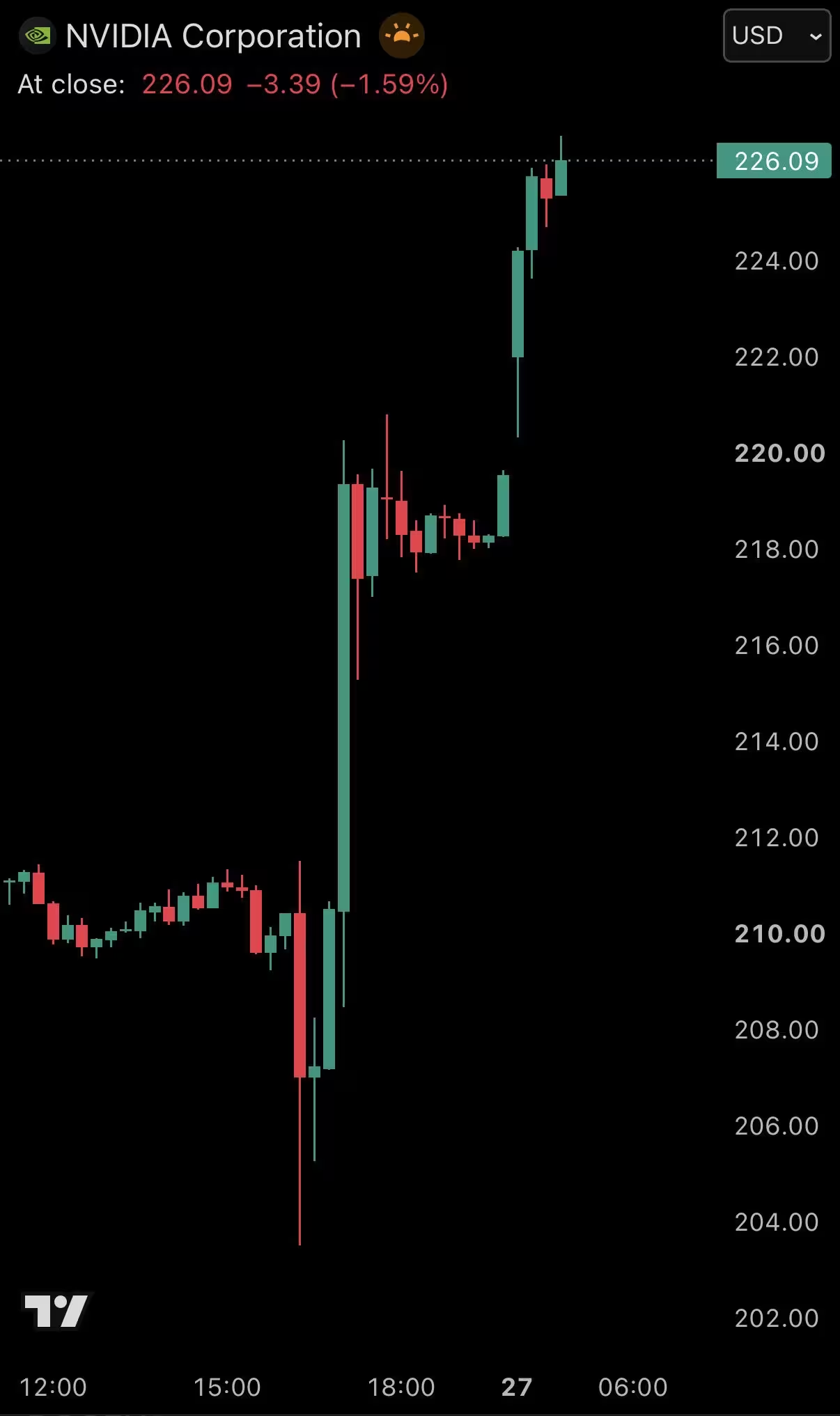
Nvidia shares jumped sharply in premarket trading on Aug. 27 after the chipmaker posted fiscal second-quarter results that outpaced Wall Street forecasts and offered an aggressive outlook for the next quarter. The stock climbed roughly 6.7% to about $223.71 in early trading and briefly spiked near 8% before the market opened, as investors digested revenue that reflected outsized demand for AI chips and data-center GPUs.
The earnings release also coincided with a meaningful lift in digital-asset markets: Bitcoin rallied roughly 2.4%, testing the $80,000 mark and trading near $80,400. Nasdaq 100 futures advanced alongside semiconductor and AI infrastructure names, underscoring how growth technology and risk assets often move in tandem when marquee AI results surprise to the upside.
Key financials that mattered
Nvidia reported revenue of $96.22 billion for the quarter ended July 26 — a 106% increase year-over-year and an 18% rise from the prior quarter — comfortably ahead of the Visible Alpha consensus of $92.2 billion. Non-GAAP diluted earnings came in at $2.22 per share versus expectations around $2.09, while GAAP net income totaled $59.69 billion with GAAP diluted EPS of $2.46.
The Data Center division once again dominated results, generating approximately $89 billion in revenue — up 117% year-over-year and representing more than 92% of the company’s total sales. Nvidia also returned about $26 billion to shareholders through buybacks and dividends during the quarter and still retains roughly $99 billion under its repurchase authorization.
Why Bitcoin and crypto stocks moved
Bitcoin rose from an intraday low near $77,658 to around $80,380 on the report, a roughly 2.4% 24-hour gain that pushed it back toward the psychologically important $80,000 level. While Nvidia’s earnings don’t exclusively drive crypto prices, the company’s performance amplified demand for growth assets and for firms that bridge the gap between AI compute and crypto mining.
Several publicly traded bitcoin-mining and infrastructure companies advanced in early trading: IREN climbed about 5%, while TeraWulf and Cipher Mining gained roughly 3% each. These moves reflect investor interest in miners and data-center operators that are redeploying power capacity and colocation resources to high-performance computing workloads — including AI — in addition to Bitcoin mining.
Industry data for the first half of 2026 shows that nine public miners invested approximately $5.11 billion in capital assets while reporting roughly $341.2 million in AI and computing revenue, signaling a material shift in how mining operators monetize their infrastructure.
Strategic partnerships and capacity shifts

Some mining and infrastructure companies are expanding direct relationships with Nvidia, securing access to GPUs and AI systems that can be used for inference and high-performance compute when not dedicated to proof-of-work mining. IREN, for example, has expanded a multi-year arrangement with Nvidia that was previously reported as a $3.4 billion agreement focused on AI infrastructure.
These partnerships make miners and data-center operators hybrid players: able to run Bitcoin hashing operations while offering AI compute on the same footprint, increasing utilization and revenue diversification.
Nvidia’s guidance and margin outlook
Nvidia forecast fiscal third-quarter revenue of $108 billion, plus or minus 2%, which surpassed analysts’ near-term estimates of about $104 billion. Notably, that outlook excludes Data Center compute sales to China — reflecting export controls and geopolitical constraints that still limit addressable markets.
Management also provided an unusually early look into fiscal 2028 expectations. Nvidia CFO Colette Kress said customer buildout plans could allow revenue growth to accelerate next year, but the company conservatively modeled roughly 70% growth for fiscal 2028 given persistent supply constraints.
CEO Jensen Huang highlighted that certain AI agent workloads can demand 15 to 100 times more compute than traditional prompt-based interactions, which helps explain why customers are aggressively expanding GPU capacity. Nvidia expects third-quarter gross margins around 74% (±50 basis points) with margins potentially bottoming near 71%–72% in the fourth quarter due to elevated memory costs. Management projects margins settling between 72%–73% in fiscal 2028 assuming planned price increases and improving supply dynamics.
Acquisition headlines and market scrutiny
Media reports suggested Nvidia had agreed to acquire open-source AI platform Hugging Face for $12.9 billion. At the time of the earnings release, neither company had issued an official confirmation or filed regulatory notices, so the deal — if true — remains unannounced and subject to typical completion and approval risks.
Investors will be watching whether such strategic moves accelerate Nvidia’s position across the AI stack and whether regulatory hurdles could complicate cross-border data-center expansion.
What crypto and blockchain investors should watch next
- Market reaction in regular-session trading and whether the early premarket gains hold into the close. Analyst revisions and updated models will likely influence both Nvidia shares and correlated tech names.
- Execution against the aggressive $108 billion third-quarter target. Given ongoing supply constraints for advanced GPUs, the company’s ability to meet demand will be pivotal for chip suppliers, cloud providers and crypto miners that depend on Nvidia silicon.
- Memory price trends and margin trajectory. Higher memory costs could pressure GPU margins and downstream pricing for AI infrastructure, affecting profitability for data-center operators and GPU-dependent crypto services.
- Adoption of hybrid AI/mining strategies at large-scale miners and colocation providers. As more firms monetize idling capacity with AI workloads, expect evolving revenue models that blend proof-of-work mining, AI inference, and HPC services.
Nvidia’s blowout quarter reaffirms the accelerating overlap between AI compute demand and crypto-related infrastructure. For cryptocurrency investors, the key takeaway is that stronger GPU-driven AI demand can buoy Bitcoin and mining-related equities — but supply constraints, geopolitics, memory costs, and regulatory developments will remain crucial variables to monitor.


Leave a Comment
Comments
No comments yet. Be the first.