

Ethereum slips toward $2,000 after large whale exits at a loss
Ethereum (ETH) traded closer to the $2,000 mark as on-chain data showed a sizable investor selling thousands of tokens at an estimated loss. Blockchain analytics firm Lookonchain identified wallet 0x69A8 as the seller of 6,532 ETH, a disposition worth roughly $13.62 million at an average execution price near $2,085. The sale followed a purchase of 5,105 ETH about a month earlier when ETH was trading near $2,691 — a trade that Lookonchain estimates generated an unrealized loss near $3.1 million before the recent disposal.
Across spot markets, ETH changed hands near $2,050 during the latest session, with 24-hour volume around $8.9 billion. The sell-off by large holders, combined with persistent outflows from U.S. spot Ethereum ETFs, added pressure to price action and contributed to weaker momentum indicators on daily charts.

Whale selling: transaction details and broader on-chain context
Wallet activity and trade history
The identified wallet’s more recent sale exceeded the amount the same address had acquired in its prior purchase, implying that the investor tapped holdings beyond that single trade. Crypto analyst reports show a broader trend of whale wallets trimming positions over the past week: roughly 17,800 ETH left whale addresses, a figure equivalent to nearly $40 million at current prices. These disposals signal distribution among larger holders, which can weigh on short-term sentiment.
Foundation-linked moves and CoW Protocol swaps
Separately, a wallet associated with the Ethereum Foundation executed additional sell orders: two transactions on November 10 and 11 moved a combined 2,000 ETH into stablecoins via CoW Protocol, valued at approximately $4.16 million in total. Earlier activity on October 26 showed another 2,785 ETH sold, bringing the reported disposals from that address to 4,785 ETH across these dates. While Foundation-linked sales are not uncommon during treasury management, the cumulative activity contributed to a narrative of sizable holders reducing liquid ETH balances.
Spot ETF outflows and institutional dynamics
ETF withdrawals and BlackRock’s impact
Institutional products also recorded net outflows. Data from Farside Investors showed U.S. spot Ethereum ETFs had about $144.8 million in net redemptions on November 11. BlackRock’s ETHA fund accounted for the bulk of that total with $129.8 million in withdrawals, while ETHB registered an additional $5.3 million in outflows. These redemptions follow other large withdrawal days earlier in the week, including $184.6 million on November 9, which saw ETHA lose roughly $119.3 million. Persistent ETF outflows can temporarily reduce buy-side pressure and amplify volatility in ETH price discovery.
Corporate treasuries and BitMine’s accumulation
Counterbalancing some selling, corporate treasury activity showed accumulation. BitMine reported a purchase of 9,587 ETH that raised its holdings to around 6.07 million tokens as of November 10. However, company filings disclosed a net loss of about $6.3 billion for the fiscal year ended August 31, 2026, largely driven by unrealized declines in crypto valuations. BitMine’s year-end balance listed 5,901,837 ETH at a cost basis near $19.95 billion and a market value of approximately $14.56 billion, illustrating how accounting rules can record mark-to-market losses despite no sales.

Staking remains strong as on-chain security deepens
Participation and validator metrics
On the network side, ETH staking participation remains elevated. Rain’s staking data indicates over 36% of circulating supply — roughly 45.3 million ETH — is currently staked with active validators. Staking continues to be a key demand driver for ETH supply, locking tokens away from liquid markets and supporting network security while generating staking rewards for validators and delegators.
Recent staking movements
Onchain Lens also flagged additional staking activity on November 12: a wallet withdrew 2,000 ETH from Binance before depositing 32 ETH into the Beacon Chain staking contract. These mixed flows—withdrawals from exchanges paired with deposits into staking—highlight divergent strategies among holders, with some seeking liquidity while others commit tokens to secure Ethereum.
Technical outlook: support, resistance, and momentum indicators
Ethereum’s daily chart has shown a sequence of lower highs and lower lows since its October peak near $2,800. Immediate technical support sits around $2,040, followed by the round-number psychological level of $2,000. A sustained break below $2,000 would likely open the path toward the $1,900–$1,950 region. On momentum, the Chaikin Money Flow is slightly positive at 0.02, indicating modest inflows despite recent selling pressure. The Stochastic RSI remains in oversold territory, with %K and %D readings reflecting weak momentum and no confirmed bullish crossover yet.
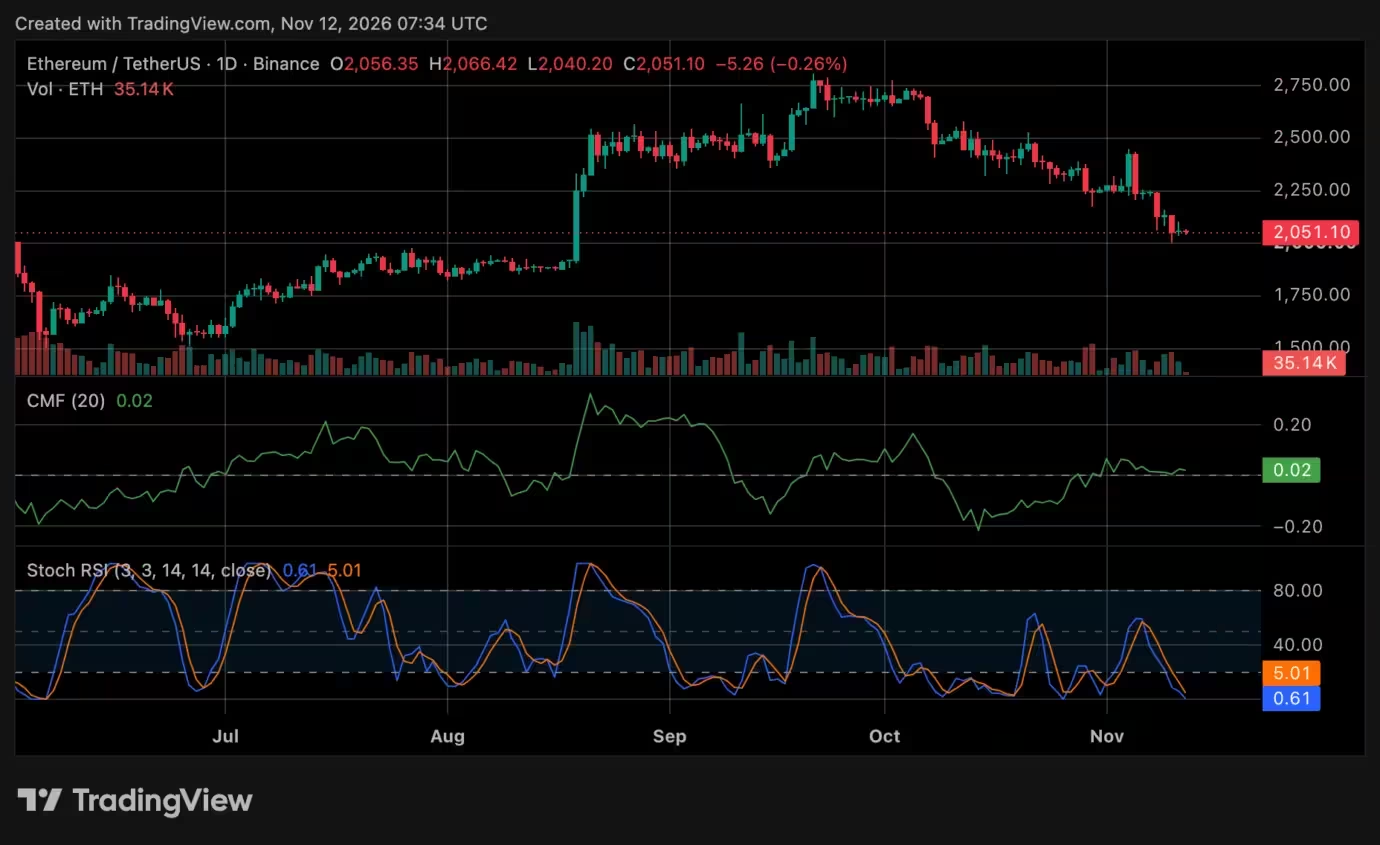
Ethereum price chart
Analysts point to concentrated liquidity around $2,150, $2,250 and $2,450, levels that could attract buy orders during any rebound. For a convincing recovery, ETH must first reclaim $2,100; a sustained advance toward $2,250 would bring it back into a zone where prior attempts to regain upside momentum faltered.
What traders and investors should watch
Key on-chain indicators and institutional flows will remain critical in the coming sessions. Monitor large wallet movements, ETF net flows (especially from major issuers like BlackRock), and staking deposits that remove supply from exchanges. Liquidity pools at the levels noted above can act as magnet points for stop hunts or buying interest during volatility. For longer-term holders, continued staking adoption and institutional treasury strategies will be central to Ethereum's supply dynamics and overall market structure.

As ETH hovers near important technical thresholds, the interplay between whale selling, ETF redemptions, and persistent staking will be the defining narrative for the next phase of price action.

Leave a Comment
Comments (2)
Staking > whales rn, but damn those ETF outflows hurt. Price flirting with 2k, nervous but curious... will it hold?
Wait, are those whale sales verified? Lookonchain is fine but wallet tags can be wrong, could be internal routing or liquidations? kinda skeptical rn