

Market snapshot: BTC stalls near $73,700
Bitcoin (BTC) remained pinned around $73,700 on November 12, reflecting an inability to stage a sustained recovery after the recent selloff. Weak institutional demand, persistent leverage across derivatives markets, and rising exchange inflows continue to challenge price momentum, keeping traders cautious.
Key takeaways
- BTC price is trading near $73,700, with little 24-hour movement and an approximate 8.3% decline over the past week.
- Derivatives data indicate the latest pullback has not produced the same leverage reset observed in prior corrections.
- Miner reserves have dropped to about 1.19 million BTC while exchange inflows have surged to nine-month highs.
- Bitcoin sits below its short-term moving averages; the RSI is approaching oversold levels, leaving room for a short-term rebound but not yet signaling a durable trend reversal.
Price action and on-chain signals
At the time of the market update, Bitcoin changed hands near $73,710, largely unchanged on the day but down roughly 8.27% over the previous seven days. BTC briefly tested toward $74,700 mid-week before slipping back toward $73,300 overnight, leaving the market without a clear directional bias.

Institutional flows and ETF dynamics
Spot ETF activity has offered limited support. US spot Bitcoin ETFs recorded net outflows of $95 million on Tuesday, extending a multi-session losing streak. Bitfinex’s market assessment showed nearly $2.22 billion exiting US spot Bitcoin ETFs across eight sessions beginning October 30. Analysts there identified $75,717 as an approximate cost basis for short-term holders—a level at which recent buyers might look to sell once that price is reclaimed.
Without a fresh wave of spot buying or renewed ETF inflows, Bitfinex analysts say Bitcoin will struggle to mount a durable recovery above resistance bands.
Macro backdrop: inflation and Fed expectations
Macroeconomic data added to the pressure. Hotter-than-expected US inflation prints on November 10 showed consumer prices rising 0.4% in October versus consensus at 0.3%. The result pushed market odds higher for another Federal Reserve rate increase in December. Higher policy rates and the prospect of more expensive borrowing tend to weigh on risk assets and can blunt appetite for crypto, particularly when institutional demand is already soft.
Derivatives, leverage and open interest
Derivatives metrics highlight a notable difference between this correction and past selloffs. CryptoQuant analyst BaykusCharts compared the current downturn with corrections earlier in the year. During February’s slide from $87,000 to $67,000, Binance BTC-USDT open interest plunged from $9 billion to $5.5 billion, with roughly 20% of BTC-denominated positions closing rapidly.
The June liquidation followed a similar pattern, as open interest fell from $8 billion to $6.1 billion before BTC hit its yearly low. By contrast, the present correction—dropping from around $85,000 in mid-October to roughly $74,300—saw Binance open interest decline from $9.4 billion to $7.2 billion, representing a substantially smaller reduction in positions when measured in BTC terms. Analysts estimate only about 12% of positions have closed in this move, and there was no single-day liquidation event comparable to prior squeezes.

Funding rates and trader positioning
Funding rates have largely stayed positive, meaning traders are still willing to hold leveraged long exposure even as prices fall. Noted trader Daan Crypto Trades flagged that open interest measured in BTC is back to ranges seen during 2021–2023, a regime that historically preceded significant position closures. However, such closures have not always translated into a consistently bearish outcome, leaving markets sensitive to where the next squeeze might occur.
Miners and exchange flows: fresh selling pressure
Selling has also come from balance-sheet dynamics among miners and elevated exchange deposits. CryptoQuant analyst Arab Chain reported miner-held reserves have fallen to about 1.19 million BTC, a low not seen since 2009. At the same time, inflows to exchanges reached a nine-month high, with Binance reportedly receiving near 2,000 BTC in a single day. While transfers onto exchanges do not guarantee immediate selling, they do increase the potential for fresh liquidations as miners or other holders seek liquidity to cover expenses.
CryptoQuant research head Julio Moreno noted the platform’s Bitcoin Bull Score dropped to zero on November 11—its most bearish reading—underscoring heightened downside risk in the near term.
Technical analysis: support, resistance and indicators
Bitcoin’s daily chart still shows lower highs and lower lows after failing to hold above $80,000. BTC trades below the 9-day moving average of 75,565.86 and the 21-day moving average of 77,633.08. The shorter moving average remains beneath the longer-term average, reinforcing the near-term downtrend.
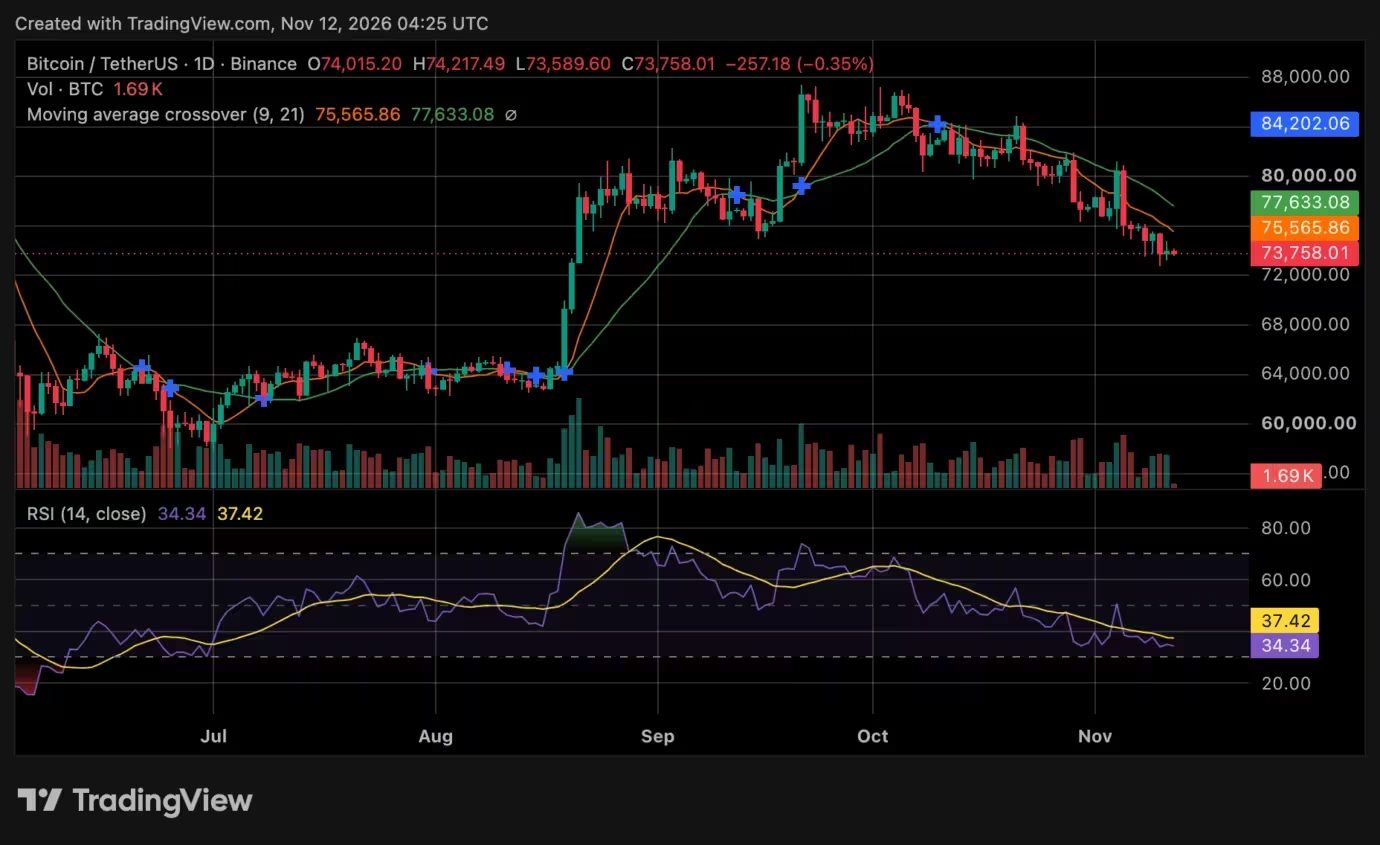
Bitcoin price chart
The Relative Strength Index (RSI) sits near 34.34, edging toward the oversold threshold around 30. Immediate support lies near $73,500, followed by $72,000. A sustained break below $72,000 would likely expose the psychological $70,000 level and increase downside risks. On the upside, Bitcoin needs to recover $75,565 to improve its technical outlook before attempting to challenge the next resistance zone near $77,633. Until the RSI confirms a bullish reversal and moving averages start to converge or flip, any bounce may remain temporary.
Outlook and what traders should watch
Market participants should monitor several key variables to gauge the next directional move for BTC: spot ETF flows and whether outflows stabilize or reverse, changes in open interest and funding rates that could signal a larger deleveraging event, and miner-to-exchange transfers that could add selling pressure. Macro data and Fed messaging will also continue to shape risk appetite.

In short, Bitcoin’s immediate path looks precarious: failing to reclaim $75,565 would keep sellers in control, while a decisive break below $72,000 could open the door to $70,000. Conversely, renewed institutional buying and a resumption of ETF inflows would be necessary to sustain a stronger recovery above short-term resistance.

Leave a Comment
Comments
No comments yet. Be the first.