

Pi Network’s PI token has come under renewed selling pressure despite a stream of ecosystem announcements at the project’s Ecosystem Summit. As of Nov. 19, PI was trading near $0.0573, off more than 5% in 24 hours and roughly 25.7% over 30 days. The token has lost significant value over the past year and remains vulnerable to further downside unless on-chain activity and mainnet services start to generate sustained demand.
Current price action and market context
Since the start of the summit (Nov. 17–19), developers unveiled a range of new tools and services intended to expand Pi Network’s utility. However, the market has already priced in these plans to a degree, and traders appear reluctant to chase the token until the announced decentralized exchange (DEX), automated market maker (AMM), and Pi Launchpad move from testnet to mainnet.
PI has shed roughly 18% over the past week and traded as low as recent weekly lows earlier this month. Daily technicals are tilted toward sellers: PI is trading below the Ichimoku Cloud and well under short- and medium-term exponential moving averages. Chaikin Money Flow has inched back into mildly positive territory, suggesting a sliver of buying pressure, but the reading remains weak.
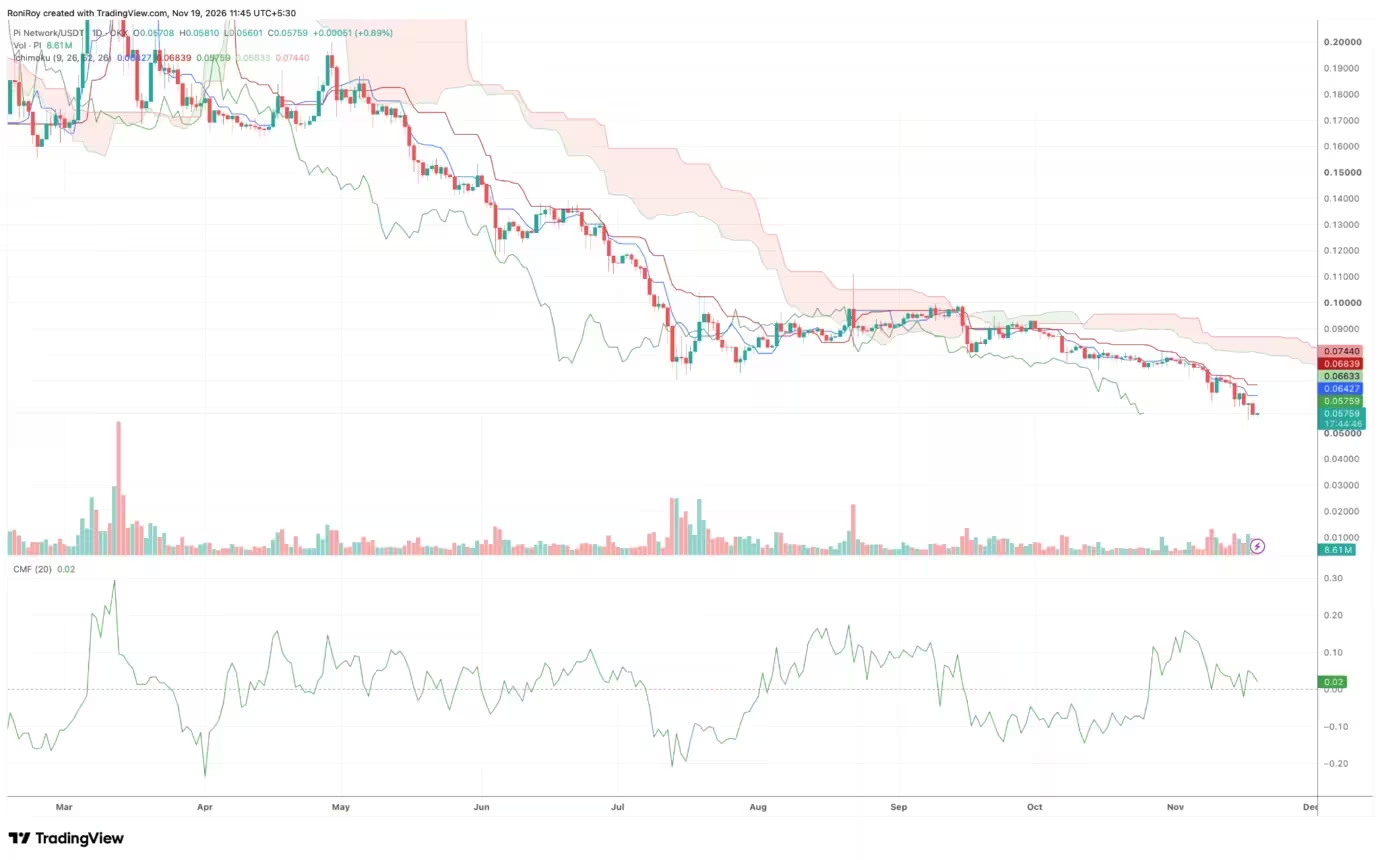
PI/USDT 1-day price chart.
Why PI is falling despite new announcements
The Pi Foundation used the summit to disclose a timeline and product roadmap: the DEX, AMM and Pi Launchpad are slated for mainnet deployment in Q1 2027, pending further testing. Those services have been trialed on testnet and are designed to enable token launches, liquidity provisioning, and native DeFi activity on Pi’s chain.
In parallel, the Foundation announced an App Growth Initiative, earmarking up to 20 million PI to help eligible teams onboard users and stimulate application activity. Day two of the summit introduced Pi DataLab, a marketplace pairing identity-verified Pi users with businesses that need human-generated data labeling and AI evaluation. Tasks completed through DataLab would be rewarded in PI, and developers were shown project management and payout workflows during demos.
Despite the product roadmap and incentives, traders are waiting for concrete mainnet launches and real usage metrics before buying aggressively. Announcements that extend months into the future often dampen short-term demand, especially when liquidity is limited and broader market sentiment is cautious.

Market liquidity and trader sentiment
Volume data preceding and during the summit has been muted: daily trading volumes remained below the levels many traders consider healthy for a robust recovery. Earlier in November, PI fell below $0.07 with sub-$4 million daily volumes—an environment where even moderate sell flows can push prices noticeably lower.
Technical outlook: indicators and trend analysis
Technical indicators currently favor sellers, though some oversold readings hint at the possibility of a short-term bounce. Key metrics to watch:
- Relative Strength Index (14): ~24.82 — well into oversold territory, which can sometimes precede corrective rallies.
- Commodity Channel Index: around -138.84 — signals strong downside momentum.
- Average Directional Index: about 50.83 — indicates a strong prevailing trend, in this case bearish.
- Moving averages: PI sits below the 20-day EMA (~$0.0677) and the 50-day EMA (~$0.0750), both of which represent meaningful resistance on any rebound.
- MACD: negative and below its signal line, reinforcing that sellers control momentum for now.
On the daily chart, the Ichimoku Cloud places immediate resistance above the current price. Tenkan-sen is near $0.06427 and Kijun-sen near $0.06839, while the cloud spans roughly $0.06633 to $0.07440. The Chaikin Money Flow’s small move into positive territory (around 0.02) shows marginal improvement in money flow but not the robust accumulation needed for a decisive trend change.
4-hour dynamics and shorter-term signals
On shorter timeframes, Bollinger Bands and On-Balance Volume (OBV) point toward ongoing weakness. PI trades beneath the Bollinger Bands’ middle line (~$0.05985) and close to the lower band (~$0.05614), which highlights compressed volatility and downside pressure. OBV is trending downward toward negative 1.7 billion, indicating cumulative selling has dominated recent sessions.
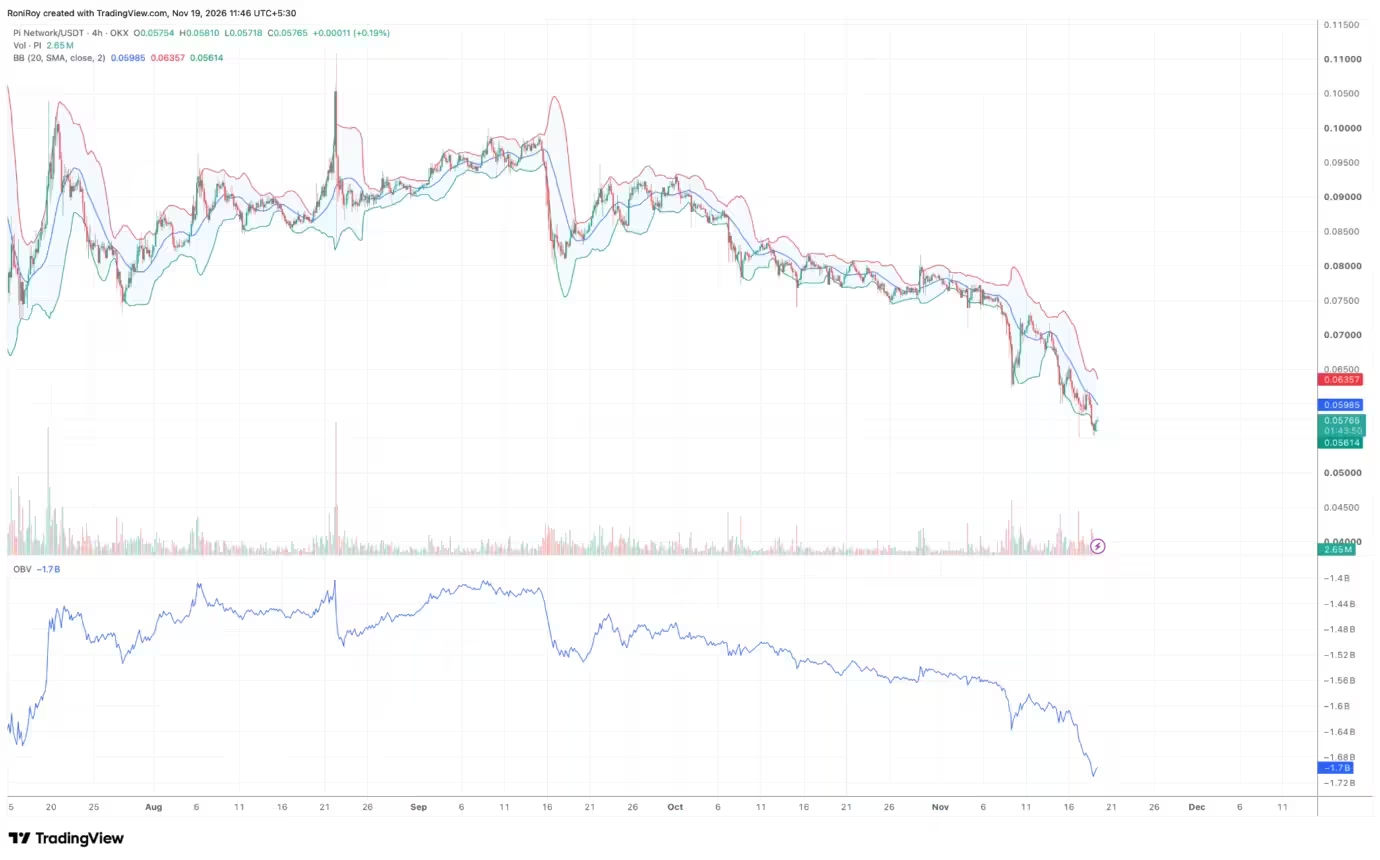
PI/USDT 4-hour price chart.

Support and resistance levels to watch
Immediate support lies near $0.0561, with a more critical floor around $0.055 where buyers have previously tried to stabilize the price. A confirmed break and daily close below $0.055 could open the way for further losses toward $0.052 and then $0.05—levels that would test longer-term holder conviction and could trigger deeper capitulation.
On the upside, reclaiming $0.05985 and the round $0.06 psychological level would be an initial bullish sign. If buyers push above $0.06 and sustain momentum, targets appear near $0.06357 and $0.06427 (upper Bollinger Band and Tenkan-sen). Stronger resistance clusters form near $0.06839 and the upper edge of the Ichimoku Cloud around $0.07440.
Scenarios that could change the trajectory
A recovery in PI hinges on several catalysts:
- Mainnet launches: tangible deployment of the DEX, AMM and Pi Launchpad with clear usage metrics would likely boost confidence and demand.
- App adoption: real user engagement across new Pi apps, including token launches and DataLab tasks paid in PI, could create recurring on-chain demand.
- Improved liquidity: larger trading volumes and market-making activity would help dampen volatility and reduce slippage, making PI more attractive for traders and projects.
Countervailing risks include general crypto market weakness, delays to the roadmap, insufficient developer adoption, or continued net outflows from holders.
Short-term catalysts
The Pi Next hackathon, starting Nov. 19 with a 200,000 USDT prize pool, is the next scheduled ecosystem event. Strong hackathon participation and early app demos could provide positive narrative momentum, but traders will likely look for on-chain metrics and sustained activity before committing at scale.
Conclusion: price outlook and trading considerations

PI remains in a vulnerable technical position with selling pressure predominant. Oversold indicators suggest a bounce is possible, but any meaningful recovery will require reclaiming $0.06 and showing real growth in mainnet-ready activity. For traders and investors, managing risk with clear stop-loss levels around $0.055 and watching volume-based confirmations will be important if considering entry. Longer-term bulls will want to see the DEX, AMM, Launchpad and DataLab deliver measurable utility before treating the token as a buy on fundamentals.
Keep monitoring liquidity, developer activity, and on-chain usage as the most reliable indicators of whether Pi Network’s ambitious roadmap can translate into sustained price recovery and broader ecosystem growth.

Leave a Comment
Comments
No comments yet. Be the first.