

Market snapshot: ETH edges higher as institutional flows lag
Ethereum (ETH) climbed just over 1% to $1,832.82 on November 17, staging a modest recovery from weekend lows even as US spot Ethereum exchange-traded funds (ETFs) recorded nearly $399 million in net withdrawals over the prior five trading sessions. The token outpaced Bitcoin and the broader crypto market on the session, but weekly performance still showed a sharp decline.
Key price and market data
- ETH price: ~$1,832.82 (November 17)
- Seven-day performance: down ~13.61%
- Session gain: ~1.09% for ETH vs. 0.46% for BTC
- Spot Ethereum ETF net outflows (Nov 9–13): $398.9 million
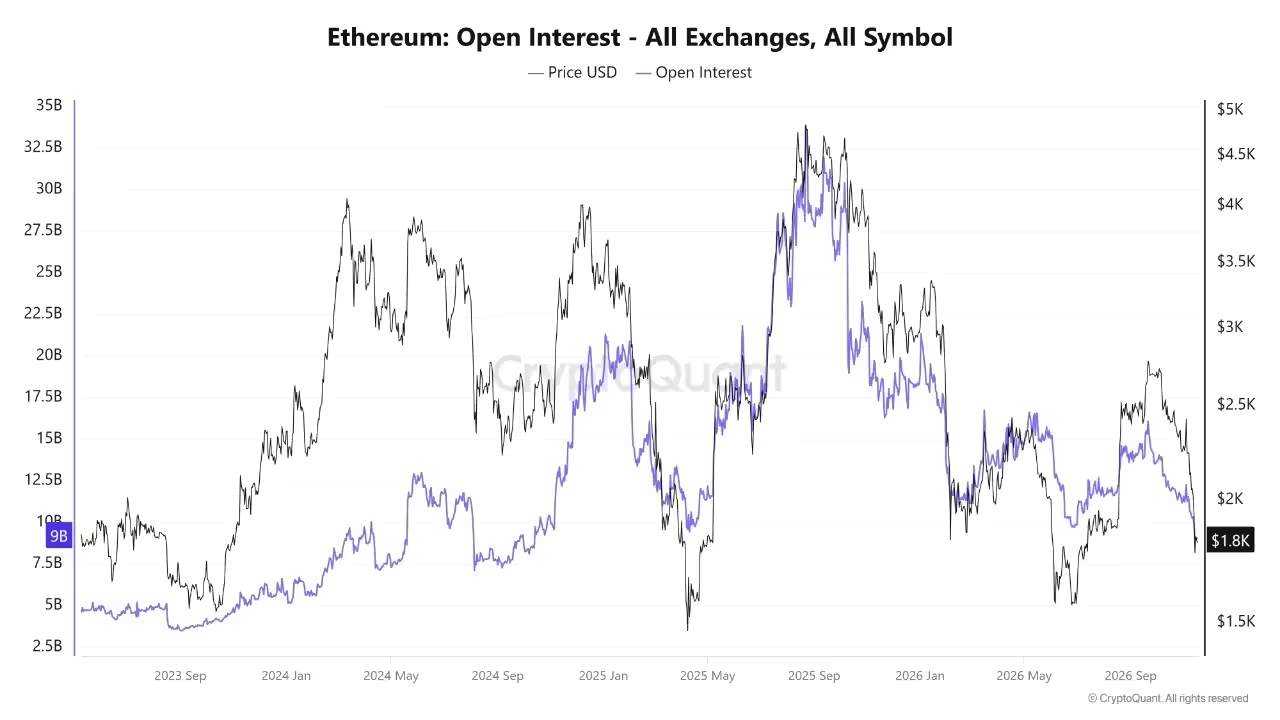
- Ethereum futures open interest: $9.12 billion (lowest since Oct 2024)
Whale accumulation: smart-money buying amid weakness
On-chain analytics show substantial accumulation by large wallets despite the short-term selloff. Blockchain tracker Onchain Lens flagged wallets it associates with Erik Voorhees buying another 6,382 ETH—roughly $11.6 million—on CoW Swap within a 12-hour window. Over several days the same cluster reportedly accumulated 82,277 ETH, spending about $158.1 million at an average entry near $1,921 per ETH.
Such concentrated buying by whales helps explain why price found buyers around the low-$1,700s during the weekend correction. Large wallet purchases can provide localized support for ETH and signal conviction from long-term holders even when broader market sentiment is weak.
Corporate accumulation continues
Institutional and corporate accounts also added to balances. Mining and staking operator Bitmine Immersion Technologies disclosed a weekly purchase of 7,653 ETH, increasing its total reported holdings to 6,077,745 ETH—representing about 4.97% of the circulating supply, according to the company. Bitmine reported that approximately 5,227,037 ETH of its inventory is in staking positions, or roughly 86% of its holdings.
Bitmine chairman Tom Lee noted the recent volatility—citing a roughly 28% drop in ETH over two weeks—and suggested external macro factors such as AI-stock turbulence and activity around major IPOs may have pressured prices.
Technical outlook: short-term levels to watch
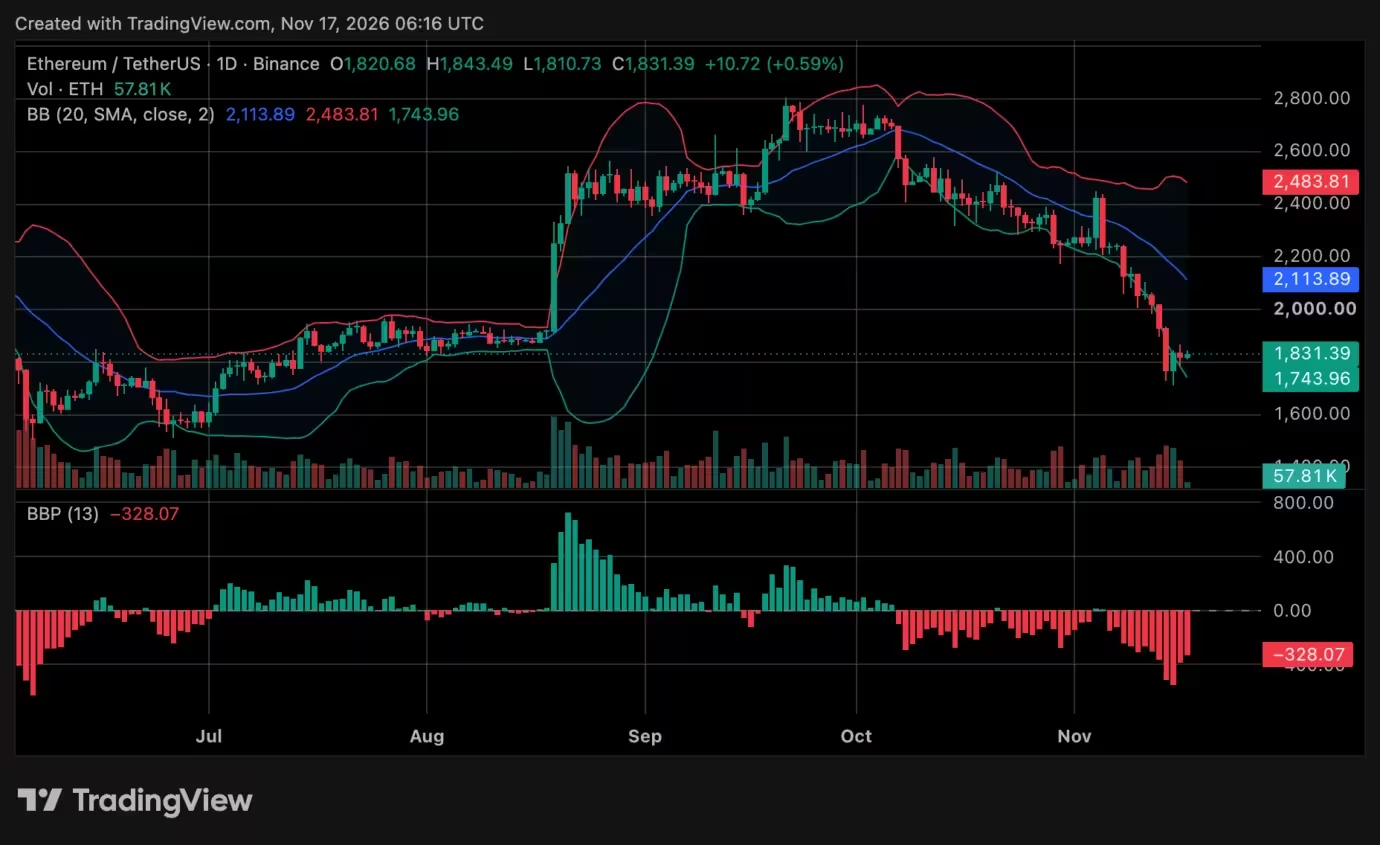
ETH’s intraday action on November 17 showed persistent technical weakness despite the bounce. The token remains below its 20-day simple moving average (SMA) of around $2,113, and the lower Bollinger Band sits near $1,743. Price dipped toward $1,712 during the weekend selloff before buyers stepped in.
Ethereum price chart
Important support and resistance
- Immediate intraday resistance: ~$1,834
- Near-term resistance: ~$1,864
- Stronger resistance band: $1,900–$2,000
- Immediate support: ~$1,802 and $1,786
- Lower support area: $1,740–$1,750
For traders, reclaiming the 20-day SMA would be a meaningful sign of momentum recovery. Until then, the market may continue to chop between the $1,700s and the $1,900 zone as liquidity and ETF-related flows dictate direction.

Futures activity and open interest
Futures markets have shown a marked pullback in commitment: CryptoQuant reported total Ethereum futures open interest fell to about $9.12 billion on November 17, the lowest reading since October 2024. Binance accounted for roughly $4.4 billion of open interest, with Bybit and OKX at about $1.5 billion and $1.4 billion respectively.
A lower open interest reading generally signals fewer dollars committed to active long and short contracts, which can reduce volatility but also indicate less directional conviction from derivatives traders. CryptoQuant analysts cautioned that a decline in open interest does not automatically equate to net selling, since it aggregates both long and short positions.
Ethereum open interest
Spot ETF flows: outflows persist despite Friday inflows
Institutional investor activity via spot ETFs remained a headwind. According to Farside Investors data, US spot Ethereum ETFs saw $398.9 million in net withdrawals from November 9–13. BlackRock’s ETHA made up the bulk of that outflow, accounting for about $311.1 million. Across the cryptocurrency ETF complex—including Bitcoin funds—weekly outflows totaled about $1.53 billion, with Bitcoin funds representing $1.065 billion of the decline.
Friday, November 13 brought a minor reversal: ETFs attracted roughly $2.3 million in net inflows, breaking a six-session withdrawal streak. Fidelity’s FETH recorded approximately $11.6 million of inflows, which partially offset $9.3 million in outflows from Grayscale’s ETH fund.
Exchange reserves and on-chain implications
Exchange-reported balances provide additional context. A November 15 reserve snapshot indicated that Binance’s estimated Ethereum holdings had fallen to roughly 2.9 million ETH—its lowest level in nearly five years. Withdrawals from exchanges can reflect transfers to private wallets, staking services, or decentralized finance (DeFi) platforms, and can reduce immediate sell-side pressure if the ETH is being locked or staked.
Outlook: consolidation likely, catalysts to watch
Ethereum’s near-term trajectory looks set for consolidation unless either institutional inflows return or derivatives activity picks up. Key catalysts to monitor include changes in ETF flow trends, large wallet activity from whales and corporations, daily futures open interest, and macro events that could shift risk appetite—such as earnings or sector rotations affecting tech and AI-related assets.
For traders and investors focused on crypto and DeFi, the current setup emphasizes risk management around the identified support levels while tracking whether whale accumulation translates into sustained demand. A successful reclaim of the $1,900–$2,000 range would be required to restore more bullish momentum, whereas a break below the $1,740–$1,750 band could open the door to deeper retracements.
In short, Ethereum’s recovery on November 17 was a positive signal but remains fragile: accumulation from whales and corporations is supportive, but ETF outflows and lower futures open interest underscore ongoing headwinds for ETH and the broader crypto market.


Leave a Comment
Comments (1)
Whales buying ok, but nearly $399M in ETF outflows? If that keeps up, who actually provides upside, feels shaky, can they hold the $1,700s…