
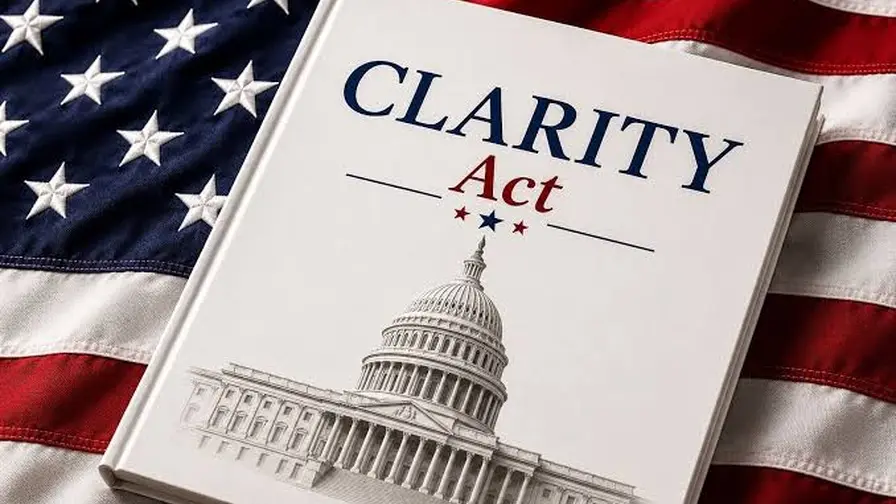
A January Reset Looms Over the CLARITY Act
The CLARITY Act faces a hard deadline as the current Congress approaches its final weeks. Without the votes needed to clear a Senate procedural hurdle in September, lawmakers must decide whether they can reconcile disputes over crypto oversight before January ushers in a new Congress, new committee leadership and the likely need to reintroduce the bill if it expires. The choice matters for crypto firms, exchanges, token issuers, investors and regulators. It also matters for the trajectory of US crypto regulation, including how the SEC and CFTC divide responsibilities over digital assets, how token sales will be classified and what investor protections will apply.
Key takeaways
- The Senate blocked cloture on Sept. 15, leaving supporters short of the 60 votes needed to advance the CLARITY Act to debate.
- Democratic gains in recent elections change the dynamics for negotiations in the next Congress, but the current session could still pass a bill if leaders agree to prioritize it and senators reach a deal.
- Central disputes include investor protections, national security safeguards and the statutory pathway for token offerings to exit securities oversight.
- A Nov. 19 Senate Banking Committee nomination hearing provides an opportunity to question potential SEC commissioners, though confirming officials would not substitute for a statutory allocation of authority under CLARITY.
- If the bill expires, the status quo — existing securities and commodities law and current agency responsibilities — remains operative while a new legislative push starts over again.
Why the September vote matters
On Sept. 15 the Senate voted on a motion to proceed to the CLARITY Act and rejected cloture by a 49 to 50 margin with one senator not voting. That vote was procedural. Cloture would have cleared a filibuster-style obstacle and allowed the Senate to begin debate and offer amendments. It was not a final vote on the law itself, yet it is the clearest public record of why supporters fall short: they lacked the 60 votes necessary to advance the bill under Senate procedure.
This gap cannot be read as a fixed list of 11 persuadable senators. Senators can change positions when a bill is amended. Some voted against proceeding because of specific provisions granting exemptions or assigning power between agencies, not because they oppose crypto regulation in principle. Others may abstain or reverse their stance due to scheduling or broader parliamentary strategy.
Senator motions to reconsider the cloture vote preserve a path back to the floor, but they do not guarantee a winning coalition. What matters next is whether negotiators can translate outstanding disagreements into statutory language that attracts additional votes, and whether Senate leaders will grant the floor time necessary to hold another cloture vote.
January will reset more than the calendar
The midterm election results shifted control of Congress, with Democrats poised to lead both chambers. That change alters committee chairmanships, hearing agendas and the legislative priorities that will shape how a future CLARITY-type bill is drafted, amended and considered. Yet the current Congress can still pass legislation before it adjourns, and sitting committee chairs retain authority until the switchover.
For CLARITY backers, passing the bill before committee gavels change would lock in negotiated compromises drafted under the current leaders. If the measure expires, the next Congress could resurrect much of the prior text but may also rewrite major elements to reflect the incoming majority's priorities. That could speed up or slow down passage depending on how much continuity lawmakers want.
A reset in January therefore has institutional as well as political consequences. Committee control affects who shapes draft language, which witnesses are brought to testify and which amendments are entertained. A new majority can change the sequencing of issues, prioritizing market structure or consumer protections differently, or dividing topics across more than one bill.
Not everything returns to zero
Calling January a reset is accurate but misleading if taken to mean all prior work is lost. Policy research, negotiated definitions and administrative testimony remain useful. Staff and agency officials retain institutional memory, which can speed drafting. The key difference is political: a new chair may demand changes to particular sections, or may reframe the negotiation by setting different red lines or priorities.
The dispute over regulatory entrance points
A recurring flashpoint in negotiations concerns how and when tokens and crypto businesses enter particular regulatory regimes. The CLARITY Act seeks to define which assets and activities fall under securities law, which are commodities, and which regulatory processes apply to exchanges, custodians and token issuers. These allocations will determine disclosures, registration requirements, supervisory access and enforcement pathways.
The central tension is whether there should be a route out of securities oversight for tokens that meet certain criteria, and if so, how that route should work. Senator Cynthia Lummis and other supporters oppose proposals that would require crypto businesses to enter the SEC's jurisdiction as the default pathway. They argue that automatic SEC supervision could chill market activity and be unduly burdensome for decentralized projects and certain token models.
Opponents of an SEC entrance argue a statutory path out of securities oversight could leave protections incomplete if the receiving regulator lacks the resources or mandate to replicate investor safeguards. The debate therefore turns on substance: how an eligible asset is defined, how transitions between regulators occur, and which obligations survive a reclassification.
Issuer vs intermediary responsibilities
A useful way to parse these disputes is to separate token issuers from intermediaries. An issuer conducting a fundraising event prompts disclosure and anti-fraud questions tied to the initial offering. An exchange or matching engine that lists tokens and processes trades raises custody, market surveillance and anti-money laundering concerns. A single firm may perform both functions, complicating decisions about which entity must register and what rules apply.

A comprehensive statutory framework must address handoffs. Consider a token first sold in a token generation event, later listed on multiple trading venues. The offering sparks obligations about how funds were raised and what purchasers were told. Subsequent trading raises separate enforcement and customer-protection considerations. Shifting an asset between categories without clarifying how prior obligations are treated will create legal uncertainty and litigation risks.
Investor protection, national security, and enforcement resources
Lawmakers opposing the current CLARITY text have cited gaps on investor protection and national security. Senator Elizabeth Warren explicitly linked her September opposition to the bill’s handling of consumer safeguards and systemic-risk issues. Other senators are focused on conflict-of-interest rules, enforcement funding and how ordinary investors can recover losses after misconduct.
Those concerns are not uniform among Democrats or Republicans. The policy trade-offs are complex. Strengthening consumer protections and anti-illicit-finance measures can expand regulatory costs and compliance burdens, potentially reducing innovation and market liquidity. Conversely, lighter obligations can invite fraud, market manipulation and consumer harm, undercutting trust in the sector.
Any compromise must therefore balance disclosure regimes, registration thresholds, surveillance expectations and dispute-resolution mechanisms. The presence or absence of transitional rules and the clarity of enforcement authority will shape how markets and institutions respond to new obligations.
Why Democratic support comes with conditions
It is misleading to treat the partisan line as a binary for or against crypto. Democrats have supported crypto legislation in the past but often with caveats. The House passed a version of CLARITY with bipartisan backing in July 2025, demonstrating that cross-party coalitions are possible. Still, House and Senate majorities differ in membership and procedure, and a House endorsement does not automatically yield the 60 Senate votes needed to overcome a procedural barrier.
Democratic backing tends to come with policy conditions. Those can include stronger anti-fraud language, enhanced oversight for mixing services and sanctions compliance, or different allocations of power between the SEC and CFTC. Negotiators who secure support from one set of senators may lose others if the changes alter regulatory jurisdiction or impose exceptions that some consider too broad.
What negotiators need to show

Public assurances are useful, but the decisive indicators will be revised statutory text and named co-sponsors who publicly commit to the new language. Amended text demonstrating how contested activities would be treated, with detailed transition rules and enforcement provisions, will be the clearest signal that a coalition can form. Otherwise, general statements about constructive talks have limited predictive value.
How the legislative calendar can help or hinder
The Senate calendar lists working days in the final weeks of the year, but a scheduled session day does not guarantee floor time for CLARITY. Floor time is a scarce resource shared among legislation, nominations and other government business. A contested bill requiring repeated procedural steps can be costly in time and political capital.
Leaders could attach crypto provisions to a year-end omnibus or must-pass package, creating another route to a vote. Yet packaging does not erase disagreements. Adding or subtracting provisions can alter the politics of a package and prompt new objections unrelated to crypto policy, potentially dooming the larger measure.
A fundamental constraint is bicameral agreement. If the Senate amends the House-passed text, the House must accept the Senate’s changes or the two chambers must reconcile differences in conference. A presidential signature is required for enactment, and a potential veto creates an additional hurdle.
Counting votes becomes more complex with vehicles
When multiple legislative vehicles are under consideration, vote arithmetic grows harder. A lawmaker's public support for a standalone bill may not translate to support for a version contained in a larger package. Conversely, a senator opposed to a narrow crypto bill might accept elements of it as part of a broader compromise. That makes it essential to track which vehicle is scheduled, the exact text it contains and the vote question presented to senators.
Agency nominations are a related but separate track
The Senate Banking Committee scheduled a Nov. 19 nomination hearing that will include prospective SEC commissioners Steven Levine and Kristin Johnson. These hearings let senators question nominees about enforcement priorities, disclosure regimes and how they interpret existing law. While important, confirmation of regulators does not substitute for a statute that reallocates authority between agencies.
Commissioners can exercise powers within extant statutory authority and can shape policy through rulemaking and enforcement. But they cannot write the statutory allocation of jurisdiction that CLARITY seeks to clarify. That allocation requires an act of Congress. Moreover, hearings and confirmations are distinct procedural steps; a hearing does not mean nominees will be confirmed prior to January.
What a reset means for crypto businesses today
If CLARITY expires with the Congress, the bill’s language disappears and would need to be reintroduced. That is a procedural reset; it does not pause existing securities, commodities, bank or consumer protection laws. Platforms, exchange operators, custodians and token issuers continue operating under current legal obligations. For many companies, the pressing questions remain operational: how are customer assets held, which registrations apply, and what obligations arise from the way capital was raised?
A token issuer’s liability for misstatements in a fundraising remains a live risk. An exchange’s custody practices and handling of customer balances are still governed by contract law, state trust law in some cases, and applicable federal statutes. Contracts, disclosures, and the actual operational structure of a business are the most reliable guides to current compliance obligations, not future legislative promises.
Transition provisions matter more than headline promises
Assuming that a future statute will deliver a particular exemption or registration pathway is risky until lawmakers publish and enact the specific transition language. Even after a signature, agencies may need time to write rules, establish registration processes and coordinate supervisory responsibilities. Businesses should plan for phased implementation timelines rather than instantaneous legal changes upon enactment.
Implementation: the real test after passage
A law promising clarity will only deliver it if the statute includes effective dates, transition rules and precise rulemaking mandates. Without clear implementation instructions, agencies will face interpretive questions when jurisdictions overlap. Practical considerations include how long companies have to transition, whether existing enforcement actions are tolled or dismissed, and which entity handles joint investigations.
The statute should also describe dispute-resolution paths and data-sharing protocols between agencies. These operational details will determine how quickly a new framework becomes useful in practice. Businesses should monitor statutory text not only for assignment of regulatory authority but also for the procedural steps required to turn that assignment into enforceable rules.

Signs to watch in the short term
During the lame-duck period and early in the new Congress, there are specific developments that would indicate momentum or stagnation:
- A published bipartisan draft showing the substance of a compromise. This signals that text has moved in response to objections and that negotiators have a coherent plan for transition and division of authority.
- An official floor notice specifying a date and the action to be taken. That indicates leadership has prioritized the measure and is ready to expend floor time.
- Successful procedural votes or named co-sponsors committing to new text. These provide the clearest evidence that senators have been persuaded by revised language.
Any one of those developments would be useful, but none by itself guarantees eventual enactment. A published compromise without floor time could still expire; floor time without the votes will produce another failed attempt.
Watch for implementation details
If a revised text appears, inspect it for effective dates, transition mechanics and rulemaking timelines. Those details determine how quickly firms must change operations and which obligations will be delayed for agency rulemaking. In many cases, the devil is in the implementation rather than the headline allocation of agency authority.
Industry influence, politics, and realistic expectations
Industry lobbying and campaign spending are often cited as drivers of legislative outcomes, yet they cannot substitute for parliamentary strategy. Money can help elect candidates, but it cannot reserve floor time, bind committee chairs, or compel a senator to vote for cloture. The impact of industry activity on the CLARITY process should therefore be measured by public commitments, policy proposals returned in legislative text and sustained advocacy that moves the needle on a named coalition of senators.
For observers, the hierarchy of evidence for legitimate progress is: an official floor notice, published text, and an identified voting coalition. A press release or anonymous prediction is much less conclusive.

The November nomination hearing: timing and scope
The next scheduled public event relevant to this debate is the Senate Banking Committee hearing on Nov. 19, listed at 10 a.m. Eastern in Dirksen 538. The hearing will include testimony from prospective SEC commissioners and offers an opportunity for senators to probe how nominees would apply current law to digital-asset markets. While the hearing is meaningful for regulatory direction, it does not resolve statutory allocation questions.
A nominee’s responses can shape expectations about enforcement priorities in the near term. For example, a commissioner emphasizing anti-fraud enforcement and investor disclosures signals a potentially tougher enforcement environment even absent statutory changes. Conversely, nominees expressing deference to Congress on jurisdictional allocation underscore why lawmakers perceive an urgent need to write new law.
Potential outcomes and scenarios
There are several plausible endgames for CLARITY over the immediate horizon:
- Passage in the lame-duck: Negotiators resolve key disputes, leaders grant floor time, and the Senate secures cloture followed by passage in both chambers. This would require a precise coalition and attention to implementation details to avoid future litigation or agency confusion.
- Expiration and reintroduction: The bill expires with the Congress and is reintroduced in the new session. Much of the text may survive but political priorities and committee control could reshape important provisions, especially those central to jurisdictional assignment and investor protection.
- Fragmentation: Lawmakers split the issues into multiple bills, addressing stablecoins, market structure, and token issuance separately. This can accelerate passage of less controversial parts while dragging contested items into longer-term debate.
- Stalemate: Ongoing disagreement prevents passage, and agencies fill the void through rulemaking and enforcement. That can produce uncertainty as firms respond to evolving enforcement priorities rather than a clear statutory regime.
Each scenario affects market participants differently. Passage provides long-term legal clarity but also introduces a new compliance landscape. Reintroduction creates transitional uncertainty. Fragmentation forces firms to track multiple parallel rulemaking tracks. A stalemate amplifies litigation and regulatory enforcement as tools for shaping policy.
Practical advice for crypto firms and investors
Given the uncertainty, firms and investors should adopt a cautious, compliance-focused approach:
- Assess current obligations: Review contracts, custody arrangements, and fundraising disclosures to identify existing legal risks under securities and commodities laws.
- Plan for multiple timelines: Prepare for immediate compliance under current law, prospective compliance with a CLARITY-type statute, and intermediary agency guidance that may arise if Congress delays action.
- Document processes and disclosures: Good corporate recordkeeping reduces litigation risk and improves the firm’s ability to adapt to new statutory requirements.
- Engage constructively: Participate in public comment processes, testify at hearings, and work with trade groups to shape pragmatic transition provisions and registration pathways.
Why substance beats symbolism
The CLARITY Act has become a political symbol as well as a legislative effort. But the operational value of any law lies in the tangible duties it creates: registration rules, disclosure thresholds, enforcement authorities, transitional mechanics, and interagency coordination. A headline that claims the law delivers clarity means little without the statutory and administrative scaffolding that makes it workable.
Negotiators therefore face an important test: can they translate competing priorities into statutory text that assigns responsibilities clearly, protects investors, preserves market integrity and allows innovation to proceed under transparent rules? If they cannot, another symbolic compromise is unlikely to resolve the practical issues that market participants face today.
Conclusion: A narrow window, high stakes
The October-to-January interval creates a compressed timetable for lawmakers if they wish to finalize CLARITY before committee control shifts. Success requires two linked elements: statutory language that resolves outstanding jurisdictional and investor-protection disputes, and Senate leadership willing to allocate floor time and tolerate the procedural steps needed to clear cloture and reach final passage.
If policymakers fail to secure both, the bill will likely be reintroduced in the next Congress, restarting a political process that incorporates the same substantive disputes. Until then, companies must distinguish between the promise of a future framework and the binding rules that govern their activities today.
For crypto watchers, the most consequential near-term events are the publication of any bipartisan draft, an official floor notice tied to specific text, and public commitments from named senators. Each of these would reduce a different kind of uncertainty and help markets assess the likelihood that CLARITY will move from proposal to enforceable law.
What to monitor next
- Any revised statutory text that addresses handoffs between the SEC and CFTC and the legal treatment of token issuers and intermediaries.
- Senate floor notices or leadership statements scheduling the bill for consideration.
- Announcements of named co-sponsors or public commitments from senators who previously opposed cloture.
- Nov. 19 Senate Banking Committee events, including testimony by prospective SEC commissioners and any committee statements that clarify the agency’s near-term priorities.
Ultimately, the CLARITY Act’s fate will turn on detailed legislative drafting and the alignment of political incentives. For the crypto industry, the prudent path is to prepare for a range of outcomes and to engage in the process where possible so that any new framework reflects workable rules for markets, platforms, issuers and investors.


Leave a Comment
Comments
No comments yet. Be the first.