

Bitcoin tumbles under $70,000 amid $1.2B in liquidations
Bitcoin fell back below the $70,000 threshold for the first time since August, sliding more than 6% as a stronger US dollar, renewed selling in technology stocks and over $1.2 billion in crypto liquidations pressured the market. BTC traded near $68,750 early Friday, November 13, after briefly touching roughly $68,500 on Binance. Other major tokens also weakened: Ethereum dipped under $2,000, XRP approached $1 and Solana traded below $80.
Key takeaways
- Bitcoin traded near $68,750 after a sell-off that pushed BTC beneath $70,000.
- Crypto futures liquidations topped approximately $1.23 billion in 24 hours, with Bitcoin accounting for about $677.5 million of the total.
- US spot Bitcoin ETFs recorded $299.8 million in net outflows on November 11, led by BlackRock’s IBIT.
- Market pressure followed Nvidia CEO Jensen Huang’s resignation, a firmer US dollar and renewed geopolitical concerns in the Middle East.
What’s driving the downturn?
Several forces converged to intensify selling pressure on crypto markets. The US Dollar Index climbed above 103 on Thursday — its highest level in about 19 months — after inflation data and rising Treasury yields increased the likelihood of further Federal Reserve tightening. When interest rates and yields rise, cash and interest-bearing instruments become relatively more attractive than non-yielding assets such as Bitcoin, prompting portfolio shifts that can weigh heavily on crypto prices.
Sentiment weakened further after Nvidia confirmed CEO Jensen Huang had resigned as both chief executive and a board member. Chief Financial Officer Colette Kress was named interim CEO. Shares of Nvidia sold off on the news, and the shock rippled through tech and AI-related investments, amplifying downside pressure on risk assets including Bitcoin.
Investors were also watching developments tied to Strategy, the largest publicly traded corporate Bitcoin holder, after MSCI announced index changes effective after November 30 that include the removal of Strategy from certain equity benchmarks. While index adjustments don’t directly force a company to sell Bitcoin, they can trigger passive fund rebalancing that affects market perception and liquidity.

Macro backdrop: dollar strength and Fed expectations
Stronger-than-expected inflation readings and surging Treasury yields raised the probability that the Fed could hike rates again in December. That dynamic underpinned the stronger dollar and pressured risk assets broadly. For crypto traders, higher US interest rates increase the opportunity cost of holding Bitcoin and other non-yielding tokens, contributing to the flow of capital back into cash and fixed-income instruments.
Crypto liquidations spike — traders hit hard

The price slide triggered large losses in leveraged futures markets. CoinGlass liquidation data shows roughly $1.23 billion in leveraged positions were liquidated across exchanges over a 24-hour window, impacting more than 151,000 traders. Bitcoin accounted for approximately $677.5 million of those liquidations: about $653.5 million were long positions and $24.1 million were shorts.
Long positions represented more than 96% of Bitcoin’s liquidations, underlining how severely traders betting on higher prices were hit. The single largest reported liquidation was a BTC-USD position worth $31.09 million on Hyperliquid. Forced liquidations like these can compound downward momentum as exchanges automatically close losing positions when collateral falls below required thresholds, adding selling pressure during fast declines.
Spot ETF outflows and institutional flows
Institutional demand showed signs of weakness. Farside Investors data indicated US spot Bitcoin ETFs recorded $299.8 million in net withdrawals on November 11. BlackRock’s IBIT was the main contributor, with $269.7 million in outflows, extending a streak of withdrawals across five consecutive trading sessions totaling about $1.44 billion.
ETF flows remain a key metric for gauging institutional appetite for BTC. Continued outflows could weigh on price discovery, while a reversal to net inflows would signal renewed institutional demand and potentially help stabilize the market.
Market breadth: altcoins and broader crypto impact
The selling was not isolated to BTC. With Ethereum under $2,000 and Solana below $80, DeFi and altcoin exposure also faced pressure as leveraged positions across the crypto derivatives market were squeezed. Margin calls and forced liquidations often ripple across multiple tokens, especially during episodes of concentrated deleveraging.
Geopolitical flashpoint: Middle East tensions add risk
Early Friday, Iran’s Islamic Revolutionary Guard Corps claimed it struck a US early-warning radar installation in Bahrain, citing retaliation for an alleged air attack on a telecommunications tower in Sirik, southern Iran. While US and Bahraini officials had not immediately confirmed the reported damage, the announcement heightened geopolitical risk in the region and concerns about navigational safety through the Strait of Hormuz.

Despite the escalation, oil prices held relatively steady — West Texas Intermediate traded near $88 per barrel as markets awaited further confirmation and potential escalation. Geopolitical shocks can create short-term bouts of risk-off sentiment that compound pressure on cryptocurrencies.
Technical outlook and analyst perspectives
Bitcoin’s daily chart displayed a continuation of lower highs and lower lows: the price fell from an opening near $71,460 to a low of $68,500. Immediate support sits between $68,500 and $69,000; a sustained breach of that zone could expose the $65,000 level next. On the upside, reclaiming $70,000 would shift attention to resistance between $71,000 and $71,500, with further hurdles at $72,727 and $74,811.
Technical indicators show strong negative momentum: the Chande Momentum Oscillator registered -88.53 on the daily timeframe, signaling oversold conditions but also persistent downside pressure. That suggests potential for short-term relief rallies but also the risk of further weakness until momentum stabilizes.
Crypto analyst Doctor Profit remained constructive despite the sell-off. In a November 13 post on X, he wrote: "Ignore the noise. I remain insanely bullish on Bitcoin." He said he still holds spot BTC positions initiated around $60,000 as well as leveraged longs started near $80,000, arguing that traders waiting for a fresh dip to prior lows could miss a rebound.
What to watch next
- Upcoming US inflation prints and Treasury yield moves that could shape Fed rate expectations.
- Next Bitcoin ETF flow figures to assess institutional sentiment and capital movement.
- Any confirmation or escalation of Middle East military developments that could provoke broader risk-off flows.
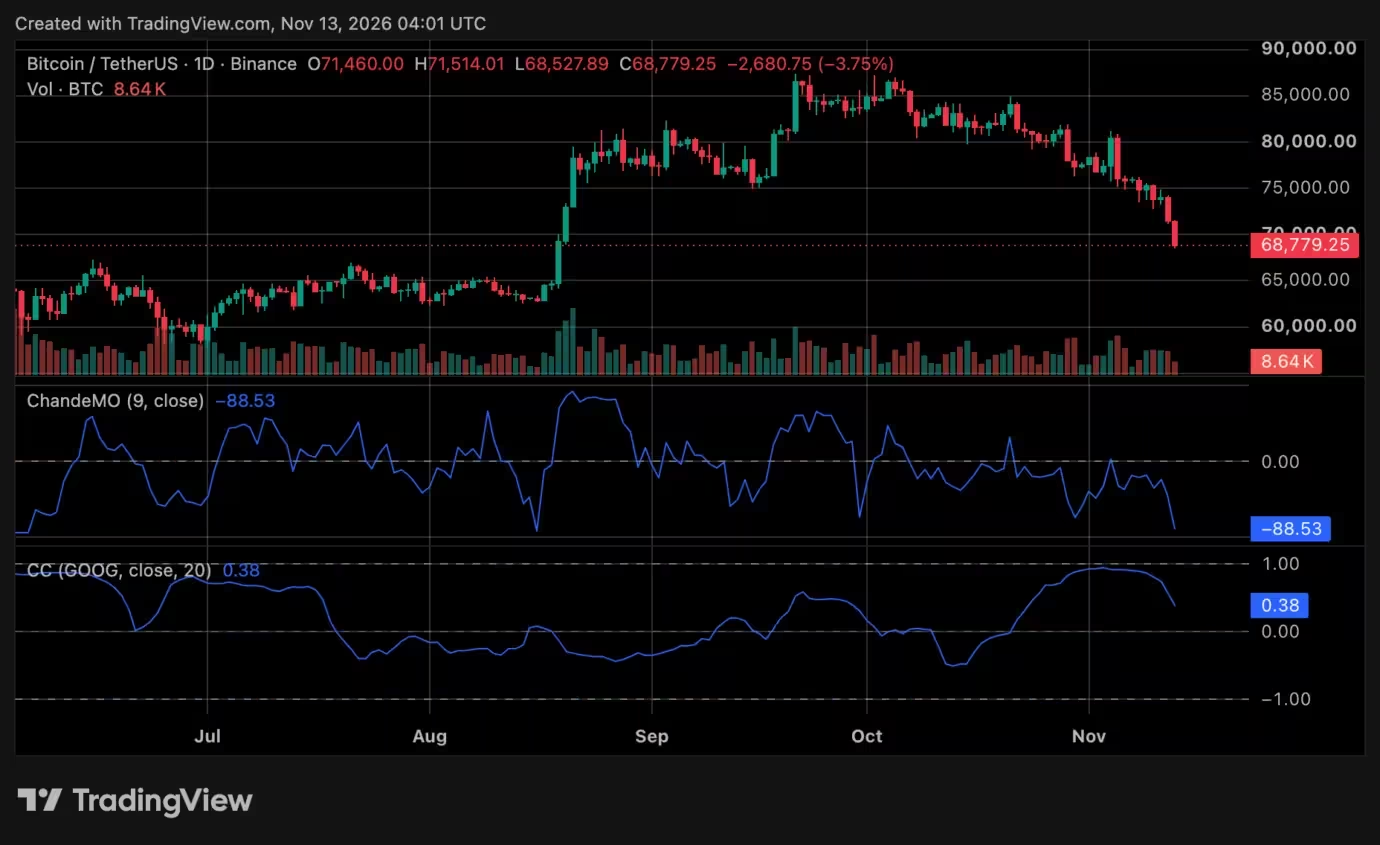
Bitcoin price chart
Bottom line
The combination of a firmer US dollar, tech-sector disruption after Nvidia’s leadership news, sizeable leveraged liquidations and ETF outflows produced a sharp correction in Bitcoin and broader crypto markets. While technical indicators point to strong bearish momentum in the near term, some analysts maintain a longer-term bullish view, citing previous recovery patterns and institutional interest. Traders and investors should monitor ETF flows, macroeconomic data and geopolitical developments closely — all three will likely continue to influence BTC volatility and price direction in the coming sessions.


Leave a Comment
Comments (1)
wow bitcoin under 70k again? Nvidia news + USD rally + $1.2B liquidations = brutal. lots of longs wiped out, ouch. short squeeze incoming?