

Where the CLARITY Act stands after September
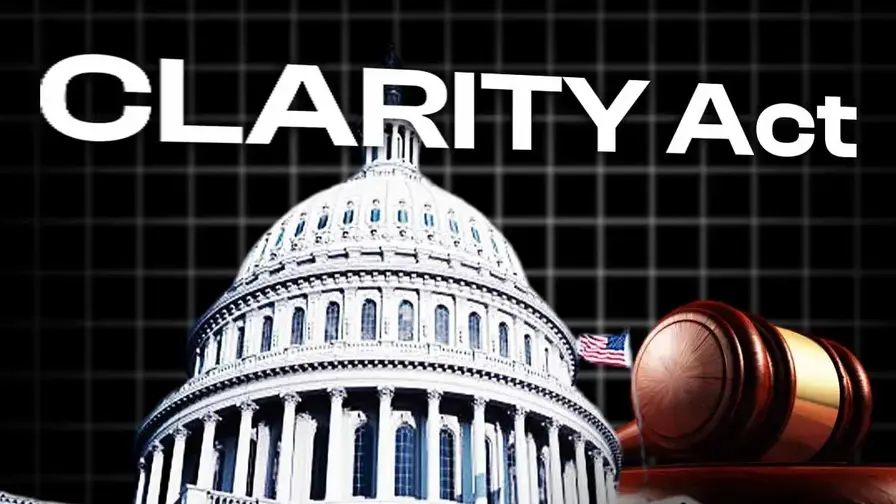
The CLARITY Act remains alive but unfinished: supporters fell short by 11 votes in the Senate’s September cloture motion, and the coming change in Congressional control on January 3 adds urgency to any remaining push. The House previously approved H.R. 3633 by 294–134 in July 2025, demonstrating cross-party appetite for a federal digital-asset market structure framework. But the Senate’s procedural vote on September 15 recorded 49 votes in favor of ending debate and 50 against, short of the 60 needed to proceed.
This article unpacks the arithmetic and politics behind that result, describes the thorny policy disputes (notably stablecoin rewards, software liability and ethics rules), explains the practical options left on the calendar, and outlines what exchanges, custodians and crypto firms should be tracking if Congress tries again before the new majority takes over.
Why the September cloture vote matters
A cloture vote on the Senate floor is a procedural threshold with outsized significance: succeeding would have allowed debate to begin and amendments to be considered. The 49–50 roll call therefore represents a snapshot of willingness to open debate on the bill as it stood then, not a final judgment on any completed CLARITY Act text. Still, that roll call establishes the initial arithmetic negotiators must address if they hope to raise the tally to the 60 votes necessary to advance the matter.
The starting point for negotiations therefore begins at 49. Each no vote in that count could theoretically be flipped, and the senator who did not vote could also add to the yes column. But converting votes is a more complex task than tallying numbers: it requires drafting precise language that addresses multiple, distinct objections without alienating the lawmakers who already supported taking up the bill.

Senate math: scenarios and limits
The raw arithmetic suggests several hypothetical paths, each with trade-offs:
A modest bipartisan pickup
One feasible route is persuading a small number of Republican senators who voted no to switch, combined with securing support from at least one Democratic senator who has been cautious. For example, if Senator Thom Tillis and Senator Chris Coons (or another Democrat) publicly commit to backing renewed floor consideration, the supportive base could rise to 51—still nine short.

A broader Republican shift
If the four Republicans who voted no in September (including Senators Susan Collins, Josh Hawley, Jerry Moran and Tillis) all change to yes and are joined by a Democrat, the coalition climbs to the mid-50s. Even in that optimistic scenario, the tally would still likely fall short of 60 unless further senators are persuaded.
Why the numbers understate the challenge
Beyond flipping votes, negotiators must preserve the support of the original 49. Amendments that appear to limit business models (for example, on stablecoin rewards) or that broaden enforcement powers (for example, by changing software developer protections) risk losing previously committed senators. Each loss requires additional pickups elsewhere, raising the bar for successful negotiation.
What happened in committee vs. on the floor
The Senate Banking Committee approved the bill in May with a 15–9 vote, a smaller and more malleable forum where coalition-building is easier. Committee votes reflect a narrower group of senators, making it possible to move a bill forward without the complex geography of the full Senate. But the full Senate requires a broader coalition that accounts for senators’ diverse state interests, such as community banking concerns or tech-sector priorities.
A committee endorsement is significant because it produces a working text and sets the legislative record. But it does not automatically translate to floor success. The Senate roll call in September measured a single procedural motion: whether to cut off debate and take up the House-passed H.R. 3633 as the vehicle. The motion failed to attract 60 votes, leaving supporters with a procedural opening but no immediate path to enactment.
Key policy flashpoints
Several provisions generated intense debate and stand out as potential deal-breakers or bargaining chips. Among them, three issues matter most to markets: how the law treats stablecoin rewards, how it defines the role and liability of software developers and intermediaries, and what restrictions (if any) elected officials face when they or close family members hold or profit from crypto assets.
Stablecoin rewards: fine language, big consequences
One of the most contested questions is whether and when rewards paid to users for holding stablecoins should be treated as interest (and potentially as deposits) or as payment incentives that fall outside deposit regulation. The debate in September focused on Section 10404 language describing payments based on balances and comparisons with interest-bearing bank deposits.
Banking groups argued that the draft’s terminology could allow products that, in economic effect, act like deposits—paying returns tied to the size or duration of a customer’s balance—while technically qualifying for an exception. Payments platforms countered that certain reward structures are incentives to use the network or subsidize transaction costs and should not be shoehorned into deposit law.
The drafting choices are subtle but decisive. A rule that prohibits "interest paid solely for holding a balance" could be evaded by imposing a minimal transactional requirement. A rule that looks at the economic basis of a reward—whether the payment scales with balance size or duration—can capture programs that merely disguise deposit-like return mechanics behind tokenized rewards.
From a policymaker’s perspective, the tension runs between protecting deposit funding at community banks and allowing payments innovators to offer competitive user incentives. Narrowing the rewards exemption could win support from senators worried about bank deposits migrating to crypto platforms; tightening the carve-out too far could lose votes from senators who view payments incentives as a legitimate market tool to expand digital payments.
Software liability and developer protections
A second major issue concerns the treatment of software creators. Should publishing code or maintaining open-source software that enables trading or custody be treated differently from operating a financial service? The distinction matters to whether developers can be held liable or regulated as service providers.
The policy trade-offs are complex. Many open-source contributors publish code without any centralized control. Holding such contributors to the same obligations as an exchange or custodian would chill innovation and raise constitutional concerns. Conversely, platforms that control front ends, collect fees, or retain backend permissions arguably function as intermediaries and should face regulatory obligations such as customer identification or transaction monitoring.
Drafting a statutory rule requires a workable definition of "control" and a clear delineation of responsibilities across entities that share different permissions. A rule based on control must specify the thresholds—what degree of influence or technical access makes an entity a regulated platform rather than a neutral developer.
Ethics and public officials
Ethics provisions in the draft sought to restrict potential conflicts where public officials or family members issue or sponsor digital assets. Democratic objections focused on whether the proposed ban or restriction would catch indirect income streams—such as licensing agreements, intermediated earnings, or residual ownership in a venture whose value changes after a law’s passage.

Policymakers can pursue disclosure-only approaches, which increase transparency but do not limit activity, or conduct-based approaches, which set limits on ownership or receipt of proceeds. Each route has political implications: disclosure alone might be insufficient to satisfy ethics-minded senators, while a broad conduct ban could be seen as punitive or legally fraught and cost votes from those who believe in lighter-touch rules.
How a Senate agreement would interact with the House
The House’s July 2025 vote shows that a market-structure bill can attract cross-party majorities in at least one chamber. But if the Senate advances a text that differs materially from the House-passed H.R. 3633, the two chambers must reconcile differences before any measure reaches the president.
That reconciliation can take several forms: the House could accept Senate changes, the Senate could accept House language, or the chambers could convene a conference committee to craft a compromise bill. Each route takes time. As the calendar shortens toward January 3, the practical feasibility of completing that work in one lame-duck session diminishes unless negotiators limit the scope of differences or secure early and explicit commitments from influential members.
Timing, calendar logistics and the motion to reconsider
Senate leadership has a limited amount of floor time between the election and the new Congress. Government funding bills and other end-of-year priorities compete for attention. Senator Thom Tillis’s motion to reconsider the September 15 vote keeps procedural options open: it preserves the ability to call the matter back up without starting from zero—but invoking that motion still requires leadership to dedicate floor time.
A successful year-end push would therefore need: (1) a revised text that identifies named supporters who previously opposed the motion; (2) enough time to circulate the language, settle on any attachments, and arrange votes; and (3) coordination with House leaders to ensure that any Senate changes will not deadlock final passage. Without those elements, even a Senate procedural victory could expire before the new Congress acts.
Regulatory alternatives: what agencies can do now
While Congress negotiates, federal agencies retain powers to refine market practices. The SEC and CFTC can issue guidance, enforcement statements, or formal rulemaking within their statutory authority. Agency action can clarify specific issues—such as token classifications, custody rules, or listing standards—without resolving jurisdictional boundaries between agencies.
Regulatory work can provide near-term certainty for particular activities. But agency action lacks the comprehensive jurisdictional clarity and statutory deadlines that Congressional legislation can deliver. Moreover, agency fixes often leave open boundary questions (for example, whether a token is a security or a commodity) that only Congress can definitively resolve.

Industry implications: what exchanges, custodians and stablecoin issuers should do
For market participants, the difference between a negotiated agreement and signed law matters more than the political theatre. Companies should track three categories closely:
1) The precise statutory language
The legal effect of a final law hinges on carefully chosen terms. Words that define who qualifies as an "issuer," what constitutes a "payment," or how "control" is measured will determine whether a product falls inside a regulated zone. Firms should prepare model-by-model assessments to estimate how different formulations would apply to their offerings.
2) Implementation timetables and transition clauses
A law that instructs agencies to adopt rules can set long implementation timelines. Firms need to know whether the statute gives them months or years to register, wind down services, or reconfigure products. Those details are crucial to compliance budgeting and to decisions about launching new services or listings.
3) Agency rulemaking and enforcement posture
Even with a statutory framework, regulators will shape day-to-day practice through rulemaking and enforcement. Market participants should monitor agency rule dockets, participate in comment periods, and model different regulatory interpretations to be ready for likely enforcement priorities.
Where the most persuasive political deals could form
Three practical negotiation strategies could produce a coalition capable of moving the bill forward, though each carries political costs:

- Narrow, targeted fixes: Agree on a limited package that resolves the most acute jurisdictional issues (for instance, a registration pathway for spot trading platforms) while deferring more contentious items to the next Congress. This keeps the bill brief and easier for both chambers to accept quickly but leaves unresolved questions for future work.
- Cross-party trade-offs: Swap narrower protections for developers in exchange for tighter limits on reward programs, or pair ethics concessions with clarifying language on agency jurisdictions. Such swaps attempt to balance interests across senators but require careful drafting to avoid unintended gaps.
- Anchoring to the House text: Preserve substantial parts of the House-passed H.R. 3633 and only change what is indispensable to secure additional Senate votes. This could ease House acceptance but makes it harder to capture holdout senators who want more substantial amendments.
Each route requires named commitments early in the process; vague assurances are unlikely to persuade senators who voted no in September to reverse course.
Detailed look: how small wording choices alter product outcomes
Stablecoin reward programs provide a case study in why legislative drafting matters. Imagine two programs:
- Program A: A platform credits users with a monthly rebate linked directly to the size of their stablecoin balance, with a nominal activity threshold that is easy to meet.
- Program B: A platform offers transaction-linked rewards, where rebates are proportional to verified purchases and cannot be earned solely by holding a balance.
If the law forbids "interest paid solely for holding a balance," Program A may still attempt to qualify by imposing a small transactional requirement. If the statute instead forbids payments calculated on the basis of balance size or duration, regulators can capture Program A while leaving Program B untouched. That difference in wording changes whether platforms can continue offering high-liquidity incentives or must restructure to avoid deposit-like features.
This is why bank trade associations and payments firms argued intensely in committee and on the floor: the economic reality of a program—its linkage to balances and how rewards are computed—determines whether a product competes with deposit funding. Senators weigh not just theoretical definitions but the tangible effects on community banks and on firms in their states that rely on rewarding customers.
Software definitions: control, influence and ecosystem roles
Drawing a regulatory line between neutral code developers and regulated operators requires precise statutory markers. Potential markers include:
- Fee-taking and monetization: Does the entity charge for access or marketplace services?
- Control over user experience: Can the entity alter the front end, change transaction routing, or block accounts?
- Permissions and uptime: Does the entity hold keys, manage custody, or maintain privileged backend tools?

Regulatory definitions that hinge on one or two markers can leave others out in the cold. For example, an entity that publishes open-source components but also offers hosted front ends might fall into a gray area. That gray area is politically dangerous because it forces every included or excluded constituency to lobby intensely.
Ethics language: disclosure vs. restriction
Ethics rules are sensitive because they mingle governance, public trust and private economics. Disclosure-based regimes favor transparency, allowing the public to assess conflicts without restricting officials’ ability to transact. Conduct-based regimes, however, set bright-line limits and can prevent certain relationships deemed incompatible with public office.
Which approach wins depends on the balance of perceived risk and political appetite. A compromise could require robust disclosure initially, paired with a sunset or review trigger to assess whether disclosures alone suffice—giving lawmakers time to reassess once enforcement and transparency mechanisms are in place.
Floor strategy: single-package vs. modular approach
Senate leaders will face a strategic choice: attempt to pass a comprehensive package or break the bill into smaller, uncontroversial modules that can be enacted more quickly. Each approach has consequences:
- Single-package: Potentially comprehensive but requires a larger coalition and greater floor time; failure on the floor would be a setback for the whole framework.
- Modular approach: Easier to pass specific fixes (for instance, narrow registration pathways or a limited stablecoin rule) but leaves unresolved pieces that could be litigated or subject to future lobbying; it may also complicate a final, comprehensive regime later.
Given year-end calendar constraints and competing fiscal priorities, modular strategies may be more realistic in the immediate weeks. However, modular fixes risk creating a patchwork regulatory landscape that businesses and courts may find difficult to navigate.
What a new Congress could do
If H.R. 3633 expires at the end of the current Congress, its language can be reintroduced by the new majority. Democratic control of both chambers starting January 3 will shift committee agendas and floor scheduling. That change can accelerate some priorities favored by the new majority while creating new battlegrounds for others.

A new Congress might:
- Reintroduce the CLARITY Act text with only minor edits and start the clock again on committee consideration;
- Use the existing work product as a template but substantially rewrite agency jurisdictional assignments; or
- Break the issue into smaller bills, assigning different matters to separate committees and timelines.
For industry stakeholders, the new Congress means renewed advocacy windows: submissions to committee records, targeted outreach to new chairs and ranking members, and early engagement on draft amendments.
Practical recommendations for market participants
- Perform a granular product inventory: Map which of your offerings could be affected by phrasing on rewards, issuer liability, or developer protections.
- Model multiple statutory scenarios: Build compliance cost estimates for conservative and permissive statutory formulations and for staggered implementation timelines.
- Engage early with regulators: Provide technical input during rulemaking dockets that may result from either statute or agency action.
- Prepare client communications: If implementation timelines could require product changes, pre-draft notices and migration plans for customers to reduce churn and reputational risk.
- Coordinate industry coalitions: Alignment among payments firms, stablecoin issuers, exchanges and developers can help present cohesive drafting proposals that protect innovation while addressing prudential concerns.
Conclusions: how likely is passage before January 3?
Passage before January 3 is possible but faces high hurdles. The September cloture result and the subsequent political calendar mean leaders would have to secure named, public commitments from holdout senators and preserve the votes of the original supporters while drafting language that resolves multiple technical disputes.
The most plausible immediate pathway is either a narrowly tailored package that wins enough cross-party votes for cloture or a modular approach that enacts elements likely to attract bipartisan support. If neither occurs, the motion to reconsider preserved by Senator Tillis will remain a procedural option, but the substantive work will likely shift to the new Congress.
For industry actors, the practical timeline to watch is less the date of a press announcement and more the specific statutory provisions, their compliance deadlines, and the terms of any agency rulemaking that statutes would trigger. Those are the items that ultimately reshape operations and legal exposures.
Final takeaways
- The CLARITY Act fell 11 votes short of cloture in September; the Senate’s 49 yes votes establish the initial arithmetic but do not guarantee eventual passage.
- Stablecoin rewards, software liability and ethics rules are the major policy flashpoints that will determine whether negotiators can find sufficient support.
- Committee success in May provided a stepping stone, but floor votes require a much broader and more geographically diverse coalition.
- Regulatory agencies can act in the interim, but legislation is the most effective way to resolve jurisdictional ambiguity and set firm timelines.
- Businesses should prioritize scenario planning, engage with policymakers, and prepare for a range of implementation timetables.
The CLARITY Act’s future depends on a detailed drafting process that balances prudential concerns with innovation. Whether the bill advances in the remaining weeks of the lame-duck Congress or is reborn in 2027, the substantive choices made now will shape the U.S. digital-asset regulatory architecture for years to come.
The motion to reconsider remains the concrete opening recorded by the Senate.


Leave a Comment
Comments
No comments yet. Be the first.