

White House Summit Aims to Break CLARITY Act Deadlock
President Donald Trump has invited key Republican senators to the White House as leaders work to resolve remaining disagreements over the CLARITY Act, a high-profile crypto regulatory bill designed to define oversight for digital assets. The meeting, reported by Politico, will bring together senators involved in drafting the legislation to brief the president on the bill's status and the path toward a Senate vote.
Who will attend and what’s at stake
Lawmakers expect Senator Cynthia Lummis, a prominent proponent of crypto legislation, to participate. Senator Bernie Moreno told reporters that attendees will outline the bill’s trajectory and next steps needed to secure passage. Senator Thom Tillis has also signaled hope that outstanding disputes, primarily over ethics provisions, can be resolved within days.
This push comes as Republicans try to pass the CLARITY Act before Congress adjourns for the August recess. Many backers see the current legislative window as the best opportunity to move the measure ahead of midterm campaign season, when Senate floor time will become more constrained.
Ripple Warns of Regulatory Gaps if CLARITY Fails
Ripple has been vocal in urging lawmakers to support the CLARITY Act. Stuart Alderoty, Ripple’s chief legal officer, warned that defeating the bill would preserve the regulatory ambiguity that allowed prior exchange failures to occur. Alderoty pointed to the FTX collapse as an example of how unclear rules and enforcement responsibilities left customers vulnerable to mismanagement and loss of funds.
Ripple’s global co-head of public policy and government, Lauren Belive, has echoed these concerns, arguing that unresolved loopholes remain in the current framework and could enable repeat failures. Under the CLARITY Act, regulatory authority over digital assets would be split between the Commodity Futures Trading Commission (CFTC) and the Securities and Exchange Commission (SEC), which Ripple says would clarify jurisdictional questions and introduce checks prior to market entry for qualifying digital assets.
Why industry groups favor clearer rules
Proponents from across the blockchain and crypto sector argue that legal certainty is critical to fostering innovation, protecting consumers, and restoring institutional confidence after major incidents such as the FTX bankruptcy. Clear definitions and agency roles could reduce litigation, accelerate token listings, and help U.S. firms compete globally in blockchain and digital asset markets.

Political Odds and Market Sentiment
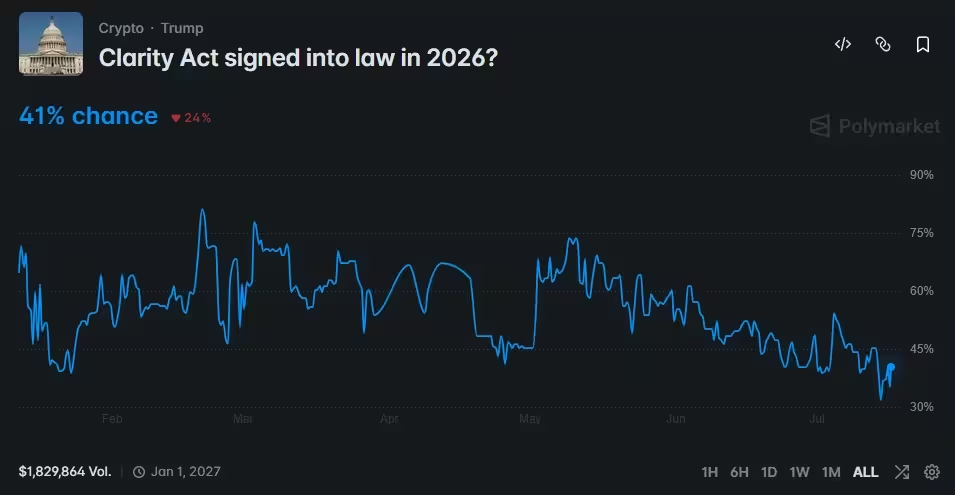
Prediction markets have reacted to the political uncertainty around the bill. Polymarket has adjusted traders' probabilities in recent days, placing the CLARITY Act’s chance of becoming law in 2026 in the mid-to-high 30s to low-40s percent range. These markets reflect concerns about unresolved ethics rules and the limited number of legislative days available before the recess.
The planned White House meeting is nevertheless a sign that the administration and Senate Republicans remain engaged, attempting to negotiate a compromise that could bring the bill to the floor.
Concurrent congressional activity
On the legislative front, the House Financial Services Committee has scheduled a July 17 hearing titled 'Building the Future of Finance: How the CLARITY Act Unlocks Innovation.' The session is expected to examine ways the CLARITY Act could bolster U.S. leadership in blockchain technology and digital assets, while also addressing investor protections and market integrity.
The committee will also review the American Reserve Modernization Act, which addresses the proposed Strategic Bitcoin Reserve. Experts and witnesses will provide perspectives on both measures, offering lawmakers technical and policy analysis as the Senate continues to push for a floor vote.
Implications for Crypto Regulation and Markets
If enacted, the CLARITY Act would represent a major legislative milestone for crypto regulation by explicitly assigning roles to the SEC and CFTC and creating a clearer compliance roadmap for token issuers and trading venues. That clarity could encourage institutional capital inflows, streamline token classification disputes, and reduce the regulatory arbitrage that has sometimes driven firms overseas.
Conversely, failure to pass the bill could leave the current patchwork of guidance and enforcement intact, which industry leaders warn risks repeating past harms and stifling innovation in blockchain and digital assets.
What to watch next
Watch for outcomes from the White House meeting and any announcements of compromise language on ethics provisions. Also monitor the House committee hearing for expert testimony that may influence Senate negotiations. With the August recess looming, lawmakers have limited time to reconcile differences and produce a bill that can win enough support for a floor vote.
As the debate continues, market participants and crypto stakeholders will be following both the political timetable and evolving policy details closely, since the CLARITY Act could shape U.S. crypto regulation and market structure for years to come.

Leave a Comment
Comments (2)
Looks like good intent, but smells like lobbyism. i’ve seen rules written this fast blow up later if that's real then... hmm
If CLARITY fails because of ethics nitpicks, we lose clarity? sounds backwards. Who's winning here, senators or firms... not comfy with this rush