
JEDEC has published an initial preview of the DDR6 memory specification, setting out a notable shift in raw throughput and module size aimed at AI, hyperscale data centers, and high-performance compute. The draft calls for a wider data path and faster transfer rates, and it specifies physical form factors that shrink module footprints substantially.
The most visible change is the memory data path widening from 64 to 96 channels (DQ), a 50 percent increase in width. Early DDR6 server modules (RDIMM) in the preview are targeted at 12.8 GT/s, compared with the current DDR5 ceiling of 9.2 GT/s. JEDEC’s roadmap also cites plans to reach 14.4 GT/s and beyond, and the combination of a broader bus and higher transfer rates should deliver more than a 50 percent gain in aggregate memory bandwidth over DDR5 at launch.
Architecture, capacity and system-level design
The specification introduces a pseudo-channel architecture to give system designers finer-grained control over data flow and to improve stability at very high speeds. JEDEC also calls for a doubling of internal memory banks and optimizations to read and refresh operations so modules can sustain high throughput even under heavy capacity and concurrency demands.
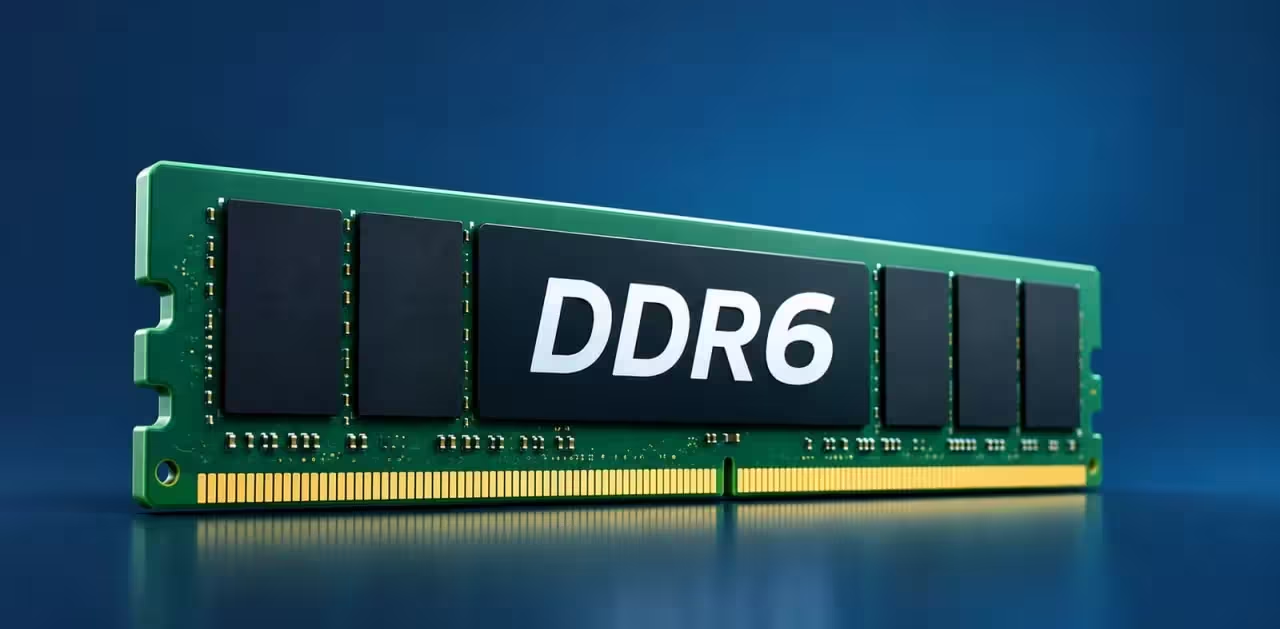
On die and module capacity, DDR6 is expected to support chip densities up to 128 Gbit, equal to 16 GByte per chip. Improved stacking and assembly techniques are called out to allow much higher overall module capacities within a similar physical space to previous generations.
One of the clearest physical changes is module length. DDR6 modules are specified at 74 mm long, down from 133 mm for DDR5 modules, a marked reduction designed to free board space in dense server and compact system builds and to enable installation of more modules per platform.
Power efficiency and reliability are also priorities. The preview references new power-control features and data-center-oriented low-power modes to improve energy efficiency per watt. JEDEC includes support for a range of system-level error-correcting code options so manufacturers can balance cost, power use, and data integrity according to deployment needs.
JEDEC expects DDR6 to appear in multiple form factors, including server RDIMM, desktop UDIMM, and compact laptop modules such as CAMM, covering conventional PCs as well as accelerated AI and large-scale compute servers.
JEDEC emphasized that these specification details are preliminary and remain under development, so changes are possible before the standard is finalized.


Leave a Comment
Comments
No comments yet. Be the first.