

Ethereum slides back to key support after a steep November drop
Ethereum (ETH) has endured a sharp slide in November, losing almost 23% and returning to a historically important support band. Weak inflows into U.S. spot Ethereum ETFs, elevated selling pressure across crypto markets and muted buying interest have combined to push ETH back toward the $1,500–$1,800 range that previously marked major rebounds.
Price action and market metrics
On Nov. 20 Ethereum traded near $1,740, down about 3.2% over 24 hours, with a daily low around $1,717.73. Trading volume that day reached roughly $12.14 billion while market capitalization hovered close to $212.66 billion. Bitcoin’s pullback below $62,000 coincided with a broader market selloff, but Ethereum’s losses have outpaced BTC: ETH has fallen almost 11% over the past seven days and surrendered more than 41% of its value since the start of 2026.
ETF outflows intensify: nearly $1 billion leaving in November
Demand through U.S. spot Ethereum ETFs has been fragile all month, with big redemptions accelerating in recent sessions. Data from Farside Investors shows net outflows of $131.2 million on Nov. 19 alone — the fourth consecutive withdrawal day for the products.
Where the outflows came from
BlackRock’s iShares Ethereum Trust was the primary driver on Nov. 19, accounting for roughly $124.2 million of that day’s net outflows (about 95%). Other products saw smaller but notable withdrawals, including Grayscale’s Ethereum Trust and BlackRock’s staked ETH vehicle. Those redemptions pushed November’s cumulative ETF net outflows close to $972.6 million, with investors removing $208.5 million during the first four trading days of the week and weekly outflows topping $398.9 million prior to that.
Spot Bitcoin ETFs have also seen meaningful redemptions, with Lookonchain reporting about $975.5 million in seven-day net withdrawals—highlighting that selling pressure is not isolated to ETH products.
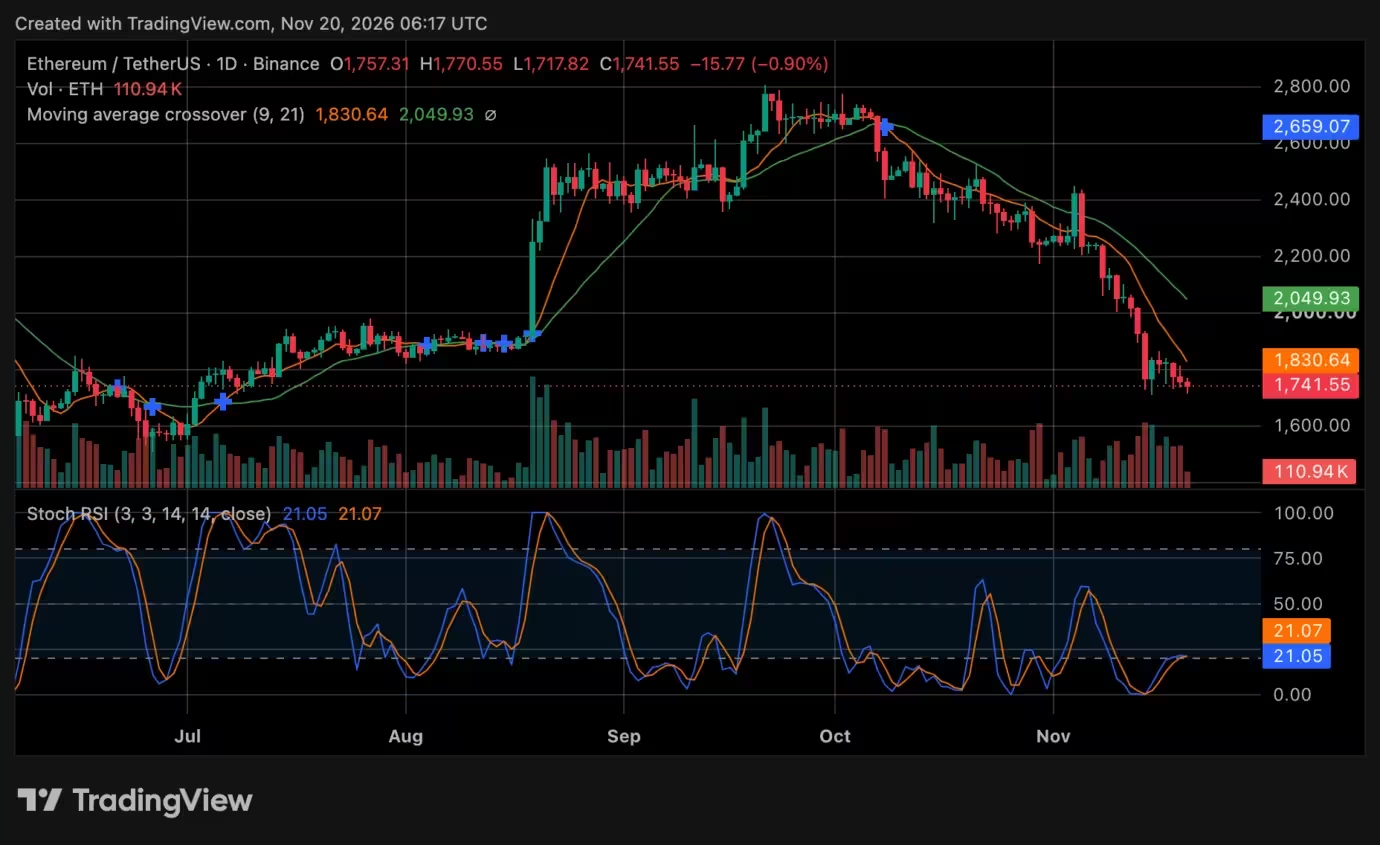
Ethereum price chart
stETH movements and implications for liquidity
Blockchain analytics provider Santiment reported a significant transfer of Lido-staked ETH (stETH) off exchanges on Nov. 19: a net withdrawal of 4,186 stETH, the largest single-day exchange outflow since May 30. Because stETH remains transferable while representing staking exposure, moving it off exchanges can reduce immediate selling inventory available to the market.

Why this matters
Lower exchange balances of stETH could, in theory, limit instant sell-side pressure and help stabilize prices if withdrawals continue and new lows stop forming. But Santiment cautioned that a single day’s withdrawals do not guarantee a market reversal. Sustained withdrawals coupled with price stability or upside would be a stronger signal that selling pressure is easing.
Technical outlook: support zones, resistance and indicators
Crypto analysts have focused on the $1,500–$1,800 area as critical. Chart historian Ella noted that previous significant ETH recoveries began inside that band, but she urged caution: rapid re-entry into the support zone after a sharp decline does not automatically constitute a bottom. Ella prefers to see ETH reclaim and hold the $1,900 level before suggesting a more confident recovery.
On the moving-average front, the nine-day moving average sits near $1,830.64, below the 21-day average at about $2,049.93 — both trending downward and indicating short-term bearish momentum. The Stochastic Relative Strength Index (Stoch RSI) has bounced from near-zero readings but remains low, with %K and %D around 21, a level that has yet to produce a bullish crossover.
Immediate technical support is observed near $1,700; a break below that could expose the $1,500–$1,600 range as the next potential buying zone. Upside resistance clusters near $1,830, with the $1,900 level and the 21-day MA (roughly $2,050) representing larger hurdles for a meaningful recovery.
Network developments: Glamsterdam upgrade timing
Ethereum core developers continue to work through compatibility and security concerns tied to the upcoming Glamsterdam upgrade, which will adjust how transaction costs are computed and how certain network operations are charged. The Ethereum Foundation postponed the Hoodi fork earlier after auditors flagged potential vulnerabilities affecting legacy smart contracts.
During a Nov. 19 developer call, participants discussed mid-January 2027 as the earliest feasible mainnet activation for Glamsterdam if specifications remain stable. Any delays or unexpected issues could weigh on sentiment, particularly while price momentum is fragile.
What traders and investors should watch
- ETF flows: Continued net outflows from U.S. spot ETH ETFs would likely keep selling pressure elevated, while a stabilization or return of inflows could provide short-term relief.
- Exchange balances: Sustained withdrawals of stETH and ETH from exchanges could reduce available liquidity and dampen immediate selling capacity.
- Price structure: Watch whether ETH can reclaim $1,900 and hold above the 21-day moving average; failing to do so would keep the bias tilted toward further downside.
- Network upgrade progress: Any announcements about Glamsterdam timelines or security fixes could influence market sentiment and developer confidence.
Ethereum’s return to the $1,500–$1,800 support zone is a familiar technical setup, but current ETF outflows, weak volume and lower-moving averages argue for prudence. For traders and longer-term crypto investors, a clear recovery signal would require both improved on-chain flows and price confirmation above key resistance levels.
Bottom line
ETH’s November decline has been steep and broad-based, driven by ETF redemptions, market-wide selling and muted buying strength. While on-chain moves like stETH withdrawals may hint at potential supply tightening, a single day of data is not definitive. Traders should monitor ETF flows, exchange balances and the technical breakpoints at $1,700, $1,500–$1,600 and $1,900 to gauge whether Ethereum is preparing for a sustained rebound or further consolidation lower.


Leave a Comment
Comments (1)
hmm, are ETF outflows really the main driver or just panic? stETH withdrawals look interesting but one day isnt proof. watch $1,700 closely