

4 Minutes
Google’s Pixel 10 lineup brings a notable hardware upgrade with the move to the 3nm Tensor G5 across the range. On paper the base Pixel 10 still ships with 12GB of RAM, but a closer look reveals that about 3GB is reserved exclusively for AI-related operations tied to the Tensor NPU and AICore. That reservation reduces the memory available to apps and background processes, and it’s a deliberate change compared with how Google managed RAM on the Pixel 9.
Why Google Reserved RAM for AI
Google decided to carve out a fixed 3GB block for on‑device AI to accelerate model loading and reduce latency when invoking AI features. On previous hardware, such as the Pixel 9, the OS dynamically loaded AI models into free RAM when needed — a flexible approach, but one that sometimes introduced a noticeable delay for users activating AI functions. By dedicating memory to the Neural Processing Unit, Google aims to make AI features instantaneous and more responsive, especially when launching generative or real‑time inference tasks.
How This Differs From the Pixel 9
With the Pixel 9, the full 12GB pool was available to apps, and the system would move memory around when AI workloads required it. The Pixel 10 takes a more aggressive stance: 3GB is effectively off‑limits for third‑party apps and general multitasking because it’s allocated to the Tensor NPU/AICore. The tradeoff is faster AI performance at the expense of some multitasking headroom.
Related Story Pixel 10 Comes With Its Refresh Rate Locked To 60Hz As Default Because Google Says The 120Hz Mode ‘Increases Battery Usage’
Now, as evidenced by the image below, whether users appreciate the change or not, 3GB of RAM is allocated for the aforementioned tasks, and if you are wondering why Google made this change in a span of a single smartphone generation, here is the honest answer for you. Those who had a propensity for leveraging Google’s AI features might have noticed a delay when firing them up on the Pixel 9, and that is because it would take a while for them to be loaded on the available memory. Now, this operation will be instantaneous, making the Pixel 10 more responsive for these kinds of tasks.
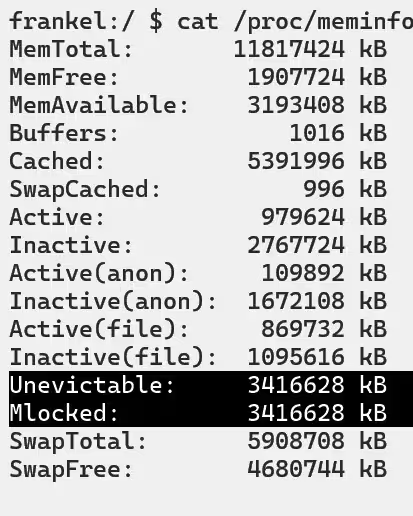
Here is how much memory Google’s Tensor NPU requires
Performance and Multitasking Impact
Everyday Use
For many users, the remaining ~9GB of usable RAM on the 12GB Pixel 10 will be sufficient for typical daily activities — browsing, messaging, social apps, streaming, and occasional photo editing. Google continues to refine Android’s memory management, and software optimizations could further reduce perceived impact.
Power Users and Heavy Multitaskers

If you frequently keep dozens of apps active, run heavy productivity workflows, or rely on memory‑intensive mobile workflows (editing large images, virtual machines, advanced multitasking), the reserved 3GB can limit background app retention. In that case, the Pixel 10 Pro and Pixel 10 Pro XL, which ship with 16GB of RAM, provide more breathing room and are better suited to power users.
Product Features and Use Cases
The Pixel 10’s architecture — Tensor G5 paired with a dedicated NPU allocation — targets low‑latency AI features: real‑time transcription, on‑device generative assistants, enhanced camera processing, and faster contextual suggestions. These features shine for users who prioritize instant AI responses without cloud round‑trips, improved privacy for local model execution, and smoother camera AI enhancements.
Comparisons and Advantages
Advantages of the reserved memory approach:
- Faster on‑device AI startup and inference.
- More consistent AI responsiveness under heavy load.
- Reduced dependency on cloud processing for latency‑sensitive tasks.
Tradeoffs include slightly reduced background app capacity on the 12GB model and the need for power users to choose higher‑RAM Pro variants for maximum multitasking flexibility.
Market Relevance
Google’s move reflects a broader industry trend: dedicating system resources to on‑device AI to deliver new user experiences and increase privacy by keeping inference local. Reserving RAM for NPU tasks is a hardware‑software co‑design choice that signals how manufacturers will balance raw specs with feature performance as AI becomes central to smartphone value propositions.
Which Pixel Should You Buy?
Choose the base Pixel 10 if you want the latest Tensor G5, robust AI features, and you’re a casual-to-moderate user — the effective 9GB available for apps will handle most workflows. Opt for the Pixel 10 Pro or Pro XL if you’re a power user who needs abundant background RAM and heavy multitasking capabilities; those models ship with 16GB and offer more flexibility for demanding users.
Conclusion

Reserving 3GB of RAM for on‑device AI on the Pixel 10 is a strategic decision that prioritizes instant AI interactions over maximum multitasking memory. For many consumers this will be an acceptable tradeoff given the benefits in latency and privacy, but heavy multitaskers should consider higher‑RAM Pro models. As Android and Google’s software optimizations evolve, the balance between dedicated AI memory and app performance may shift, so buyers should weigh their priorities around AI responsiveness, multitasking, and long‑term use.









Leave a Comment
Comments
No comments yet. Be the first.