
3 Minutes
Intel is quietly circling back. After years of pushing hybrid CPU designs, new hiring activity suggests the company may be plotting a return to a unified core architecture—one that blends performance and efficiency into a single core blueprint rather than splitting duties between P-cores and E-cores.
The hybrid era began with Alder Lake, when Intel paired high-performance Golden Cove cores with power-efficient Gracemont cores and introduced the P‑Core / E‑Core dichotomy. That architecture solved a real problem: it let laptops and desktops juggle heavy gaming or creative workloads on beefy cores while delegating background tasks to tiny, thrifty cores. Thread Director, Intel’s scheduler intelligence, then became the traffic cop, steering threads to the right silicon in real time.
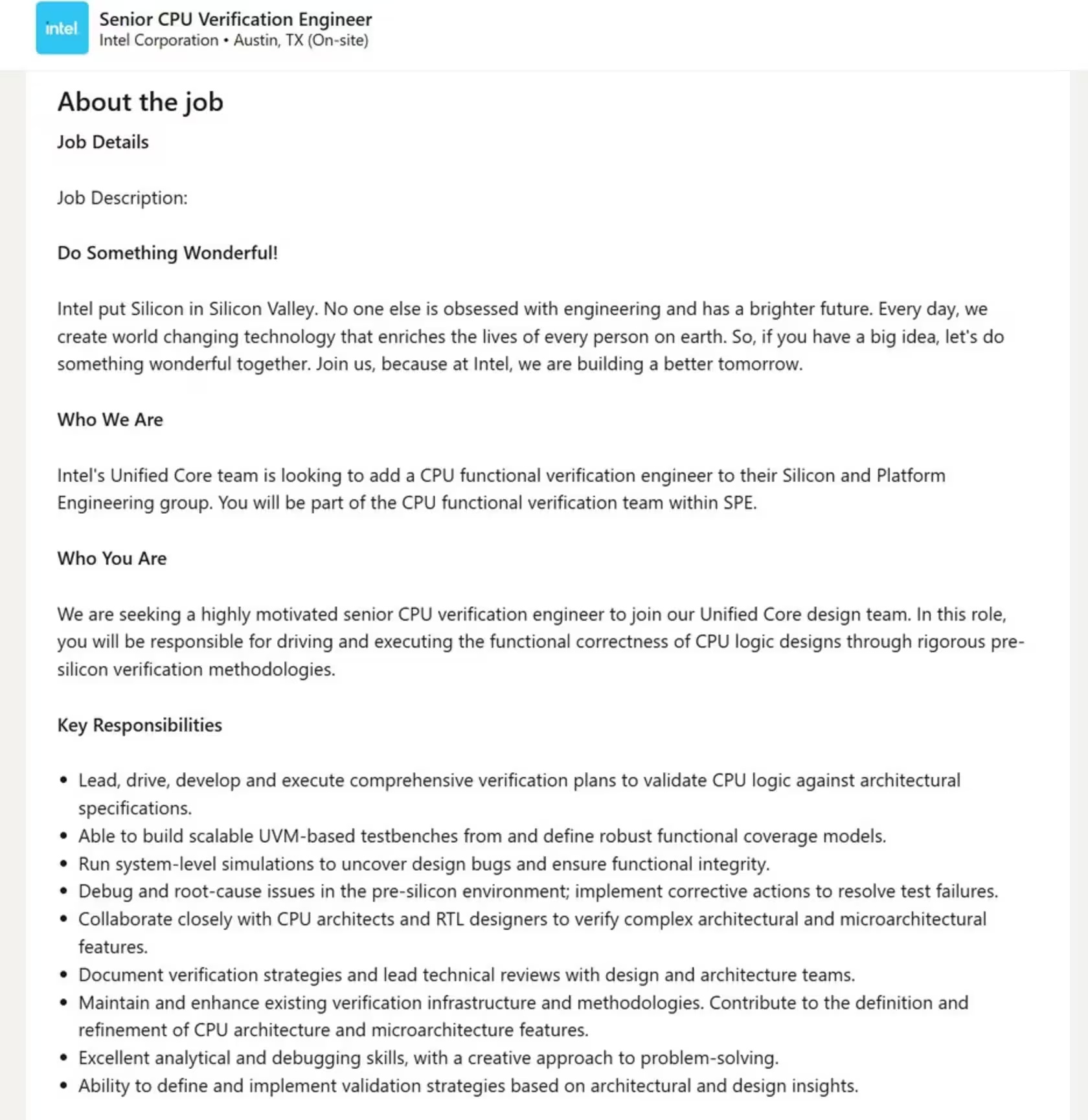
But a recent job posting for a “Unified Core” team has engineers and industry watchers asking whether Intel wants one core design to rule them all. Could consolidating P and E features into a single microarchitecture simplify roadmaps and manufacturing? Could it reduce die area and make packaging denser? The idea is not merely academic. Merging core functions inevitably forces the product strategy to shift—cache budgets, core counts, and power budgets must be recalibrated.
According to reports, Intel may be exploring a Unified Core that fuses the strengths of its current P‑ and E‑cores into a single, cohesive design.
One obvious lever is cache. L2 and L3 caches occupy a large portion of die real estate. Trimming cache per core is a blunt but effective way to create product tiers—AMD has taken a similar approach with Zen 5 and a compact Zen 5c variant—so it wouldn’t be surprising to see Intel use cache density and core counts to preserve differentiation if it moves away from hybrid layouts.
Server strategy complicates the picture. Intel already ships Xeon variants that are either all P‑core or all E‑core, servicing scenarios from raw cloud scale to AI inference where thousands of homogeneous cores matter. Any Unified Core plan would have to satisfy that range: power efficiency for dense cloud instances, and single‑thread throughput where it matters.
How soon could this happen? Likely not overnight. Architectural overhauls take years—especially at Intel scale. Sources suggest hybrid topologies will remain part of the lineup for the near term, perhaps through the end of the decade, while research into Unified Core designs continues behind closed doors.
So what’s the takeaway for the rest of us? Expect experimentation and gradual shifts, not a sudden switch. Intel’s roadmap has always balanced engineering trade‑offs and market needs, and a move toward unified cores would be another chapter in that balancing act. Keep an eye on job listings and architectural disclosures—sometimes the quietest signals tell the loudest stories.


Leave a Comment
Comments
No comments yet. Be the first.