
3 Minutes
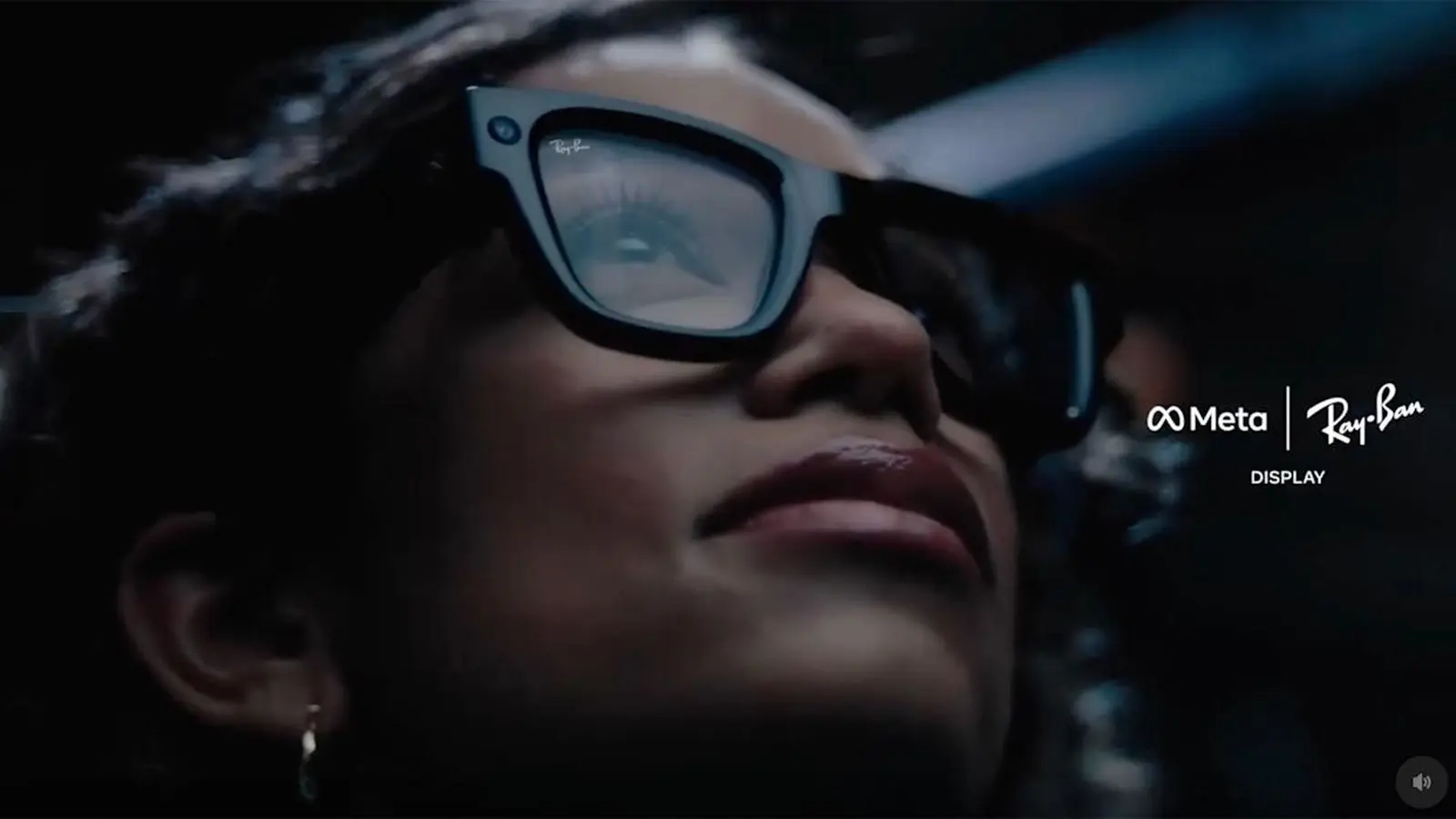
A brief YouTube upload — since removed — appears to have revealed Meta’s first pair of smart glasses with an integrated HUD. The short clip pairs the new Ray-Ban Display frames with a forearm band that uses sEMG sensors to register finger movements, showing how the two devices could work together to control a heads‑up interface.
What the leak shows
The HUD shown in the footage is fixed and monocular: only the right eye receives the display. The visuals are presented as an overlay for information consumption rather than as spatially registered augmented reality content, which positions these glasses as a notification- and AI‑assistance device rather than a full AR headset. Demonstrated use cases include quick access to Meta AI, messaging, navigation cues and other glanceable services.
Design, weight and price — modest upgrades, higher cost
From the available images and reports, the Ray-Ban Display models use slightly thicker frames to house the display hardware. Leaks suggest a weight of about 70 g, compared with roughly 50 g for Meta’s non‑display Ray-Ban smart glasses. According to reporting by Mark Gurman, the launch price could be around $800, which positions these as a premium wearable in Meta’s lineup.
Why Meta may separate this model
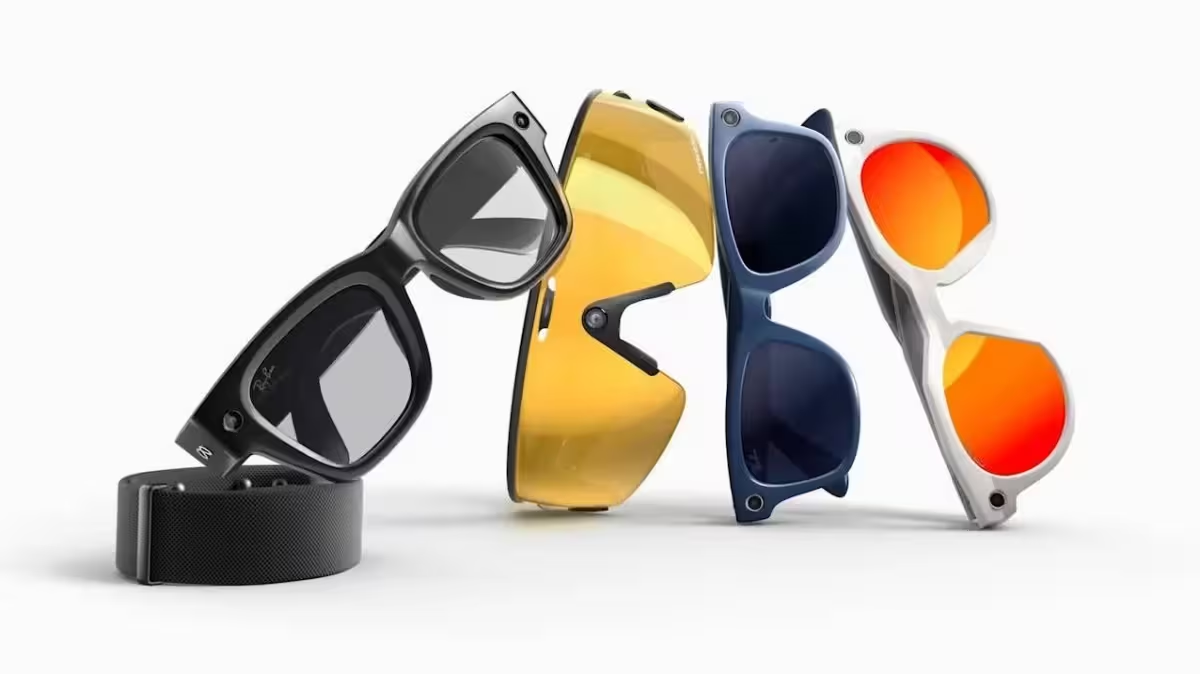
Meta appears set to market the product explicitly as "Meta Ray-Ban Display" to distinguish it from its existing Ray-Ban smart-glass models. That makes sense from a product-stack perspective: these are functionally different — a monocular HUD plus a new input accessory — and deserve separate branding.
The sEMG wristband: an evolution of the Neural band
The wristband seen in the leak resembles prior Neural band prototypes but focuses on sEMG (surface electromyography). sEMG measures small electrical signals from forearm muscles to infer finger movements, enabling touchless gestures and text input without relying on cameras or bulky controllers. In practice, this could allow users to flick through messages, summon AI replies, or control media with subtle finger and wrist motions.
Highlights and potential benefits:
- Monocular HUD for glanceable information and hands-free prompts
- sEMG wristband enables discreet gesture controls
- Lighter integration than a full AR system, likely lower power draw
Possible limitations:
- Monocular display may not suit full AR experiences
- Heavier frames and higher price may affect mainstream adoption
Meta Connect 2025, the company’s annual event, begins this week; the timing of the removed video suggests the Ray-Ban Display and its companion band could be announced there or shortly afterward. Whether the final product matches the leak exactly remains to be seen, but the combination of a fixed HUD and sEMG controls points to a new direction for practical, AI‑centric eyewear.










Leave a Comment
Comments
No comments yet. Be the first.