

3 Minutes
Intel is gearing up for a loud showing in Taipei. Expect more than a few product reveals—this looks like a season of new silicon, not a single keynote.
Panther Lake is the backbone of Intel’s comeback. Market watchers already saw hints: Core Ultra Series 2 did not magically erase earlier missteps, but Series 3—branded Panther Lake—arrives with real momentum. These chips push performance across mobile and laptop tiers, and their integrated Xe3 graphics have shifted expectations for onboard gaming. Short story: iGPU performance now competes with mainstream Zen 5 setups. That is not trivial.
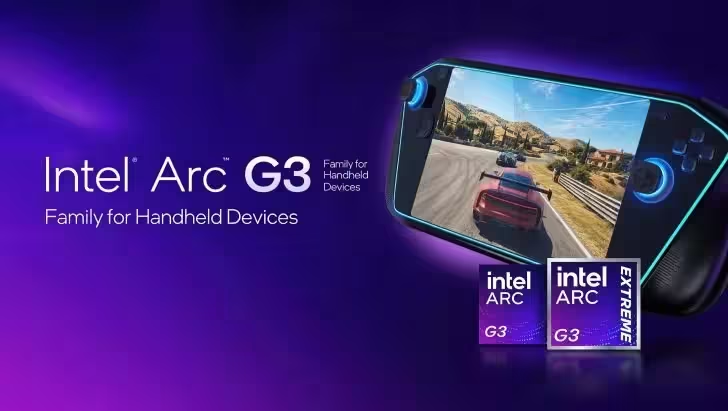
And Intel isn’t stopping at laptops. Two days ago the company unveiled Arc G3 variants built from Panther Lake silicon and tuned specifically for handheld gaming. The Arc G3 Extreme, a compact SoC that pairs a 14-core compute cluster with 12 Xe3 graphics cores, is designed to give portable consoles desktop-class chops. MSI, OneXPlayer and Acer are already lining up hardware that uses this chip. Previously, Intel struggled to gain traction in handhelds—MSI stood almost alone—but this generation looks different. More OEMs are prepared to ship devices with Arc G3 inside.

On the enterprise side, whispers about +Clearwater Forest Xeon 6 have hardened into near-certainty. Intel confirmed mass production, and leaked slides show chips built on the 18A node. These server processors stitch together multiple packaging and transistor advances—RibbonFET transistors, PowerVia power delivery, Foveros Direct stacking and EMIB 2.5D interconnect. The headline figures are blunt: up to 288 efficiency cores—double past comparable Xeon models—around a 17 percent IPC uplift, and more than a fivefold increase in last-level cache. In cloud workloads where memory and parallelism rule, those numbers matter.

Nova Lake is another card Intel seems ready to play. It’s slated for release this year and represents the first family to mix two GPU microarchitectures on a single die: Xe3 and Xe3P. That hybrid approach targets flexible graphics scaling—more performance on demand, better power efficiency at idle. Rumors point to a flagship variant packing as many as 52 compute cores with a 175W thermal envelope. If true, Nova Lake could sit anywhere from high-end laptops to compact desktops, depending on how OEMs tune power and clocks.
Not every launch is about flagship firepower. Wildcat Lake chips are Intel’s budget play: simple, efficient silicon intended for thin, light laptops and affordable mini-PCs. They’ve shown up in benchmarks and low-cost Chinese notebooks priced from roughly $449. So far OEM adoption among major global brands has been limited, but that could change fast. Wildcat Lake gives Intel a chance to press on entry-level MacBook Neo territories and to arm value-focused Windows devices with newer silicon.

What ties these roadmaps together is a clear strategy: broaden the portfolio and match silicon to context. Ultra-mobile gaming, mainstream laptops, dense servers—each segment gets targeted engineering. The interesting part will be how quickly partners translate chips into real products and how performance-per-watt plays out in the market.
Computex will reveal whether Intel’s product breadth becomes competitive depth. Expect demos, partner hardware, and plenty of performance claims—then the real work begins on desks, in racks, and in gamers' hands.


Leave a Comment
Comments
No comments yet. Be the first.