

7 Minutes
Bitcoin rallies above $77,400 after BOJ rate move
Bitcoin surged above $77,400 on Sept. 18 following the Bank of Japan’s decision to raise its policy rate by 25 basis points to 1.25% — the highest level in roughly three decades. The yen weakened in early trading despite the surprise-tightening narrative, while U.S. spot Bitcoin ETFs continued to register inflows that helped underpin BTC’s recovery.
Quick market snapshot
At the time of reporting, CoinGecko showed Bitcoin trading near $77,409.41, up roughly 1.4% over 24 hours and trading within a daily range of $75,971.64 to $77,623.53. The intraday high of $77,624 marked resistance in the upper $77,000 area as traders absorbed the BOJ announcement and incoming macro data.
Key bullet points
- BOJ raised its benchmark rate from 1.0% to 1.25% by a 7–2 vote. - Bitcoin climbed above $77,400 after the announcement and BTC/JPY on bitFlyer rose about 0.5% to 12.06 million yen. - USD/JPY moved higher from ~156.20 to ~156.70, indicating a weaker yen despite the BOJ hike. - U.S. spot Bitcoin ETFs recorded net inflows of $159.5 million on Sept. 17, led by BlackRock’s IBIT. - Technical indicators show a neutral-to-bullish RSI but a bearish MACD crossover, suggesting cooling short-term momentum.
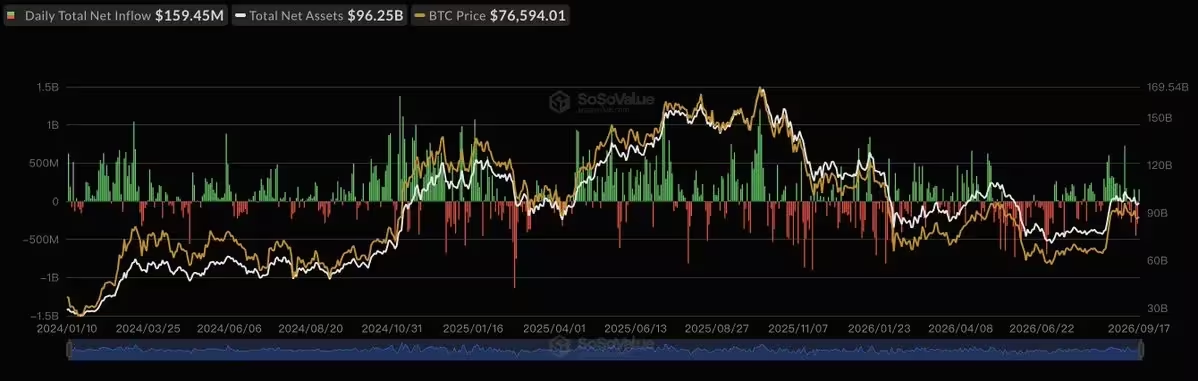
U.S. spot Bitcoin ETFs
What the BOJ decision means for crypto markets
The Bank of Japan’s Policy Board approved a 25-basis-point increase to 1.25% on Friday, marking its second hike since June and a clear move away from the ultra-low rates that had dominated Japan’s policy for decades. Policymakers voted 7–2 in favor of the step higher, citing heightened inflation risks tied to import prices, energy costs and changes in domestic price-setting dynamics.

The BOJ statement said the central bank will continue adjusting monetary accommodation if the economic and inflation outlook evolves in line with expectations. It stopped short of committing to a timetable for further increases, which left some investors cautious — and likely explains why the yen did not strengthen immediately after the announcement.
Reuters and other outlets noted the presence of two dissenting votes and the lack of more aggressive forward guidance. That nuance mattered to FX and crypto desks: higher rates were anticipated, but the guidance signaled a data-dependent, measured path forward rather than a rapid tightening cycle.

Why this can matter for Bitcoin
Tighter Japanese policy can affect global markets because of the historically large pool of yen-funded leveraged positions — including carry trades that at times have amplified moves in equities and crypto. When Japanese borrowing costs were ultra-low, traders frequently borrowed yen to buy higher-yielding assets. Rising BOJ rates increase the financing cost of those positions and can add volatility if positions are unwound quickly.
Still, Friday’s initial market response did not resemble a disorderly carry-trade unwind. Instead, the yen weakened and Bitcoin rallied, indicating the first reaction was more nuanced and influenced by flows into U.S. spot Bitcoin ETFs, broader macro forces and technical buying.
FX reaction: yen weakens even after the hike
Traditional currency markets moved somewhat counterintuitively: USD/JPY rose from roughly 156.20 before the BOJ decision to about 156.70 afterward. That reflects market focus on the BOJ’s messaging and the two dissenting votes rather than just the headline hike. A weaker yen raises import costs for Japan — especially for energy — which can sustain inflationary pressures and leave the BOJ room to stay data-driven.
Higher oil prices remain a primary inflationary source for Japan, since the country imports most of its energy. A weaker yen amplifies dollar-priced energy costs in local-currency terms, keeping inflation risks elevated and shaping BOJ deliberations.
Macro backdrop: Fed policy and global rates
Japan’s policy shift arrives against the backdrop of U.S. monetary tightening. The Federal Reserve raised its target range to 3.75%–4.00% earlier this week, leaving an interest-rate gap of roughly 2.5–2.75 percentage points versus Japan’s new 1.25% policy rate. That spread continues to be an important driver of yen carry trades and cross-asset flows.

Analyst expectations for the Fed’s next move vary. Reuters reported that Goldman Sachs and BofA Global Research see another Fed hike in October, while Morgan Stanley and Macquarie were more inclined toward a rate increase later in the year or into 2026. These divergent forecasts add another layer of uncertainty for fixed income and risk assets, including Bitcoin.
Institutional flows: Bitcoin ETFs return to net inflows
Institutional demand for BTC remained an important support factor ahead of and after the BOJ vote. U.S. spot Bitcoin ETFs posted $159.5 million in net inflows on Sept. 17, reversing two consecutive sessions of withdrawals. BlackRock’s iShares Bitcoin Trust (IBIT) led the charge with $183.7 million of net inflows. By contrast, Fidelity’s FBTC recorded $16.6 million in outflows and VanEck’s HODL saw $7.6 million leave.
The net result highlights how a single large inflow to one fund can be partially offset by outflows in others. The Sept. 17 net inflow followed two earlier withdrawal days of about $450.4 million (Sept. 15) and $295.9 million (Sept. 16), underscoring the day-to-day volatility in institutional flows.
BlackRock’s IBIT remains the largest U.S. spot Bitcoin ETF by holdings. Data from Bitbo placed total U.S. spot ETF holdings at about 1.259 million BTC as of Sept. 17, with IBIT holding roughly 784,526 BTC. These cumulative holdings form an important structural demand backdrop for Bitcoin amid macro and policy-driven noise.
Technical picture: momentum easing under resistance
Bitcoin’s price action shows a rebound from the $76,200–$76,400 area into the $77,400–$77,600 zone, where candles have encountered resistance and consolidated. The 14-period RSI sits at 56.89, below its moving average of 60.55. An RSI above 50 generally keeps the indicator on the positive side of neutral, while readings below 70 suggest the market is not in overbought territory.
The MACD is more cautious. Its line is near 73, below the signal line at about 91, and the histogram is roughly -19 — a bearish crossover that implies short-term momentum has weakened even as BTC holds above $77,000. Taken together, these indicators point to a market that has regained some buyer interest but faces near-term resistance around the high $77,000s.
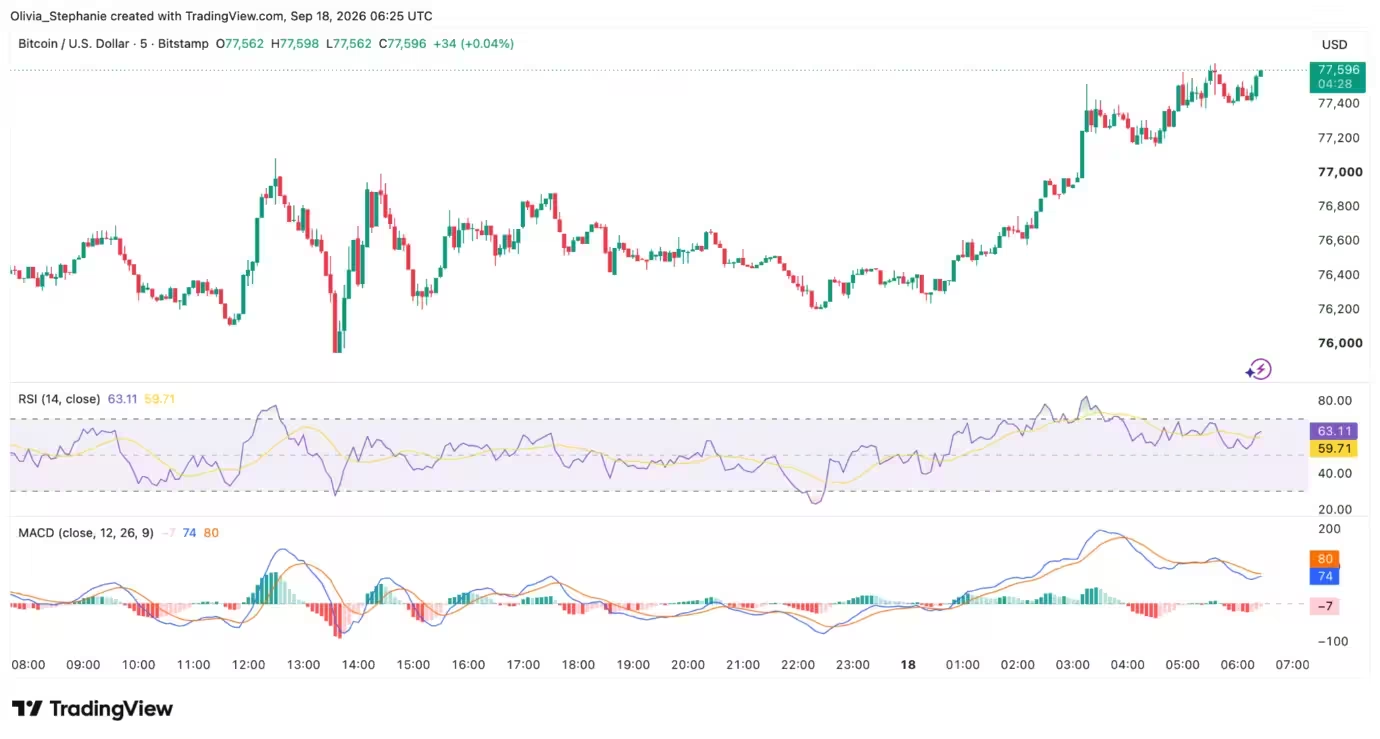
Bitcoin (BTC) price chart

Traders will watch whether BTC can clear the $77,600–$78,000 band with conviction. A solid break above would open the next technical targets, while a failure to sustain above the upper $77k region could see support re-tested near $76k and potentially lower into the $75,000s.
Drivers beyond the BOJ: why Bitcoin rallied before the vote
It’s important not to attribute Bitcoin’s entire move to the BOJ decision. BTC had begun a recovery from the mid-$76,000 region prior to the announcement. Other contemporaneous variables played a role: ETF flows, U.S. Treasury yields, oil prices, geopolitical developments and Federal Reserve guidance all influenced risk appetite and positioning.
Analysts had flagged the BOJ meeting as a potential volatility source precisely because changes in Japanese policy can affect the funding costs of yen-funded leverage. Still, the market’s multi-faceted drivers mean that attribution is rarely singular in nature.
Carry-trade risk remains a factor
The yen carry trade is a recurring risk factor for crypto. Historically, low Japanese rates encouraged borrowing yen to finance positions in higher-yielding assets. As the BOJ lifts rates, the cost of maintaining those positions rises. If the yen were to strengthen rapidly, borrowers would face more expensive repayments, potentially forcing liquidation across asset classes. That catalyst was central to the August 2024 market selloff referenced by many analysts.
For now, the yen’s initial weakening after Friday’s hike suggests carry-trade dynamics did not immediately trigger a large unwind. But market participants will continue to monitor FX moves closely for signals that funding stress might re-emerge.
Outlook for traders and investors
Near term, Bitcoin’s price action will likely be shaped by a combination of technical resistance around $77,600–$78,000, continued ETF flows, and macro developments from the U.S. and Japan. If U.S. spot ETF inflows resume, they could provide additional cushioning for BTC; conversely, renewed outflows or a sharp shift in global bond yields could produce pressure.
Macro watchers will focus on upcoming inflation prints, corporate earnings, and any further signaling from central banks. For crypto-focused traders, the key levels to watch remain the $75,000–$76,000 support zone and the $77,600–$78,000 resistance area.

Conclusion
Bitcoin’s move above $77K following the BOJ’s 25-basis-point rate increase reflects the intersection of central-bank policy, ETF demand and technical dynamics. While Japan’s policy shift raises the specter of renewed volatility through carry-trade channels, the immediate market response was mixed: the yen weakened while BTC rallied, and institutional ETF flows added a constructive element. Traders should monitor FX, ETF flows and momentum indicators closely as BTC attempts to break higher or retrace toward established support levels.

Leave a Comment
Comments (1)
wow, BOJ hiking and yen weak? crazy. BTC pumping on ETF flows but could flip fast, watch those carry trades maybe this is just short squeeze…