

Market snapshot: Bitcoin retreats near $84,000 after testing $87K
Bitcoin traded in the low-$80,000s on Sept. 24, hovering close to $84,000 after a failed attempt to break and hold above the $87,000 zone. Real-time trackers showed BTC near $83,863.54 during the latest check, marking a 3.8% decline over 24 hours but nearly a 10% gain across the prior seven days. Daily trading volume remained elevated, near $42.69 billion, and market capitalization was roughly $1.685 trillion — underscoring persistent institutional and retail interest.
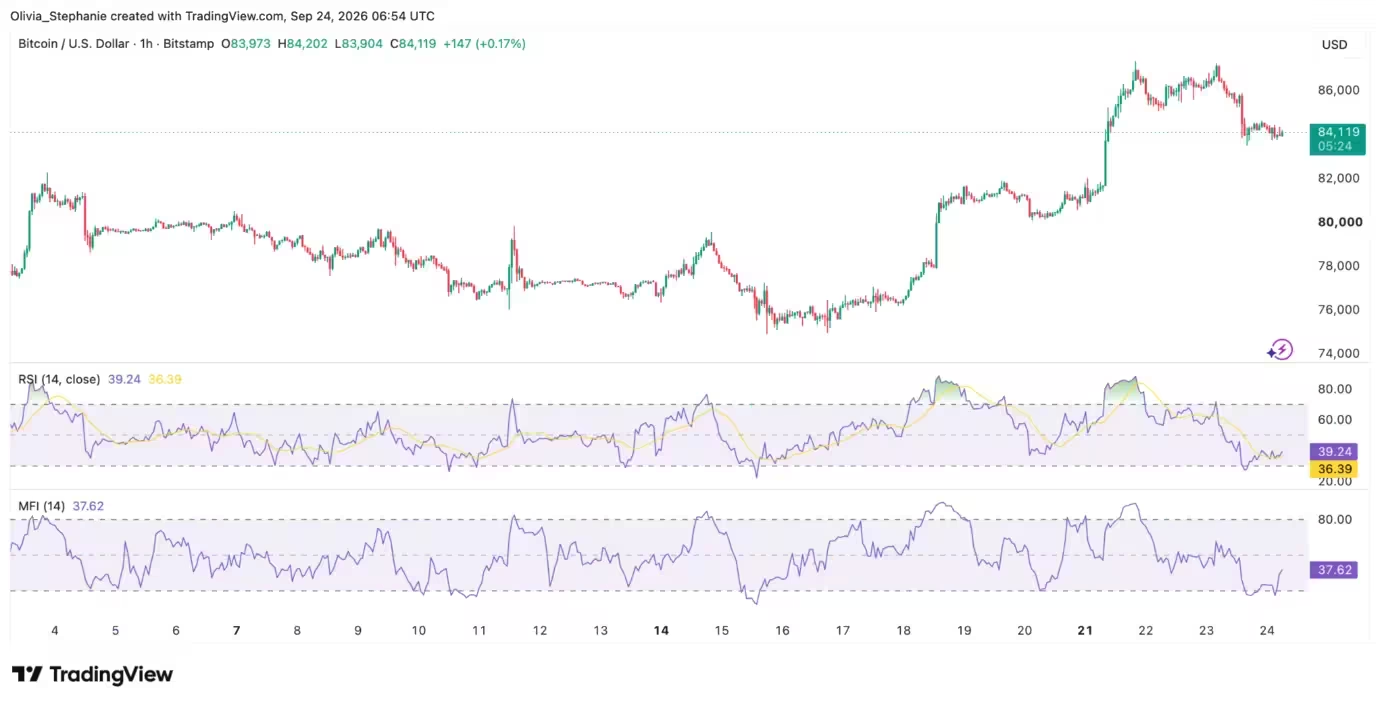
Bitcoin (BTC) price chart
The recent pullback followed a peak at $87,392 on Sept. 21, the highest print since late January. After the spike above $87K, momentum cooled and Bitcoin slipped back below $85,000, prompting short-term indicators to weaken while still avoiding extreme oversold readings.
Key technical indicators
On the hourly frame, the Relative Strength Index (RSI) sat near 39.38 and the Money Flow Index (MFI) was about 37.71. Both values are under the neutral 50 line, signaling softer short-term momentum but not a deep oversold condition. Longer-view Supertrend support on the four-hour chart was calculated near $83,593 after the move down from the $87K area.
Resistance and support: What traders are watching
Analysts flagged a notable resistance cluster around $85,000–$86,700. Crypto market researchers at Bitfinex Alpha identified $85K–$86.5K as a high-volume buyer cost band — a zone that historically separated durable recoveries from quick, failed bounces. The yearly open sits above this band at $87,722, while Bitfinex estimated corporate treasury average cost near $80,500.
Market participants are keeping a close eye on $82,000–$83,000 as a critical retest level. Crypto analyst Rekt Capital highlighted that Bitcoin needs to remain above roughly $82,000, or at least retest that region successfully on any dip, to preserve the bullish case and avoid slipping back into the prior $60K–$80K trading range.

Wallet accumulation: Whales and mid-size holders step in
On-chain intelligence provider Santiment reported that wallets holding between 100 and 1,000 BTC collectively added 113,950 BTC between July 15 and Sept. 23. That accumulation lifted the cohort’s balance by about 2.22%, bringing their combined holdings to roughly 5.24 million BTC.
Santiment has historically highlighted this wallet tier as a strong "smart money" indicator; increases in this group’s balances have often coincided with stronger price phases. However, Santiment and independent analysts caution that wallet counts are imperfect proxies for distinct institutional buyers — single entities, custodians, or exchanges can control multiple addresses, and on-chain transfers can move balances between wallets without indicating new market purchases.
This accumulation came while Bitcoin was recovering from its July 1 low near $57,803 and rallying toward the $87K print on Sept. 21. The size and timing of these inflows into 100–1,000 BTC wallets suggest growing confidence among mid-sized holders, often viewed as a bellwether for sustained demand.
U.S. spot Bitcoin ETFs: Five consecutive days of net inflows
U.S. spot Bitcoin exchange-traded funds continued to attract capital, extending a five-session net inflow streak. Data tied to SoSoValue showed a total of $346.98 million in net inflows on Sept. 23, led by BlackRock’s IBIT ($166.29 million) and Fidelity’s FBTC ($143.24 million). Morgan Stanley’s MSBT and ARK 21Shares’ ARKB also recorded inflows of $32.41 million and $5.04 million, respectively.
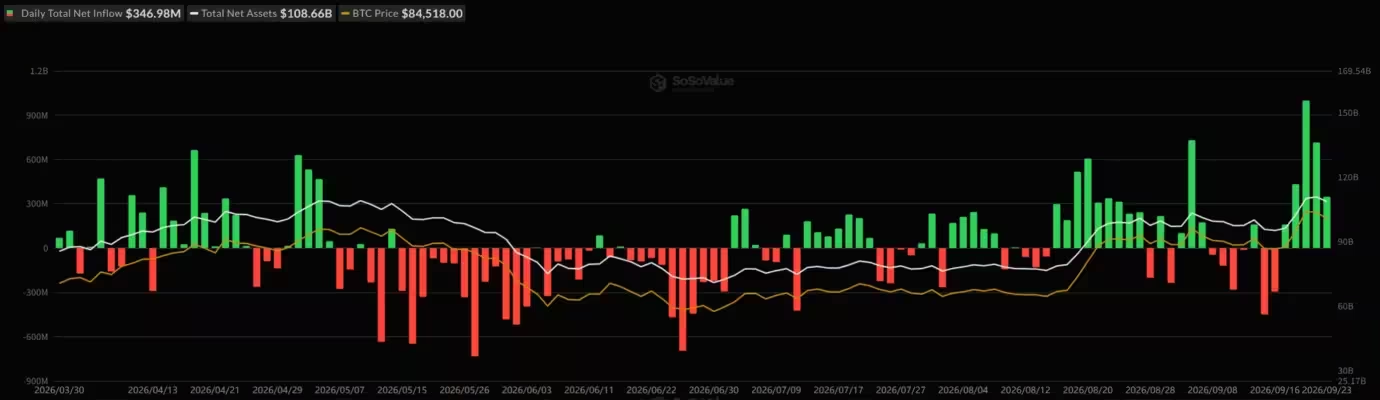
The five-day run included larger daily inflows earlier in the week — about $159.5 million on Sept. 17, $433 million on Sept. 18, roughly $999 million on Sept. 21, and $714.7 million on Sept. 22. Combined, those five sessions accounted for approximately $2.65 billion in net new capital into U.S. spot Bitcoin ETFs.
Demand for spot Ether ETFs also showed strength on Sept. 23, with SoSoValue reporting about $105 million in inflows, dominated by BlackRock’s ETHA and Fidelity’s FETH. These flows reflect growing institutional appetite for regulated, spot exposure to major PoW and PoS digital assets.
Derivatives and leverage: Binance open interest drops

Derivative markets reflected a rapid de-risking after the $87K push. CryptoQuant analyst Amr Taha noted that Binance’s Bitcoin open interest declined from about $5.4 billion to $4.9 billion between Sept. 21 and Sept. 23 — a roughly $500 million reduction that equates to around a 9.3% pullback in outstanding positions.
Cumulative volume delta (CVD) also fell sharply during that stretch, dropping from almost $3 billion to about $1.48 billion — approximately a 51% decline. Analysts interpret the combination of lower price, declining open interest, and shrinking CVD as evidence that leveraged traders reduced exposure after Bitcoin failed to sustain the advance above $87K.
Binance BTC funding stabilized near 0.001%, effectively neutral, which suggests derivatives positioning has become less skewed toward one-sided leveraged longs than during prior aggressive rallies.
Why this matters
Falling open interest alongside price weakness typically points to position liquidation or voluntary margin reductions rather than fresh short-selling domination. In a market where large leverage is common, this dynamic can dampen volatility once traders have taken profits or cut positions, creating room for longer-term buyers to step in.
On-chain caveats and macro context
While wallet accumulation and ETF inflows are bullish signals, market watchers stress limitations and nuance. On-chain metrics do not automatically reveal purchaser intent; custodial movements, exchange internal transfers, and rebalancing by funds can alter on-chain balances without direct correlation to open-market buying. Similarly, ETFs aggregate flows from a range of investors and do not isolate which player classes — retail, family offices, or institutional allocators — are driving the demand.
Macro and liquidity conditions also matter. A sustained move below the $81,300 threshold — particularly if combined with ETF outflows — would challenge the current breakout thesis, according to Bitfinex analysts. Conversely, renewed inflows and a clean retest and hold above $82K could reassert a constructive trend and increase the odds of a fresh leg higher.
Outlook: What traders and investors should watch next
- Support cluster to monitor: ~$82,000–$83,000. A decisive hold here would support bullish continuation.
- Near-term resistance: $85,000–$86,700. Overcoming this band with volume could open the path back to the yearly open and above.
- ETF flows: Continued inflows into U.S. spot Bitcoin ETFs remain a critical demand signal and a major driver of BTC liquidity absorption.
- Derivatives metrics: Open interest, funding rates, and CVD on major venues like Binance provide early clues about risk appetite among leveraged traders.
- On-chain accumulation: Movement and balance changes in the 100–1,000 BTC wallet cohort should continue to be tracked as a smart-money indicator.
Conclusion
Bitcoin’s retreat into the low-$80,000s after a run to $87K reflects a market pausing to reconcile heavy buying with profit-taking and leverage reduction. Strong ETF inflows and noticeable accumulation among mid-sized whale wallets provide a constructive backdrop, while derivatives and short-term indicators show reduced momentum and active risk management by leveraged traders. For a sustained bullish trajectory, the market likely needs a clean retest of the $82K area and renewed absorption of supply across the $85K–$87K band. Traders and long-term investors should monitor ETF flows, open interest changes, and on-chain accumulation for signs of renewed conviction.

This is a developing market story; readers should treat technical levels and on-chain signals as part of a broader risk-management framework rather than deterministic forecasts.

Leave a Comment
Comments (1)
Hmm is that huge whale accumulation real or just custodial shuffles? ETF inflows are impressive, but I wanna see a clean hold above 82k first. Skeptical.