

3 Minutes
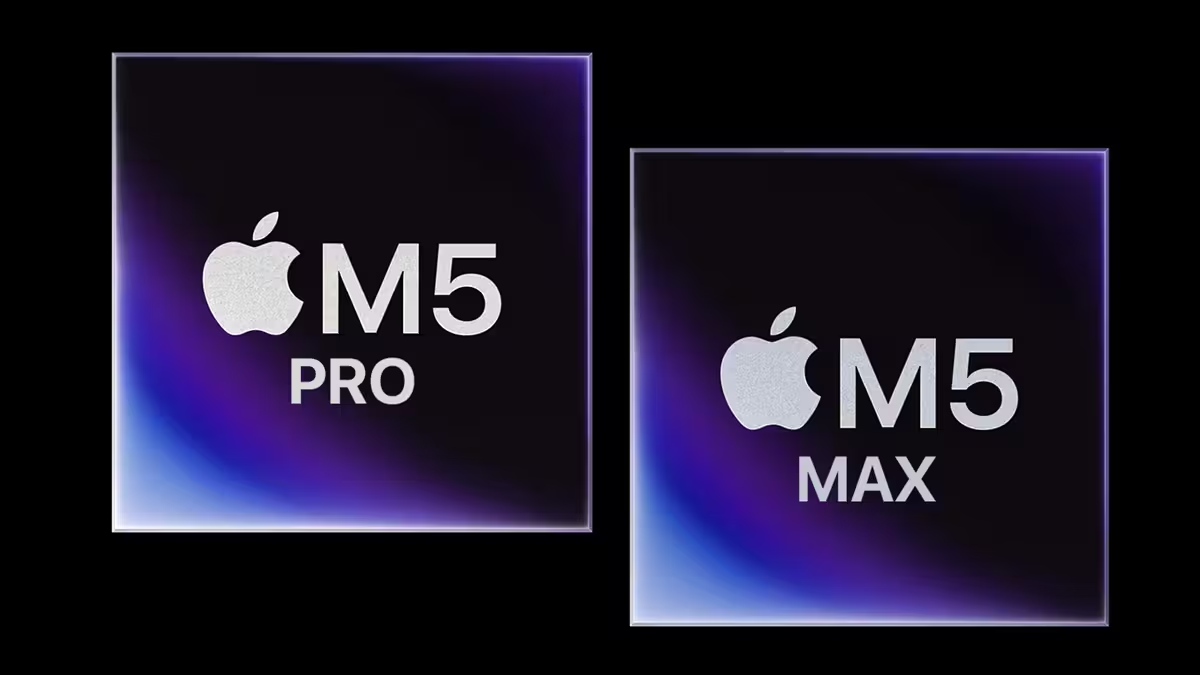
Apple’s silicon roadmap is heating up. New reporting suggests the M5 family will expand beyond the standard M5, with M5 Pro, M5 Max and an M5 Ultra scheduled to power refreshed MacBook Pros and a Mac Studio in the first half of 2026. Here’s what we know, what’s speculative, and why it matters for pros and creatives.
What Apple has planned for M-series silicon in early 2026
Bloomberg’s Mark Gurman outlines a staggered rollout that begins early next year. The headline: 14‑inch and 16‑inch MacBook Pro models are expected to ship with M5 Pro and M5 Max chips, while a workstation-grade M5 Ultra is tipped for the Mac Studio. The report also points to an M5 MacBook Air and refreshed Mac mini variants arriving across the same window.
A phased launch, not a single event
- Early H1 2026 — new MacBook Pro models with M5 Pro and M5 Max, plus an M5 MacBook Air.
- Mid H1 2026 — M5 and M5 Pro Mac mini updates, and Mac Studio options using M5 Max and M5 Ultra.
- Later in 2026 — Apple’s next-generation M6 chip and a rumored low-end 14‑inch MacBook Pro.
The staggered approach means Apple can target laptops and desktops with silicon tuned to different thermal and performance envelopes, rather than launching everything at once.
Performance expectations and architectural hints
Even the base M5 has impressed in early benchmarks: despite keeping the same 10‑core CPU and 10‑core GPU counts as the M4, the chip delivered multi‑core scores near the M1 Ultra in Geekbench 6 and significant frame‑rate gains in demanding games like Cyberpunk 2077. That sets a high baseline for what the Pro, Max and Ultra variants might deliver.
Two architectural changes are getting attention. First, Apple could shift to separate CPU and GPU blocks for the Pro and Max SKUs — a modular layout that would let buyers pick different CPU/GPU mixes depending on their workloads. Second, the M5 Max might include an UltraFusion-style connector to tile two dies into an M5 Ultra. It’s also possible Apple could move to a single monolithic die for the Ultra — nothing is confirmed yet.
What this means for users and the Mac lineup
For creative professionals, developers and video editors, upgraded Pro/Max/Ultra chips promise better multi‑core throughput, expanded memory bandwidth and more GPU horsepower — without necessarily changing the thermal design of Apple’s thin‑and‑light laptops. For workstation users, an M5 Ultra Mac Studio could replace older Intel‑based towers and offer high core counts with optimized power efficiency.
And for buyers, there are practical implications: expect a mix of price tiers and targeted releases. Apple’s approach lets it refresh MacBook Air and Mac mini to keep entry and mid tiers competitive, while reserving premium updates for the Pro and Studio lines.
Why to keep an eye on macOS leaks and firmware hints
References to higher‑end M5 variants first appeared in leaked macOS Tahoe code earlier this year, and those breadcrumbs often line up with what insiders later confirm. While leaks aren’t definitive, they can preview SKU names, power profiles and device codenames — helpful if you’re planning an upgrade in 2026.
Apple’s exact launch dates and final specs still carry uncertainty, but the consensus from reputable reporting is clear: the M5 family expansion is very likely, and it will reshape the Mac roadmap in early 2026.
Keep watching for official announcements and hands‑on benchmarks once Apple unveils these chips — the next year should be interesting for Apple Silicon fans and professional users alike.













Leave a Comment
Comments
No comments yet. Be the first.