

The European Union is preparing stronger limits on Chinese vendors' role in 5G rollout across member states. After years of debate and a handful of national bans, Brussels now wants tighter rules that could bar companies like Huawei and ZTE from building next‑generation mobile infrastructure.
From guidance to stricter enforcement: what’s changing
Brussels says the 5G cybersecurity "toolbox"—a set of recommendations first issued almost six years ago—will be enforced more rigorously. That means vendors deemed "high‑risk" could be excluded from participating in 5G deployments in EU countries. The move targets not only mobile radio access networks but also fixed networks and other critical parts of telecom infrastructure.
What counts as a high‑risk supplier?
Under the toolbox, a high‑risk supplier is broadly defined as a company that could be subject to pressure from a non‑EU government that lacks adequate legal or democratic safeguards. In practice, that label has been applied to major Chinese telecom manufacturers, and officials have made clear the list could be enforced across the bloc.
How member states are reacting
Responses across Europe have varied. Some countries already moved decisively: Sweden banned Huawei and ZTE from its 5G networks in 2020 and ordered removal of their equipment by January 1, 2025. The United Kingdom, no longer an EU member, has likewise prohibited Huawei gear. More recently, Germany told operators to strip core 5G networks of critical Huawei and ZTE equipment by 2026.
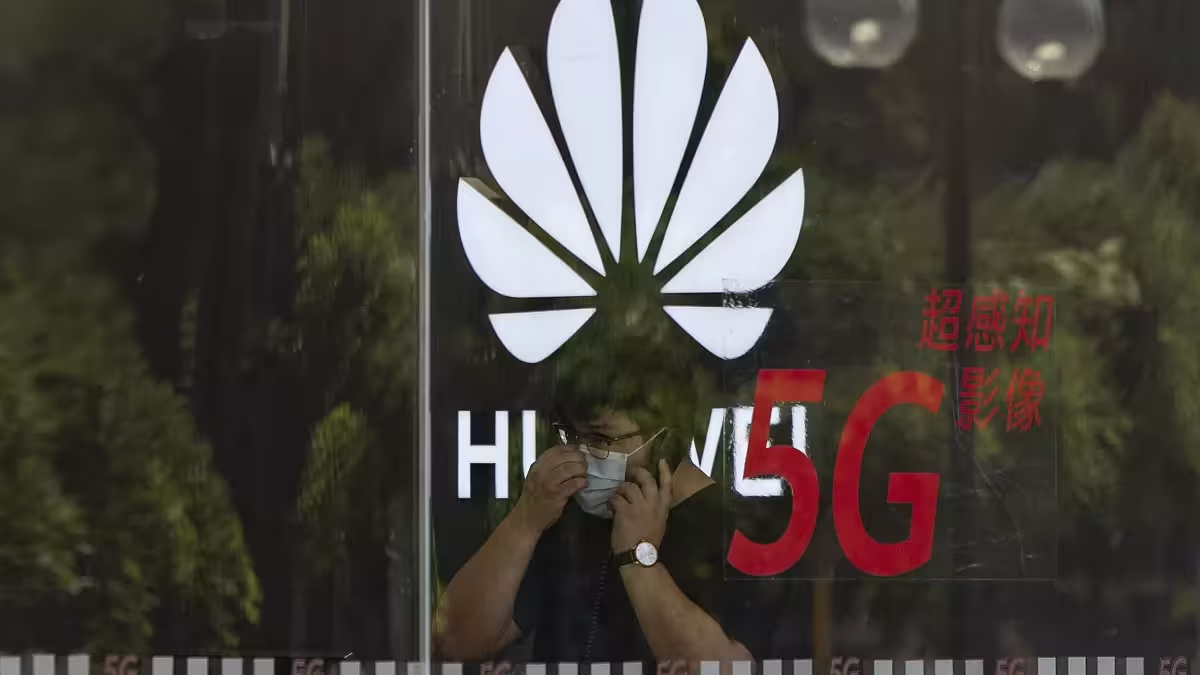
Other governments take a softer approach. Italy reviews contracts with Chinese suppliers on a case‑by‑case basis, while some smaller states have rejected legislative efforts aimed at making it easier to remove so‑called risky vendors.
Beyond borders: funding as leverage
Brussels is also exploring ways to discourage non‑EU countries from using Chinese suppliers. One proposal links EU external investment—particularly the Global Gateway funding instrument—to supplier choices. In short: projects built using flagged vendors could be ineligible for EU financing, a powerful incentive for partner states that rely on European development funds.
Why this matters to operators, suppliers and citizens
For telecom operators, stricter enforcement means revising procurement plans, shifting to alternate suppliers, potentially incurring higher short‑term costs, and adjusting timelines for rollouts. For vendors labeled high‑risk, the measures could shut off significant market access across Europe.
For citizens and governments, the debate is about more than vendors. It’s about supply‑chain resilience, data protection, and geopolitical risk in critical infrastructure. As 5G becomes the backbone for smart cities, industry automation and emergency services, decisions made now will shape connectivity and security for years to come.
What’s next?
- Brussels will detail enforcement steps and timelines as the toolbox is operationalized.
- Member states will have to reconcile national policies—some already strict, others more permissive—under a more unified EU framework.
- Non‑EU partners seeking EU funding may face new procurement conditions tied to vendor choice.
Imagine the ripple effects: a handful of procurement decisions could accelerate the shift toward alternative vendors, spur local or European equipment vendors, and reshape strategic tech partnerships worldwide. Whether that trade‑off favors security, cost or competitiveness will be decided in boardrooms and capitals in the months ahead.


Leave a Comment
Comments
No comments yet. Be the first.