
3 Minutes
Apple's iPhone 17 lineup quietly earned a networking upgrade this year: the new N1 networking chip. It's the first time Apple has replaced Broadcom parts with its own silicon, and early Speedtest data shows that the change is already paying off in real-world Wi‑Fi 7 performance.
Why the N1 matters even when you can't see it
On the surface, the iPhone 17 draws attention for cameras, design tweaks and a fresh SoC. But networking hardware is one of those invisible changes that can reshape daily experience — faster downloads, smoother streaming, and better connections in crowded places. Apple building its own networking chip signals a longer-term strategy to control radio performance end-to-end, from antennas to firmware.
Ookla's crowdsourced tests: iPhone 17 holds its own
Ookla aggregated Wi‑Fi 7 results from a mix of devices — including Google’s Pixel 10 series, Samsung Galaxy S25 models and several Snapdragon- and Dimensity-based flagships. The iPhone 17 surprised many by matching or beating many Android rivals despite being Apple’s first in-house networking effort.
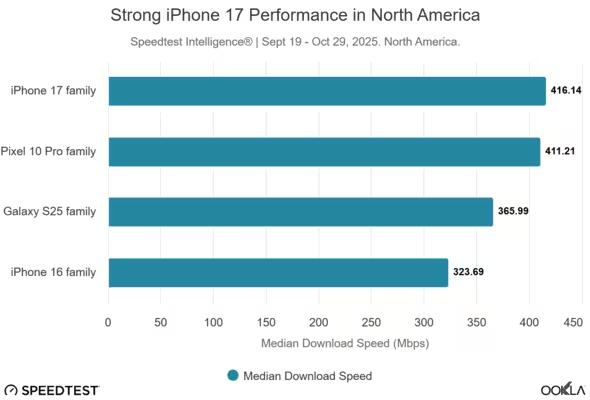
Compared with the iPhone 16, the iPhone 17 reports about a 40% uplift in overall network performance. Globally, the Pixel 10 still posts a slightly higher median download speed, but the margin is narrow. More notable: in congested environments — think apartments, cafés and airports — the iPhone 17 tends to retain bandwidth better, translating to fewer hiccups when networks get busy.
North America: where the gains shine brightest
North America currently has the highest Wi‑Fi 7 adoption in Ookla's sample, and that's where the iPhone 17's improvements are most visible. Peak speeds for the iPhone 17 hit roughly 416 Mbps, edging past the Pixel 10 Pro at about 411.21 Mbps and leaving Samsung's S25 around 323.69 Mbps. Apple also approaches the 1 Gbps mark at the 90th percentile — impressive for a first-gen networking chip.
How Apple offsets a narrower channel
One odd detail: the N1 tops out at 160 MHz channel width, while Wi‑Fi 7 can use up to 320 MHz. On paper, that limitation should put Apple at a disadvantage. But Ookla's numbers imply that Apple's radio engineering — antenna tuning, scheduling, and software-level optimizations — is compensating for the narrower channels, at least in current real-world conditions.
- First-party networking silicon gives Apple more control over hardware-software integration.
- The iPhone 17 shows roughly 40% improvement versus iPhone 16 in Wi‑Fi performance.
- In crowded networks the iPhone 17 holds bandwidth better than many Android flagships.
Wi‑Fi 7 adoption remains low in many parts of Europe and Asia, so broad impact will take time. Still, Apple's shift to a custom N1 chip suggests it's preparing for a future where faster local networks and tighter integration matter as much as raw camera specs. If you care about real-world wireless performance, the iPhone 17's under-the-hood changes are worth watching.





Leave a Comment
Comments
No comments yet. Be the first.