
Google is pushing back the full retirement of Google Assistant as it prepares to make Gemini the default AI helper on Android. What was once a firm deadline has become a phased migration stretching into 2026 — and that delay matters for users, developers, and device makers.
Why the delay? A smoother switch to a smarter assistant
Earlier this year Google said Gemini would replace Assistant on Android phones by the end of 2024, then moved that goal to the end of 2025 for most devices. Now the company says the final transition will continue across 2026 to ensure a "smooth, disruption-free" migration. In short: Google needs more time to bring Assistant’s features over to Gemini and to roll out the change without breaking people’s daily routines.
What users can expect during the transition
- Most mobile devices should start seeing Gemini upgrades by the end of 2025, but the migration will continue into 2026.
- After migration completes, Google Assistant will be removed from Android phones and tablets; the standalone iOS Assistant app will also be discontinued.
- Some phones — like Pixel models — already show a "Back to Google Assistant" option inside the Gemini app, giving users a temporary safety net.

Where Gemini already lives — and where it’s headed next
Gemini isn’t brand new to Google’s ecosystem. It’s available on Wear OS and is gradually being rolled out to Google TV and Android Auto. Google also continues an early-access program for Gemini for Home, aimed at smart speakers and displays. The staggered rollout across platforms makes the extended timeline sensible: moving an AI assistant involves more than a simple update.
Devices and services in the pipeline
- Wear OS: Gemini available now.
- Google TV and Android Auto: progressive rollout underway.
- Smart speakers and displays: Gemini for Home in early-access testing.
Why 2026 marks the official end of an era
Google Assistant first arrived in 2016 and became a core part of how millions interact with Android. Replacing a decade-old assistant with a new generational AI is a major technical and product effort. With the migration now spanning into 2026, that year looks set to be the official handoff: Assistant’s final chapter closes as Gemini takes center stage across Google’s consumer ecosystem.
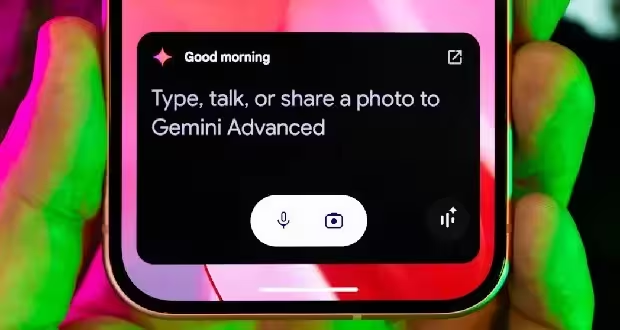
For users, the takeaway is straightforward: expect a gradual experience shift rather than a hard cutover. For developers and integrators, this is the time to test compatibility and explore Gemini’s new capabilities. And for everyone who relies on voice or ambient intelligence, Google’s cautious timeline aims to keep everyday tasks working while the company finishes the heavy lifting behind the scenes.
Keep an eye out for more details from Google in the coming months as the company publishes specifics about timing, feature parity, and any tools it will offer to ease the transition.


Leave a Comment
Comments
No comments yet. Be the first.