

3 Minutes
Samsung's next-generation Exynos chip has surfaced in early benchmark data, and it already raises questions about design direction and performance. A Geekbench listing points to a new 10-core layout and a fresh Xclipse 970 GPU — but the raw numbers tell only part of the story.
What the Geekbench leak actually shows
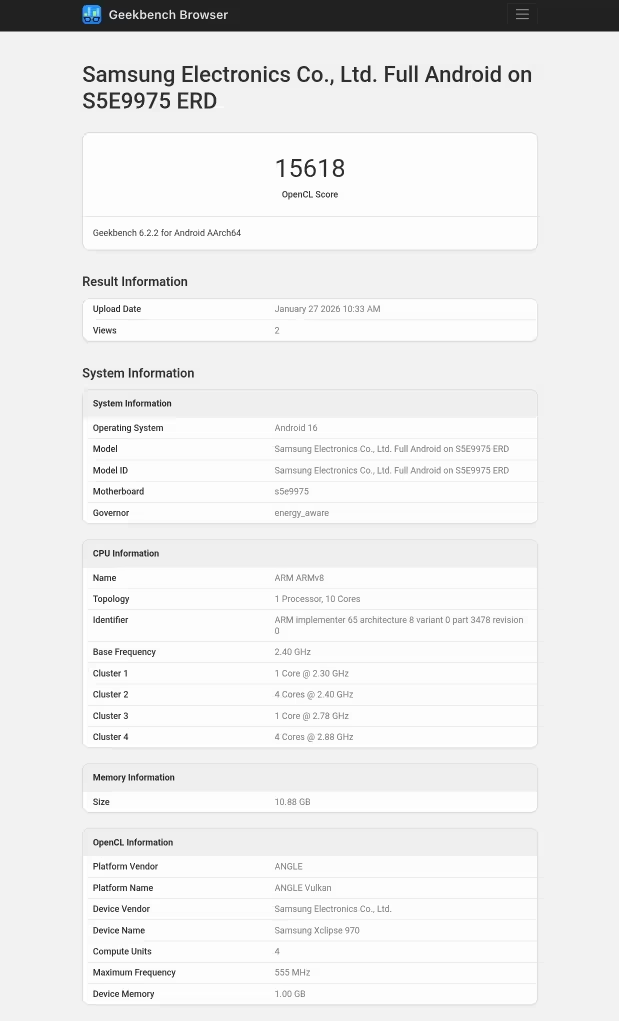
According to the listing spotted by tipster Abhishek Yadav, the Exynos 2700 uses a four-cluster CPU arrangement totaling 10 cores. The reported frequencies break down as one core at 2.30GHz, four cores at 2.40GHz, one core at 2.78GHz and four cores at 2.88GHz — a clear departure from the three-cluster setup seen on the Exynos 2600.
Key takeaways from the leak:
- 10-core, four-cluster CPU design — signaling more experimentation with core tiers.
- Test device ran Android 16 and showed 12GB of RAM.
- New GPU: Xclipse 970, replacing the Xclipse 960 used on the Exynos 2600.
GPU comparison: Xclipse 970 vs Xclipse 960
On paper the Xclipse 970 looks noticeably lighter than its predecessor. The Geekbench entry lists four compute units, a peak clock around 555MHz, and 1GB of GPU-accessible memory. By contrast, the Xclipse 960 on Exynos 2600 devices was listed with eight compute units, a 980MHz top frequency and 4GB of device memory.
That translated to an OpenCL score of about 15,618 for the 970 sample versus roughly 25,791 on Exynos 2600 hardware. Those numbers suggest a meaningful GPU regression in this early sample — but there's an important caveat.
Why early benchmark scores can be misleading
Most readers should assume this Geekbench result comes from an Engineering Reference Device (ERD) board. ERDs are development platforms used for internal testing. They often run unfinished firmware, lower clocks and limited memory configurations to validate subsystems early in the cycle.
In plain terms: engineering hardware rarely reflects final retail performance. Clock speeds are frequently conservative, drivers are unoptimized, and features may be disabled. Samsung's final silicon, retail firmware and thermal tuning could lift those numbers significantly.
Where this chip might fit in Samsung's roadmap
Industry reports have previously labelled the Exynos 2700 as a flagship-class chip (codename Ulysses) expected around 2027, possibly targeting the Galaxy S27 lineup. Rumors say Samsung Foundry will produce it on the second-generation 2nm SF2P process with Gate-All-Around transistors — changes aimed at boosting power efficiency and sustained performance.
Other rumored upgrades tied to Exynos 2700 include:
- ARM's next-gen C2 CPU cores for improved single-thread and efficiency gains.
- An AMD-influenced Xclipse GPU architecture — though the leak's Xclipse 970 sample looks pared back.
- Advanced thermal packaging to help with sustained loads.
- Support for LPDDR6 memory and UFS 5.0 storage for faster bandwidth and responsiveness.
So, should you worry about these benchmark numbers?
Not yet. The listing is an interesting early glimpse but not a final verdict. Imagine a concept car shown at the prototype stage — it proves intent, not showroom readiness. Samsung is clearly experimenting with different core cluster strategies and GPU configurations, which is a normal part of development for a chip slated to lead future flagships.
Expect more leaks and, eventually, official word from Samsung as testing moves from engineering boards to final devices. Until then, take single-sample benchmarks as directional hints rather than final performance promises.














Leave a Comment
Comments
No comments yet. Be the first.