
4 Minutes
Think of Antarctica not as a slow-moving glacier but as a circuit board: a subtle change in one place can reroute currents elsewhere and suddenly alter the whole system. That is the picture emerging from a new climate reconstruction that suggests the Antarctic ice sheet crossed a climatic threshold about one million years ago and, after that, began to react far more sharply to changes in the atmosphere and oceans.
Researchers at the IBS Center for Climate Physics in South Korea stitched together a three-million-year climate simulation and fed its temperature and precipitation output into a detailed ice-sheet and ice-shelf model developed at Penn State. The result is a continuous, physics-based replay of how Antarctic ice behaved across multiple glacial cycles—far richer than the fragmentary proxy records researchers have relied on until now.
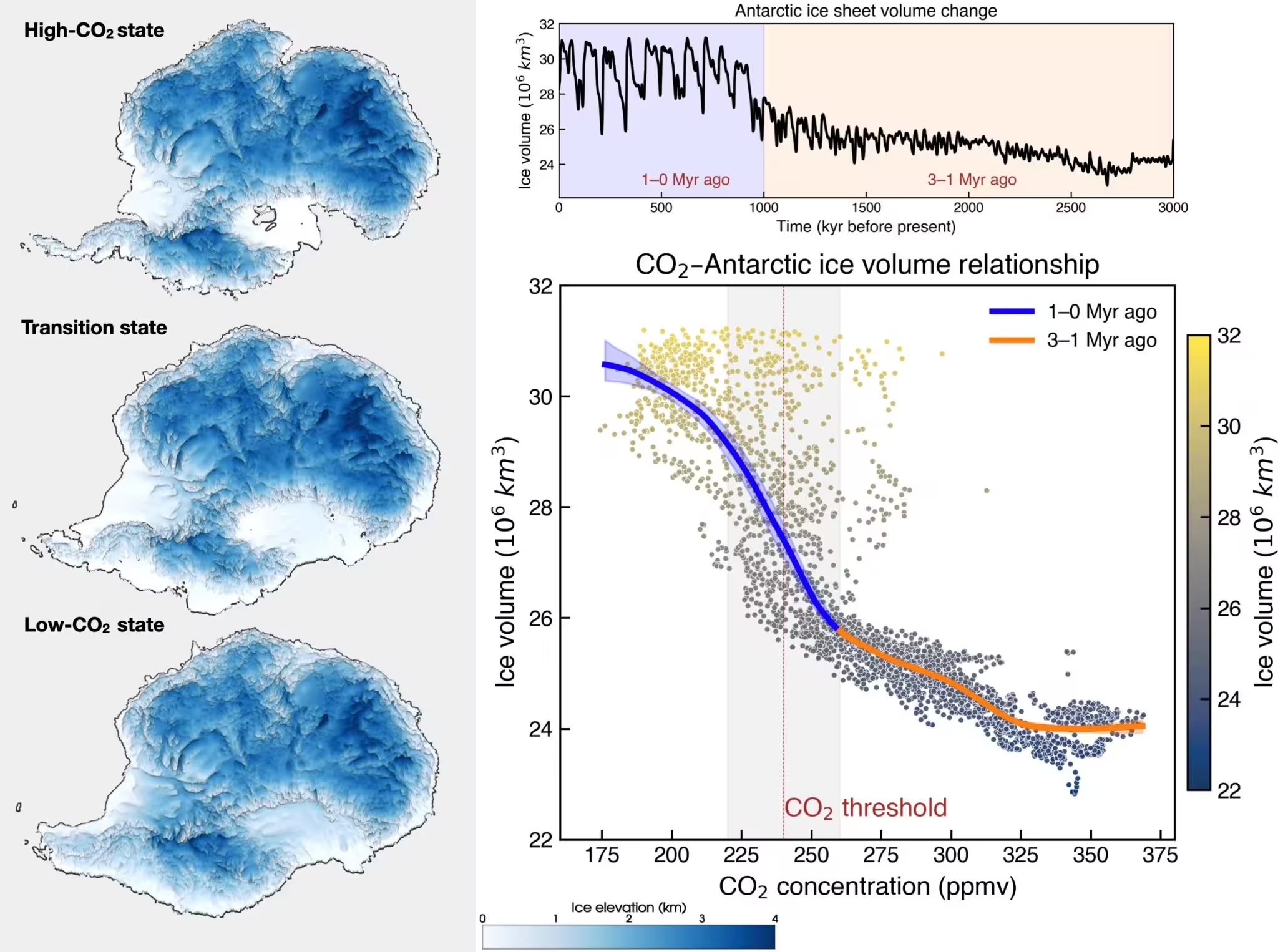
What popped out of the simulations was a distinct shift in behavior tied to atmospheric CO2. When concentrations dipped below roughly 240 parts per million, Antarctic ice volume stopped shifting slowly and predictably. Instead, the continent’s ice became much more sensitive to changes—especially to cooling of the Southern Ocean and to sea-level variations. Glacial advances were bigger, retreats more dramatic. In short: a threshold was crossed.
Why would a few dozen parts per million of carbon dioxide matter so much? The models point to a couple of physical mechanisms working together. Colder ocean waters during glacial peaks reduced melting beneath the marine-based sector of the ice sheet, stabilizing and thickening ice grounded below sea level. Meanwhile, global sea level was tens of meters lower than today—estimates center around 50 to 100 meters—relieving pressure on coastal bedrock. That reduced load allowed slow isostatic rebound: the bedrock rose, permitting coastal ice to pile up more effectively. Those combined effects favored the larger, more persistent Antarctic ice sheets that characterize the later phase of the Pleistocene.
The timing lines up with the so-called Mid-Pleistocene Transition, a planetary change in which ice ages lengthened and deepened. Until now, scientists could describe that transition in broad strokes but had trouble linking it to concrete Antarctic dynamics because long, consistent climate and ice-sheet records were sparse. By running climate and ice-sheet models together across three million years on one of South Korea’s top supercomputers, the team reconstructed how Antarctica’s elevation and extent evolved under different CO2 states and sea levels—complete with modeled ice shelves in the Ross and Weddell seas.

The practical upshot is unsettling. Ice sheets are not always placid, predictable systems that respond to warming in neat, linear ways. Instead, they can flip into regimes of higher sensitivity once a threshold is crossed. That makes forecasting sea level rise trickier: if ice-sheet behavior can change qualitatively, past responses may not fully constrain future ones.
If ice sheets can switch regimes, their future response to anthropogenic warming could be abrupt and larger than simple extrapolations suggest.
That is not a forecast that says collapse is imminent. It is, however, a cautionary finding. The study reinforces the view that both ocean temperatures and global sea level—and the CO2 concentrations that help drive them—are central controls on Antarctic stability. It also highlights the value of long, physically consistent simulations that marry climate models with ice dynamics; such coupled approaches reveal thresholds and feedbacks that isolated datasets can miss.
So where does that leave us? The past shows that Antarctic ice can become more reactive once certain conditions are met. The future will depend on whether human-driven warming nudges the system toward states that amplify that reactivity. Scientists now have a clearer framework to explore those pathways. The clock is still ticking; how fast we turn it will influence what the ice decides to do next.

Leave a Comment
Comments (2)
Is 240 ppm really the magic cut off? models look solid but they rest on assumptions, proxies are messy, curious how robust this is
Whoa that threshold idea gives me chills... Antarctica flipping modes?? Scary but fascinating. We gotta act, like, now, if that...